Department of Urology, Graduate School of Medical and Dental Sciences, Kagoshima University, Kagoshima, Japan.
Cancer Sci. 2020 May;111(5):1607-1618. doi: 10.1111/cas.14395. Epub 2020 May 5.
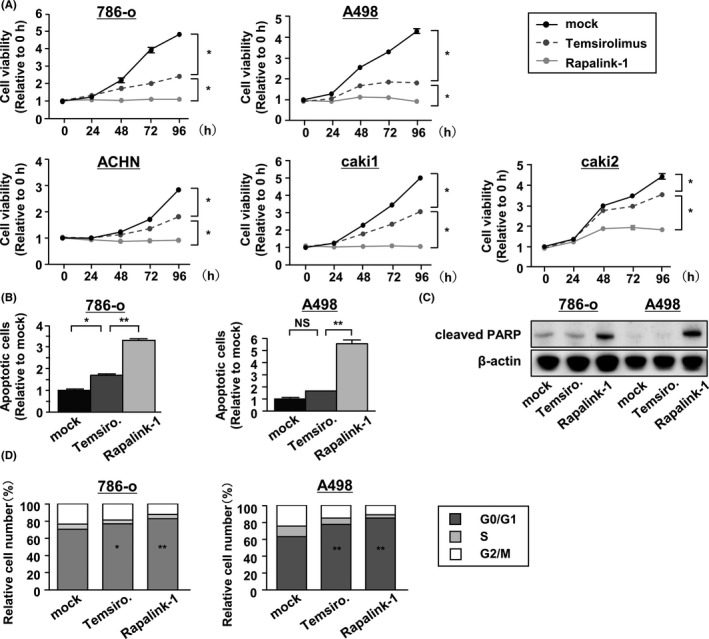
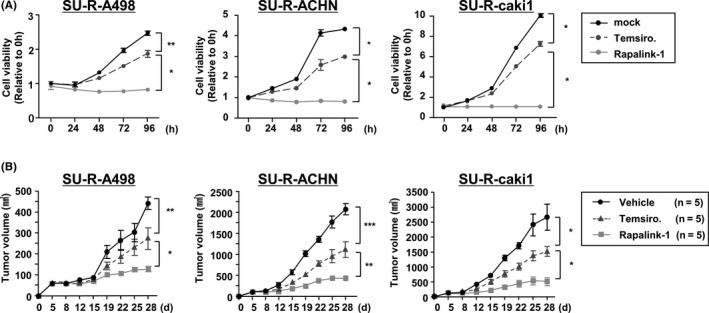
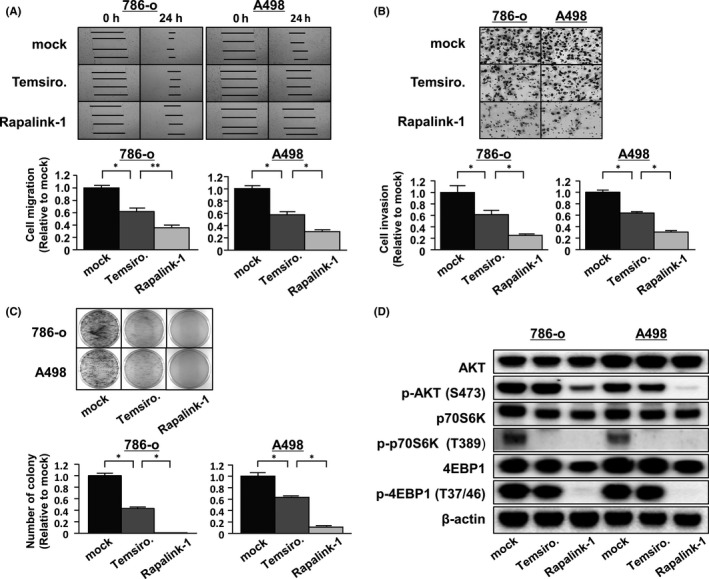
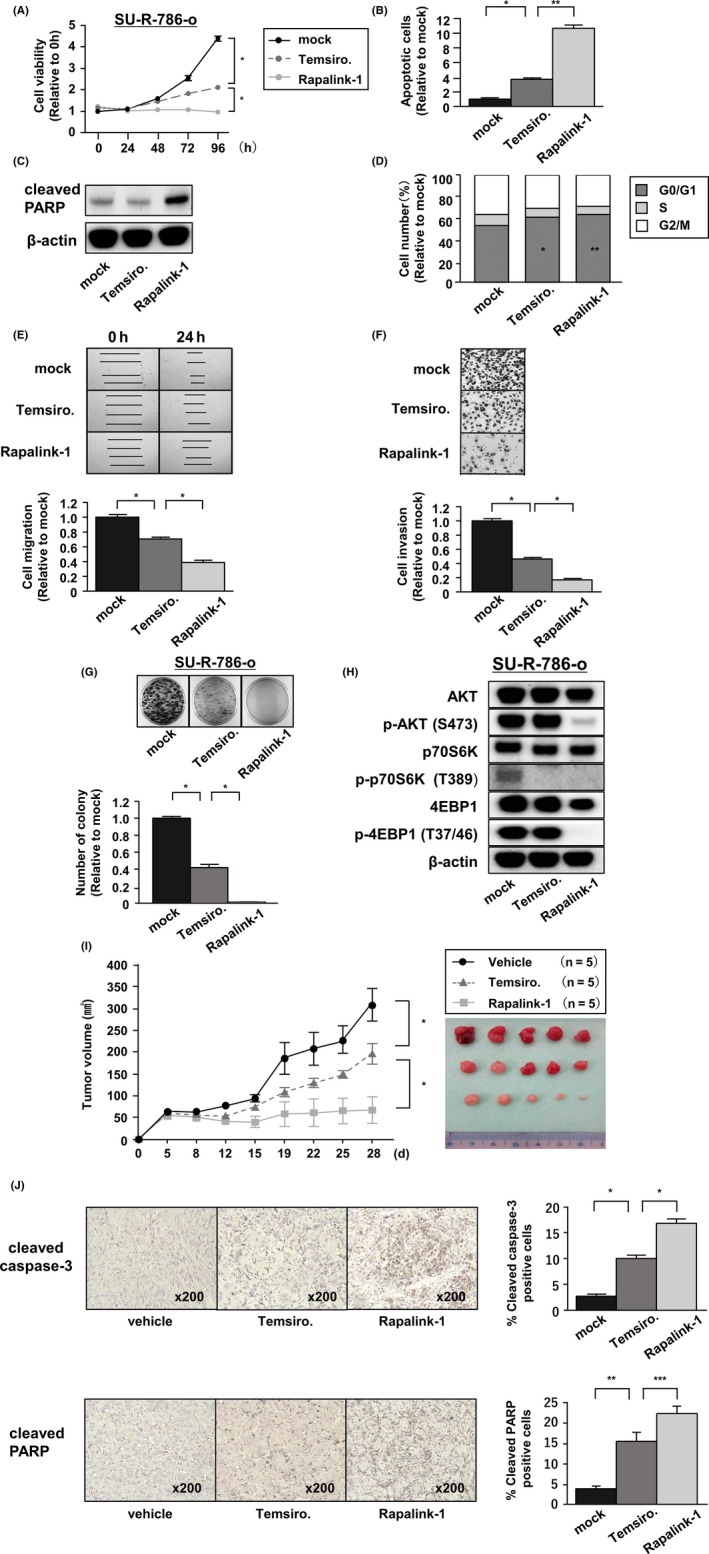
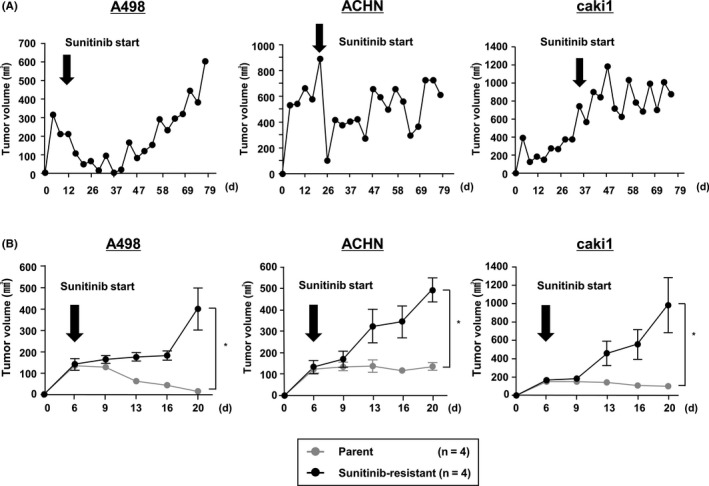
Sunitinib, a multitargeted receptor tyrosine kinase inhibitor including vascular endothelial growth factor, has been widely used as a first-line treatment against metastatic renal cell carcinoma (mRCC). However, mRCC often acquires resistance to sunitinib, rendering it difficult to treat with this agent. Recently, Rapalink-1, a drug that links rapamycin and the mTOR kinase inhibitor MLN0128, has been developed with excellent therapeutic effects against breast cancer cells carrying mTOR resistance mutations. The aim of the present study was to evaluate the in vitro and in vivo therapeutic efficacy of Rapalink-1 against renal cell carcinoma (RCC) compared to temsirolimus, which is commonly used as a small molecule inhibitor of mTOR and is a derivative of rapamycin. In comparison with temsirolimus, Rapalink-1 showed significantly greater effects against proliferation, migration, invasion and cFolony formation in sunitinib-naïve RCC cells. Inhibition was achieved through suppression of the phosphorylation of substrates in the mTOR signal pathway, such as p70S6K, eukaryotic translation initiation factor 4E-binding protein 1 (4EBP1) and AKT. In addition, Rapalink-1 had greater tumor suppressive effects than temsirolimus against the sunitinib-resistant 786-o cell line (SU-R 786-o), which we had previously established, as well as 3 additional SU-R cell lines established here. RNA sequencing showed that Rapalink-1 suppressed not only the mTOR signaling pathway but also a part of the MAPK signaling pathway, the ErbB signaling pathway and ABC transporters that were associated with resistance to several drugs. Our study suggests the possibility of a new treatment option for patients with RCC that is either sunitinib-sensitive or sunitinib-resistant.
舒尼替尼是一种多靶点受体酪氨酸激酶抑制剂,包括血管内皮生长因子,已广泛用于治疗转移性肾细胞癌(mRCC)。然而,mRCC 经常对舒尼替尼产生耐药性,使其难以用这种药物治疗。最近,Rapalink-1 是一种将雷帕霉素和 mTOR 激酶抑制剂 MLN0128 连接起来的药物,对携带 mTOR 耐药突变的乳腺癌细胞具有出色的治疗效果。本研究旨在评估 Rapalink-1 与替西罗莫司(一种常用的 mTOR 小分子抑制剂,是雷帕霉素的衍生物)相比,对肾细胞癌(RCC)的体外和体内治疗效果。与替西罗莫司相比,Rapalink-1 对舒尼替尼敏感的 RCC 细胞的增殖、迁移、侵袭和集落形成具有更显著的抑制作用。抑制作用是通过抑制 mTOR 信号通路中的底物磷酸化来实现的,如 p70S6K、真核翻译起始因子 4E 结合蛋白 1(4EBP1)和 AKT。此外,与替西罗莫司相比,Rapalink-1 对我们之前建立的舒尼替尼耐药 786-o 细胞系(SU-R 786-o)以及在此处建立的另外 3 个 SU-R 细胞系具有更大的肿瘤抑制作用。RNA 测序显示,Rapalink-1 不仅抑制了 mTOR 信号通路,还抑制了部分 MAPK 信号通路、ErbB 信号通路和 ABC 转运体,这些通路与对几种药物的耐药性有关。我们的研究表明,对于舒尼替尼敏感或耐药的 RCC 患者,可能有新的治疗选择。