Department of Anesthesiology, University Hospital Duesseldorf, Moorenstr. 5, 40225, Duesseldorf, Germany.
Institute of Cardiovascular Physiology, Heinrich-Heine-University Duesseldorf, Universitaetsstr. 1, 40225, Duesseldorf, Germany.
Cardiovasc Drugs Ther. 2020 Jun;34(3):303-310. doi: 10.1007/s10557-020-06972-4.
The melatonin receptor (MT) agonist ramelteon has a higher affinity to MT1 than for MT2 receptors and induces cardioprotection by involvement of mitochondrial potassium channels. Activation of mitochondrial potassium channels leads to release of free radicals. We investigated whether (1) ramelteon-induced cardioprotection is MT2 receptor specific and (2) if free radicals are involved in ramelteon-induced cardioprotection.
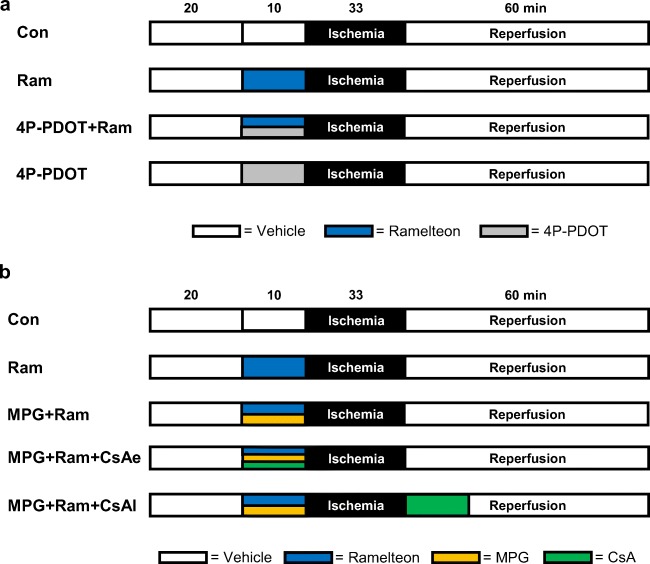
Hearts of male Wistar rats were randomized, placed on a Langendorff system, and perfused with Krebs-Henseleit buffer at a constant pressure of 80 mmHg. All hearts were subjected to 33 min of global ischemia and 60 min of reperfusion. Before ischemia hearts were perfused with ramelteon (Ram) with or without the MT2 receptor inhibitor 4-phenyl-2-propionamidotetralin (4P-PDOT+Ram, 4P-PDOT). In subsequent experiments, ramelteon was administered together with the radical oxygen species (ROS) scavenger N-2-mercaptopropionylglycine (MPG+Ram). To determine whether the blockade of ramelteon-induced cardioprotection can be restored, we combined ramelteon and MPG with mitochondrial permeability transition pore (mPTP) inhibitor cyclosporine A (CsA) at different time points. Infarct size was determined by triphenyltetrazolium chloride (TTC) staining.
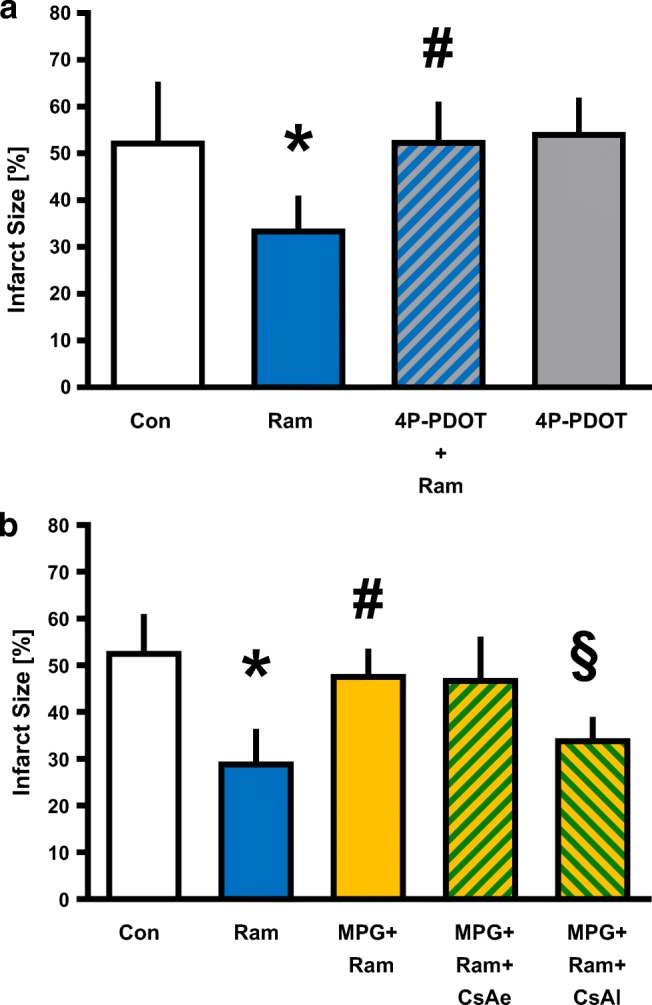
Ramelteon-induced infarct size reduction was completely blocked by 4P-PDOT and MPG. Ramelteon and MPG combined with CsA before ischemia were not cardioprotective but CsA at the onset of reperfusion could restore infarct size reduction.
This study shows for the first time that despite the higher affinity to MT1 receptors, (1) ramelteon-induced cardioprotection involves MT2 receptors, (2) cardioprotection requires ROS release, and (3) inhibition of the mPTP can restore infarct size reduction.
褪黑素受体(MT)激动剂雷美替胺对 MT1 受体的亲和力高于 MT2 受体,通过涉及线粒体钾通道发挥心脏保护作用。线粒体钾通道的激活导致自由基的释放。我们研究了(1)雷美替胺诱导的心脏保护作用是否是 MT2 受体特异性的,以及(2)自由基是否参与雷美替胺诱导的心脏保护作用。
雄性 Wistar 大鼠的心脏被随机分配,置于 Langendorff 系统中,并在 80mmHg 的恒定压力下用 Krebs-Henseleit 缓冲液灌注。所有心脏均经历 33 分钟的全局缺血和 60 分钟的再灌注。在缺血前,心脏用雷美替胺(Ram)灌注,或用 MT2 受体抑制剂 4-苯基-2-丙酰氨基四氢萘(4P-PDOT+Ram,4P-PDOT)灌注。在随后的实验中,雷美替胺与活性氧(ROS)清除剂 N-2-巯基丙酰甘氨酸(MPG+Ram)一起给药。为了确定是否可以恢复雷美替胺诱导的心脏保护作用的阻断,我们在不同时间点将雷美替胺和 MPG 与线粒体通透性转换孔(mPTP)抑制剂环孢素 A(CsA)结合。通过三苯基四唑氯化物(TTC)染色测定梗死面积。
4P-PDOT 和 MPG 完全阻断了雷美替胺诱导的梗死面积减少。在缺血前与 CsA 联合使用雷美替胺和 MPG 没有心脏保护作用,但在再灌注开始时 CsA 可以恢复梗死面积减少。
这项研究首次表明,尽管对 MT1 受体的亲和力更高,(1)雷美替胺诱导的心脏保护作用涉及 MT2 受体,(2)心脏保护作用需要 ROS 释放,以及(3)抑制 mPTP 可以恢复梗死面积减少。