Department of Psychiatry, Columbia University Irving Medical Center, New York, New York.
Department of Psychiatry and Behavioral Sciences, Duke University Medical Center, Durham, North Carolina.
Am J Addict. 2020 Jul;29(4):313-322. doi: 10.1111/ajad.13024. Epub 2020 Apr 4.
When patients seek to discontinue buprenorphine (BUP) treatment, monthly injectable extended-release naltrexone (XR-NTX) may help them avoid relapse. The efficacy of low ascending doses of oral NTX vs placebo for patients transitioning from BUP to XR-NTX is evaluated in this study.
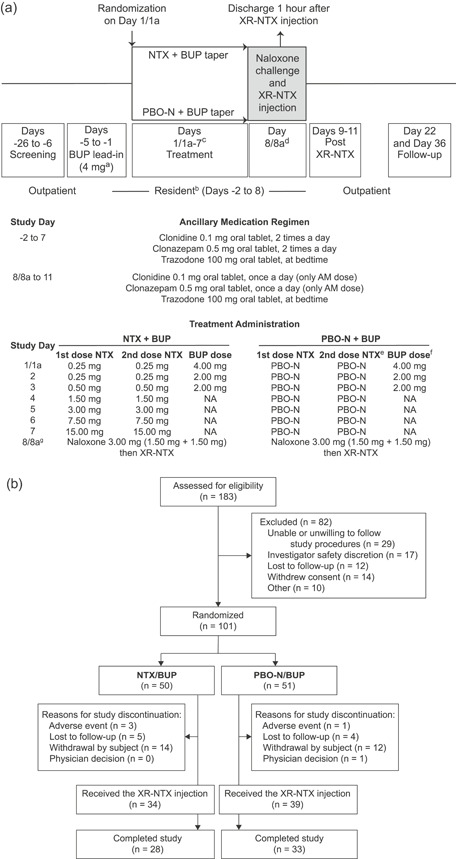
In a phase 3, hybrid residential/outpatient study, clinically stable participants with opioid use disorder (N = 101), receiving BUP for more than or equal to 3 months and seeking antagonist treatment, were randomized (1:1) to 7 residential days of descending doses of BUP and low ascending doses of oral NTX (NTX/BUP, n = 50) or placebo (PBO-N/BUP, n = 51). Both groups received standing ancillary medications and psychoeducational counseling. Following negative naloxone challenge, participants received XR-NTX (day 8). The primary endpoint was the proportion of participants who received and tolerated XR-NTX.
There was no statistical difference between groups for participants receiving a first dose of XR-NTX: 68.6% (NTX/BUP) vs 76.0% (PBO-N/BUP; P = .407). The mean number of days with peak Clinical Opiate Withdrawal Scale (COWS) score less than or equal to 12 during the treatment period (days 1-7) was similar for NTX/BUP and PBO-N/BUP groups (5.8 vs 6.3; P = .511). Opioid withdrawal symptoms during XR-NTX induction and post-XR-NTX observation period (days 8-11) were mild and similar between groups (mean peak COWS score: NTX/BUP, 5.1 vs PBO-N/BUP, 5.4; P = .464). Adverse events were mostly mild/moderate.
Low ascending doses of oral NTX did not increase induction rates onto XR-NTX compared with placebo. The overall rate of successful induction across treatment groups supports a brief BUP taper with standing ancillary medications as a well-tolerated approach for patients seeking transition from BUP to XR-NTX. (Am J Addict 2020;00:00-00).
当患者寻求停止丁丙诺啡(BUP)治疗时,每月注射的纳曲酮延长释放剂(XR-NTX)可能有助于他们避免复发。本研究评估了低递增剂量的口服纳曲酮(NTX)相对于安慰剂用于从 BUP 转为 XR-NTX 的患者的疗效。
在一项 3 期混合住院/门诊研究中,纳入了 101 例患有阿片类药物使用障碍且临床稳定的参与者(N=101),他们接受 BUP 治疗超过或等于 3 个月并寻求拮抗剂治疗,这些参与者被随机(1:1)分为 7 天的 BUP 递减剂量和低递增剂量的口服 NTX(NTX/BUP,n=50)或安慰剂(PBO-N/BUP,n=51)。两组均接受常规辅助药物和心理教育咨询。在阴性纳洛酮挑战后,参与者接受 XR-NTX(第 8 天)。主要终点是接受并耐受 XR-NTX 的参与者比例。
接受 XR-NTX 首剂量的两组之间无统计学差异:68.6%(NTX/BUP)与 76.0%(PBO-N/BUP;P=0.407)。治疗期间(第 1-7 天)达到临床阿片戒断量表(COWS)评分峰值小于或等于 12 的天数,NTX/BUP 和 PBO-N/BUP 两组相似(5.8 天 vs 6.3 天;P=0.511)。在 XR-NTX 诱导期间和 XR-NTX 观察期(第 8-11 天)的阿片类药物戒断症状在两组中均较轻且相似(NTX/BUP 组平均峰值 COWS 评分:5.1,PBO-N/BUP 组:5.4;P=0.464)。不良事件主要为轻度/中度。
与安慰剂相比,口服 NTX 的低递增剂量并未增加 XR-NTX 的诱导率。治疗组总体成功诱导率支持在接受常规辅助药物的情况下,进行 BUP 短暂减量,这是一种耐受良好的从 BUP 转为 XR-NTX 的方法。