Health and Rehabilitation Sciences Doctoral Program, School of Health and Rehabilitation Sciences, The Ohio State University, Columbus, Ohio.
Division of Physical Therapy, School of Health and Rehabilitation Sciences, The Ohio State University, Columbus, Ohio.
J Orthop Res. 2020 Nov;38(11):2443-2453. doi: 10.1002/jor.24680. Epub 2020 Apr 13.
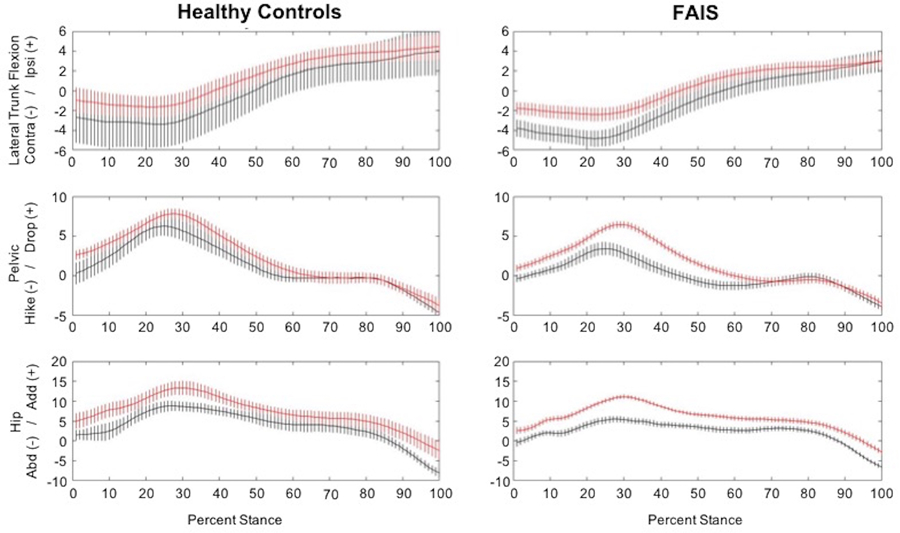
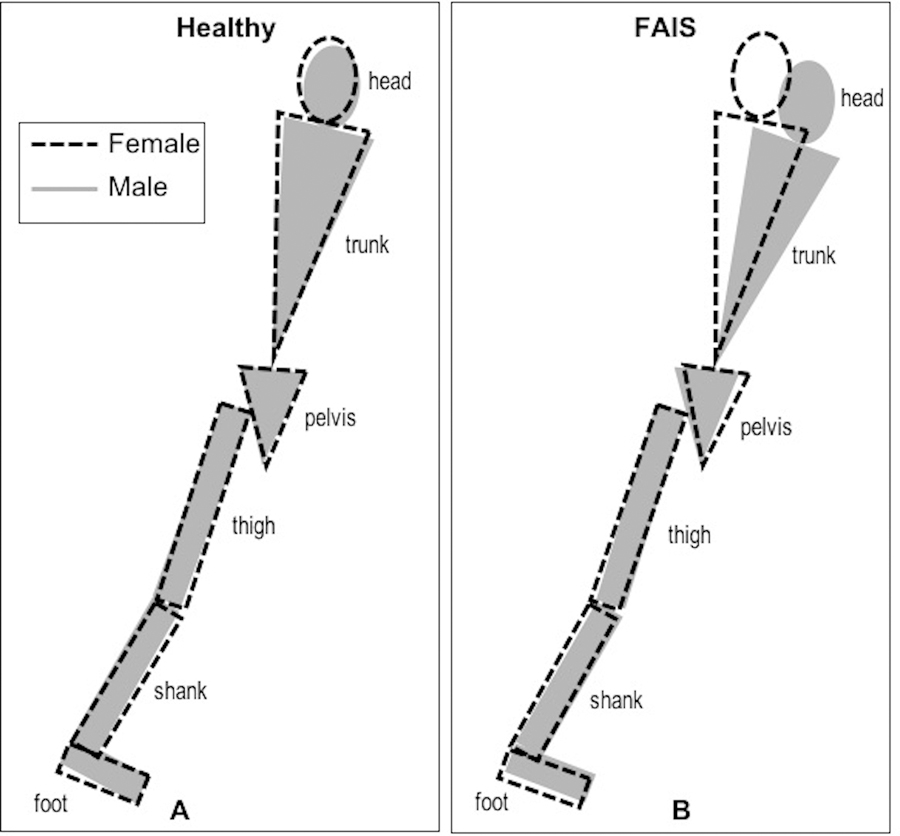
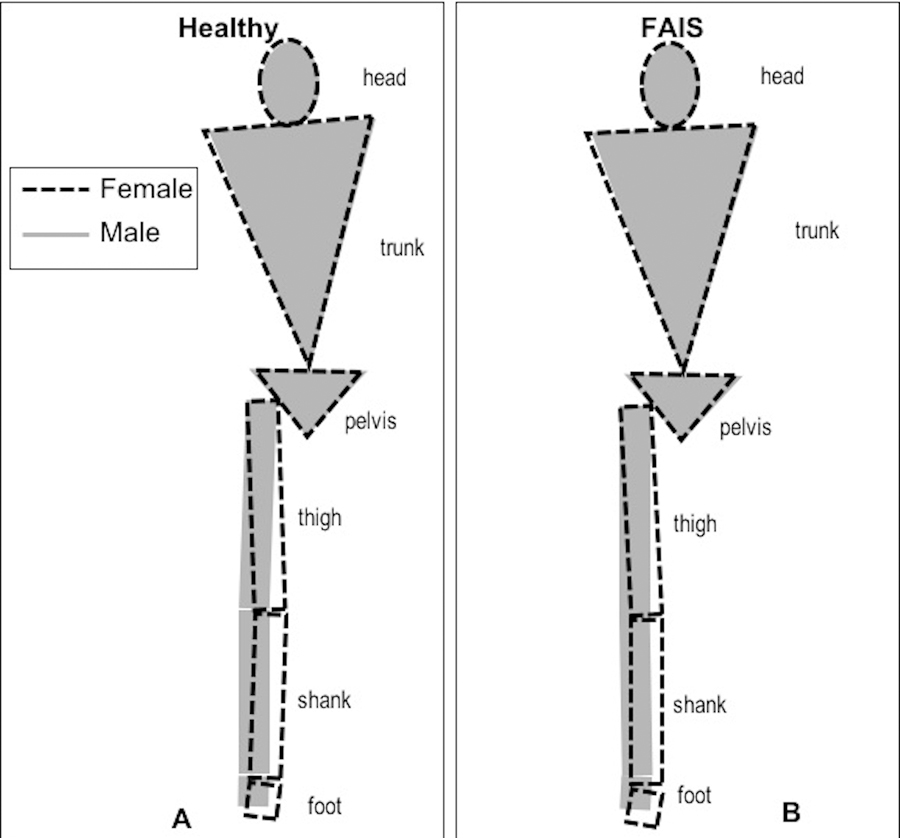
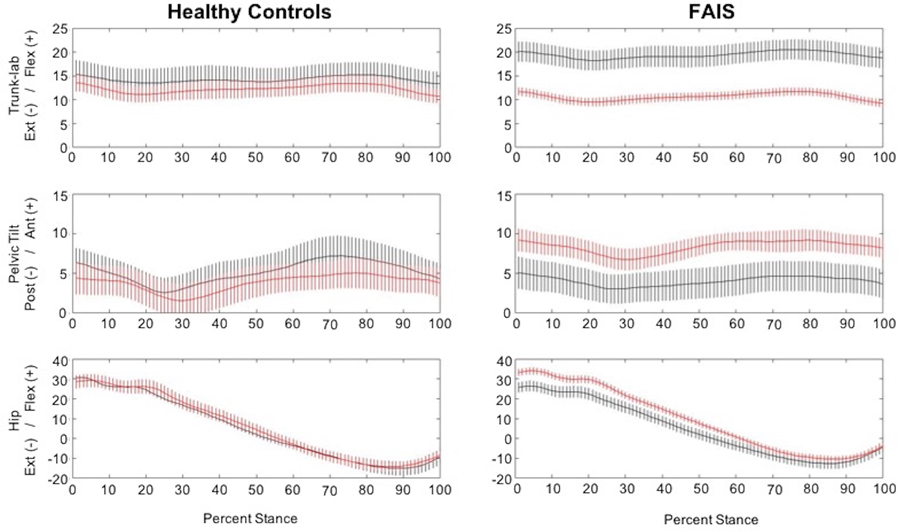
Postoperative gait mechanics in persons with femoroacetabular impingement syndrome (FAIS) remain understudied as a treatment outcome despite observed, yet inconclusive, preoperative gait abnormalities. Females with FAIS demonstrate worse preoperative patient-reported hip function and altered hip mechanics when compared with males; it is unknown whether these sex differences persist postarthroscopy. The purpose of this study was to compare sex-specific gait kinematics between persons at least 1 year postarthroscopy for FAIS and healthy comparisons. General linear models with estimating equations were used to evaluate the effect of (a) limb and sex within each group, and (b) limb and group within each sex for peak sagittal and frontal plane trunk, pelvis, and hip kinematics during stance phase of gait. Analyses were covaried by gait speed. Seventeen females and eight males an average 2.5 years postarthroscopy (1.1-7.2 year) for FAIS were compared with healthy females (n = 7) and males (n = 5). Females in the FAIS group presented with an average of 4.6° more anterior pelvic tilt, and 4.8° less hip extension compared with healthy females (P ≤ .03) and 8.6° less trunk flexion, 4.8° more anterior pelvic tilt, 3.1° more pelvic drop, and 7.5° more hip flexion than males with FAIS (P ≤ .03). Males in the FAIS group presented with 2.9° less pelvic drop, and 3.2° less hip adduction than healthy males. Preoperative gait mechanics were not collected and thus changes in mechanics could not be evaluated. This study is significant to clinicians who treat patients postarthroscopy to consider sex-specific gait impairments.
髋关节撞击综合征(FAIS)患者术后步态力学仍作为治疗结果研究较少,尽管术前观察到步态异常,但尚无定论。与男性相比,FAIS 女性患者表现出更差的术前髋关节功能和改变的髋关节力学;尚不清楚这些性别差异是否在关节镜术后仍然存在。本研究的目的是比较 FAIS 患者和健康对照者至少在关节镜术后 1 年的特定性别的步态运动学。使用具有估算方程的一般线性模型来评估(a)组内的肢体和性别,以及(b)每组内的肢体和性别对步态站立相期间矢状面和额状面躯干、骨盆和髋关节运动学的峰值的影响。分析通过步态速度进行协方差。将 17 名女性和 8 名男性 FAIS 患者平均 2.5 年(1.1-7.2 年)后与健康女性(n = 7)和男性(n = 5)进行比较。FAIS 组中的女性与健康女性相比,骨盆前倾平均增加 4.6°,髋关节伸展减少 4.8°(P≤.03),与 FAIS 男性相比,躯干前屈减少 8.6°,骨盆前倾增加 4.8°,骨盆下降增加 3.1°,髋关节屈曲增加 7.5°(P≤.03)。FAIS 组中的男性与健康男性相比,骨盆下降减少 2.9°,髋关节内收减少 3.2°。术前步态力学未收集,因此无法评估力学变化。本研究对治疗关节镜术后患者的临床医生具有重要意义,应考虑特定性别的步态障碍。