Department of Biomedical Sciences for Health, University of Milan, Milan, Italy.
Endocrinology and Diabetology Service, IRCCS Istituto Ortopedico Galeazzi, Milan, Italy.
Mediators Inflamm. 2020 Jan 17;2020:3417329. doi: 10.1155/2020/3417329. eCollection 2020.
Primary hyperparathyroidism (PHPT) is a common cause of secondary osteoporosis in postmenopausal women. Th17 lymphocytes and the released cytokine IL-17A play an important role in bone metabolism. Th17 cells have been shown to be activated by PTH, and peripheral blood T cells from patients affected with PHPT express higher levels of IL-17A mRNA than controls.
To investigate circulating levels of IL-17A and the ratio RANKL/OPG, as markers of osteoclastogenesis, in 50 postmenopausal PHPT women compared with postmenopausal osteoporotic non-PHPT women ( = 20).
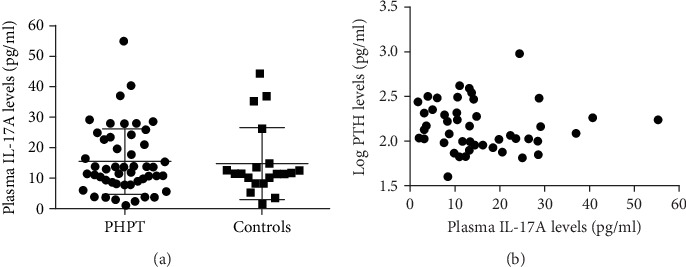
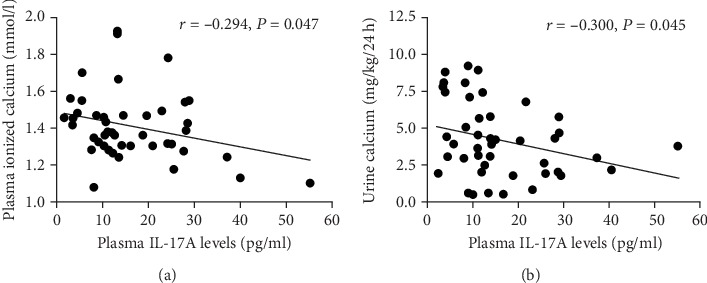
Circulating levels of IL-17A were similarly detectable in most PHPT and non-PHPT osteoporotic women (12.9 (8.4-23.1) vs. 11.3 (8.3-14.3) pg/ml, median (range interquartile), = 0.759), at variance with premenopausal women where IL-17A was undetectable. In PHPT women, any significant correlations could be detected between circulating IL-17A levels and PTH levels. Nonetheless, significant negative correlations between circulating IL-17A and ionized calcium levels ( = -0.294, = 0.047) and urine calcium excretions ( = -0.300, = 0.045) were found. Moreover, PHPT women were characterized by positive correlations between IL-17A levels and femur neck ( = 0.364, = 0.021) and total hip ( = 0.353, = 0.015) -scores. Circulating IL-17A levels did not show any significant correlation with sRANKL, OPG, and sRANKL/OPG ratio in PHPT women.
In postmenopausal PHPT women, circulating IL-17A levels were similar to those detected in postmenopausal non-PHPT women, showing a disruption of the relationship observed in postmenopausal osteoporosis among circulating PTH, sRANKL, OPG, IL-17A, and bone demineralization in postmenopausal PHPT women. The data support an osteogenic effect of IL-17A in postmenopausal PHPT women.
原发性甲状旁腺功能亢进症(PHPT)是绝经后妇女继发性骨质疏松症的常见原因。Th17 淋巴细胞及其释放的细胞因子 IL-17A 在骨代谢中发挥重要作用。已经表明,甲状旁腺激素可以激活 Th17 细胞,并且患有 PHPT 的患者的外周血 T 细胞表达的 IL-17A mRNA 水平高于对照组。
在 50 名绝经后 PHPT 女性与绝经后非 PHPT 骨质疏松症女性(= 20)相比,研究循环中 IL-17A 的水平以及作为破骨细胞生成标志物的 RANKL/OPG 比值。
在大多数 PHPT 和非 PHPT 骨质疏松症女性中均可检测到循环 IL-17A 的水平(12.9(8.4-23.1)与 11.3(8.3-14.3)pg/ml,中位数(四分位间距范围),= 0.759),而在绝经前妇女中则无法检测到 IL-17A。在 PHPT 女性中,循环 IL-17A 水平与 PTH 水平之间没有发现任何显著相关性。尽管如此,仍发现循环 IL-17A 与离子钙水平(= -0.294,= 0.047)和尿钙排泄(= -0.300,= 0.045)之间存在显著负相关。此外,PHPT 女性的特点是 IL-17A 水平与股骨颈(= 0.364,= 0.021)和总髋部(= 0.353,= 0.015)评分之间呈正相关。PHPT 女性的循环 IL-17A 水平与 sRANKL、OPG 和 sRANKL/OPG 比值之间没有任何显著相关性。
在绝经后 PHPT 女性中,循环 IL-17A 水平与绝经后非 PHPT 女性相似,表明在绝经后 PHPT 女性中,循环 PTH、sRANKL、OPG、IL-17A 和骨矿物质脱失之间的关系发生了中断。这些数据支持 IL-17A 在绝经后 PHPT 女性中的成骨作用。