Miao Dan, Lei Kuok-Tong, Jiang Jing-Feng, Wang Xin-Jun, Wang Hong, Liu Xiao-Ru, Zhang Jia-Jia, Xiong Jia-Wei
Key Laboratory of Acupuncture and Medicine Research of Ministry of Education, Nanjing University of Chinese Medicine, Nanjing 210023, China.
Affiliated Hospital of Nanjing University of Traditional Chinese Medicine, Nanjing 210023, China.
Evid Based Complement Alternat Med. 2020 Mar 19;2020:5094914. doi: 10.1155/2020/5094914. eCollection 2020.
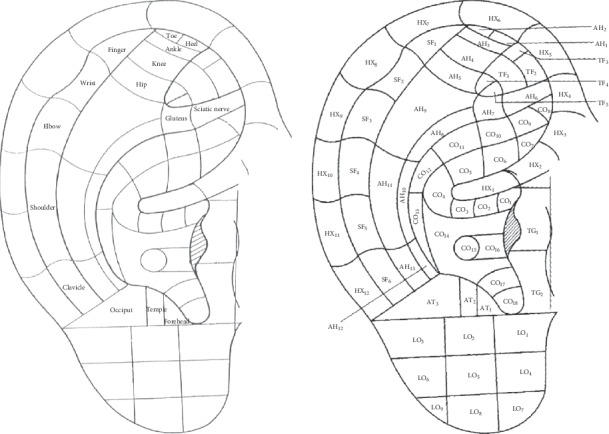
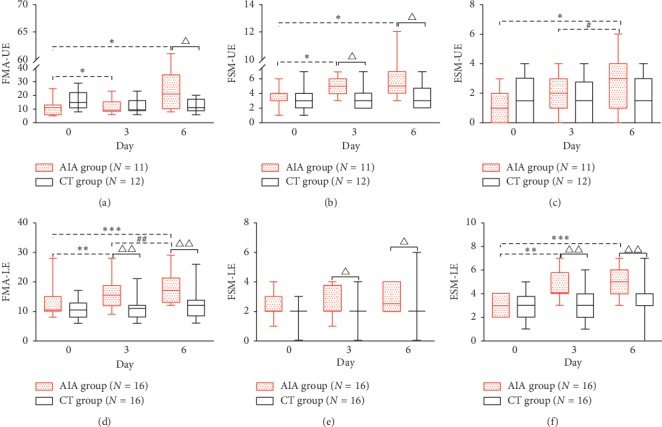
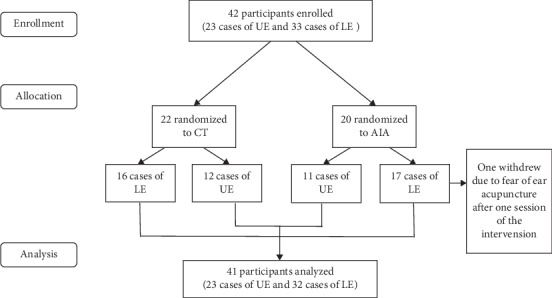
We have explored the potential of auricular intradermal acupuncture (AIA) in standard rehabilitation and acupuncture treatment for motor recovery in poststroke patients. This was a randomized, controlled preliminary clinical study in which the patients were randomly assigned to the CT group (conventional treatment, standard rehabilitation, and routine acupuncture) or AIA group (AIA combined with conventional treatment) and underwent 6 sessions in 1 week (6 days). Standard procedures and previously reported acupuncture points were used. Clinical outcomes were measured by the Fugl-Meyer motor assessment (FMA) of flexor and extensor synergy movement (FSM and ESM) of the upper and lower extremities (UE and LE) at days 0, 3, and 6. The assessment was performed by blinded assessors. The AIA group showed a significant increase in FMA-UE/FMA-LE scores on day 3 (=0.012 and 0.001, respectively) and day 6 (=0.041 and < 0.001, respectively), but this was not observed in the CT group. Furthermore, unlike the CT group, the AIA group exhibited a significant increase in the FMA-LE score on day 3 (=0.004) and the FMA-UE scores on day 6 (=0.048). Finally, the correlation between ESM and FMA-UE/FMA-LE was higher than that between FSM and FMA-UE/FMA-LE after treatment: for ESM and UE, = 0.759, =0.007; for ESM and LE, = 0.697, =0.003; for FSM and UE, = 0.604, =0.049; for FSM and LE, = 0.347, =0.188. AIA is useful for motor rehabilitation in poststroke patients, particularly in terms of improving extensor synergy. This trial is registered with CHiCTR1800020150.
我们探讨了耳穴皮内针(AIA)在中风后患者运动恢复的标准康复和针灸治疗中的潜力。这是一项随机对照初步临床研究,患者被随机分配到CT组(传统治疗、标准康复和常规针灸)或AIA组(AIA联合传统治疗),并在1周内(6天)接受6次治疗。采用标准程序和先前报道的穴位。在第0、3和6天,通过Fugl-Meyer运动评估(FMA)对上肢和下肢(UE和LE)的屈肌和伸肌协同运动(FSM和ESM)进行临床结局测量。评估由盲法评估者进行。AIA组在第3天(分别为=0.012和0.001)和第6天(分别为=0.041和<0.001)的FMA-UE/FMA-LE评分显著增加,但CT组未观察到这种情况。此外,与CT组不同,AIA组在第3天的FMA-LE评分(=0.004)和第6天的FMA-UE评分(=0.048)显著增加。最后,治疗后ESM与FMA-UE/FMA-LE之间的相关性高于FSM与FMA-UE/FMA-LE之间的相关性:对于ESM和UE,=0.759,=0.007;对于ESM和LE,=0.697,=0.003;对于FSM和UE,=0.604,=0.049;对于FSM和LE,=0.347,=0.188。AIA对中风后患者的运动康复有用,特别是在改善伸肌协同方面。本试验已在CHiCTR1800020150注册。