Li Si-Qi, Fan Qiao-Zhen, Xu Lan-Ping, Wang Yu, Zhang Xiao-Hui, Chen Huan, Chen Yu-Hong, Wang Feng-Rong, Han Wei, Sun Yu-Qian, Yan Chen-Hua, Tang Fei-Fei, Liu Yan-Rong, Mo Xiao-Dong, Wang Xin-Yu, Liu Kai-Yan, Huang Xiao-Jun, Chang Ying-Jun
Beijing Key Laboratory of Hematopoietic Stem Cell Transplantation, National Clinical Research Center for Hematologic Disease, Peking University People's Hospital, Peking University Institute of Hematology, Beijing, China.
Peking-Tsinghua Center for Life Sciences, Beijing, China.
Front Oncol. 2020 Mar 17;10:320. doi: 10.3389/fonc.2020.00320. eCollection 2020.
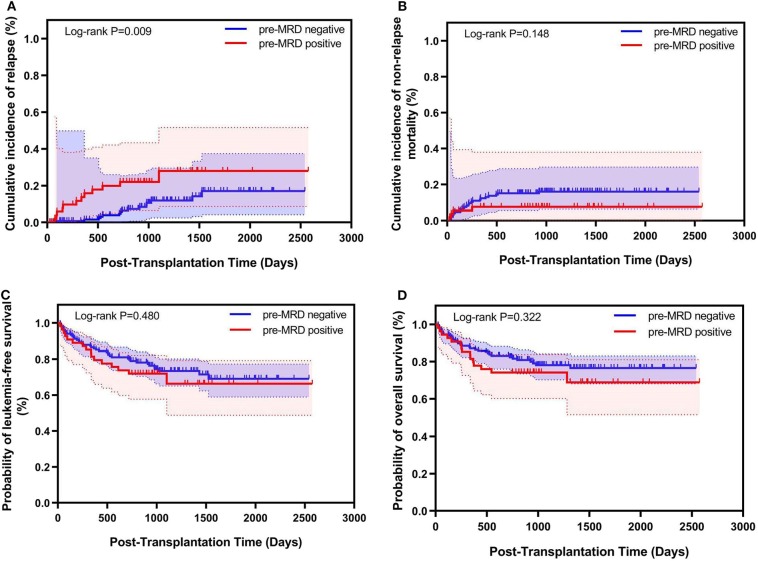
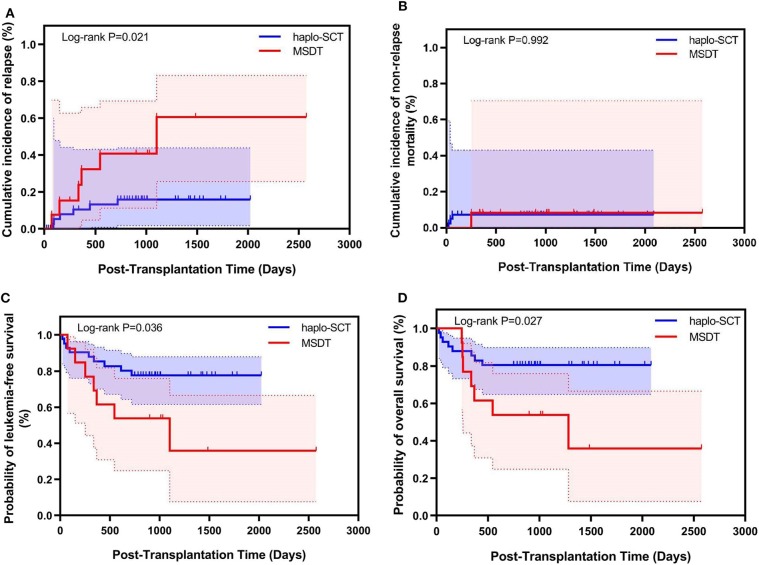
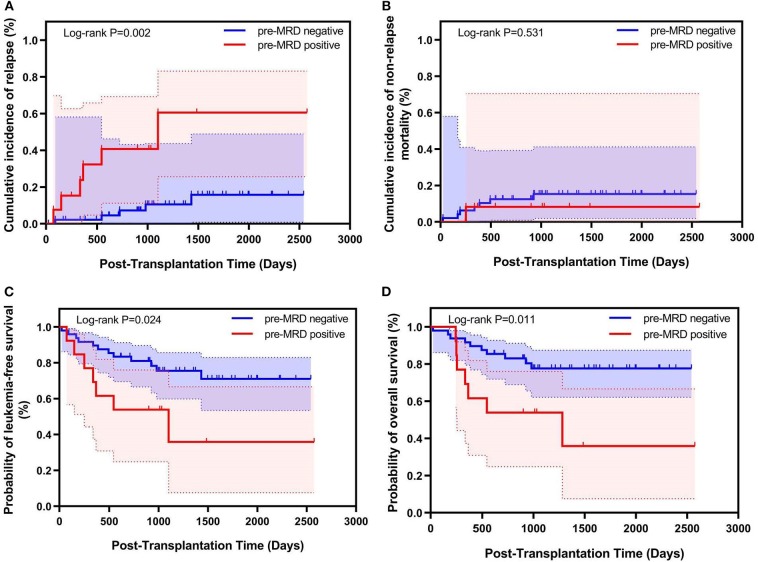
This study compared the effects of pre-transplantation measurable residual disease (pre-MRD) on outcomes in Philadelphia chromosome (Ph)-positive ALL patients who underwent human leukocyte antigen-matched sibling donor transplantation (MSDT) or who received unmanipulated haploidentical SCT (haplo-SCT). A retrospective study ( = 202) was performed. MRD was detected by RT-PCR and multiparameter flow cytometry. In the total patient group, patients with positive pre-MRD had a higher 4-year cumulative incidence of relapse (CIR) than that in patients with negative pre-MRD (26.1% vs. 12.1%, = 0.009); however, the cumulative incidence of non-relapse mortality (NRM) (7.4% vs. 15.9%, = 0.148), probability of leukemia-free survival (LFS) (66.3% vs. 71.4%, = 0.480), and overall survival (OS) (68.8% vs. 76.5%, = 0.322) were comparable. In the MSDT group, patients with positive pre-MRD had increased 4-year CIR (56.4% vs. 13.8%, < 0.001) and decreased 4-year LFS (35.9% vs. 71.0%, = 0.024) and OS (35.9% vs. 77.6%, = 0.011) compared with those with negative pre-MRD. In haplo-SCT settings, the 4-year CIR (14.8% vs. 10.7%, = 0.297), NRM (7.3% vs. 16.3%, = 0.187) and the 4-year probability of OS (77.7% vs. 72.3%, = 0.804) and LFS (80.5% vs. 75.7%, = 0.660) were comparable between pre-MRD positive and negative groups. In subgroup patients with positive pre-MRD, haplo-SCT had a lower 4-year CIR (14.8% vs. 56.4%, = 0.021) and a higher 4-year LFS (77.7% vs. 35.9%, = 0.036) and OS (80.5% vs. 35.9%, = 0.027) than those of MSDT. Multivariate analysis showed that haplo-SCT was associated with lower CIR (HR, 0.288; = 0.031), superior LFS (HR, 0.283; = 0.019) and OS (HR, 0.252; = 0.013) in cases with a positive pre-MRD subgroup. Our results indicate that the effects of positive pre-MRD on the outcomes of patients with Ph-positive ALL are different according to transplant modality. For Ph-positive cases with positive pre-MRD, haplo-SCT might have strong graft-vs.-leukemia (GVL) effects.
本研究比较了移植前可测量残留病(pre-MRD)对接受人类白细胞抗原匹配同胞供体移植(MSDT)或接受未处理单倍体相合造血干细胞移植(haplo-SCT)的费城染色体(Ph)阳性急性淋巴细胞白血病(ALL)患者预后的影响。进行了一项回顾性研究(n = 202)。通过逆转录聚合酶链反应(RT-PCR)和多参数流式细胞术检测MRD。在总患者组中,pre-MRD阳性患者的4年累积复发率(CIR)高于pre-MRD阴性患者(26.1%对12.1%,P = 0.009);然而,非复发死亡率(NRM)的累积发生率(7.4%对15.9%,P = 0.148)、无白血病生存率(LFS)概率(66.3%对71.4%,P = 0.480)和总生存率(OS)(68.8%对76.5%,P = 0.322)相当。在MSDT组中,与pre-MRD阴性患者相比,pre-MRD阳性患者的4年CIR增加(56.4%对13.8%,P < 0.001),4年LFS降低(35.9%对71.0%,P = 0.024),OS降低(35.9%对77.6%,P = 0.011)。在haplo-SCT情况下,pre-MRD阳性和阴性组之间的4年CIR(14.8%对10.7%,P = 0.297)、NRM(7.3%对16.3%,P = 0.187)以及4年OS概率(77.7%对72.3%,P = 0.804)和LFS概率(80.5%对75.7%,P = 0.660)相当。在pre-MRD阳性的亚组患者中,haplo-SCT的4年CIR较低(14.8%对56.4%,P = 0.021),4年LFS较高(77.7%对35.9%,P = 0.036),OS较高(80.5%对35.9%,P = 0.027),高于MSDT。多变量分析显示,在pre-MRD阳性亚组病例中,haplo-SCT与较低的CIR(风险比[HR],0.288;P = 0.031)、更好的LFS(HR,0.283;P = 0.019)和OS(HR,0.