Mapstone Mark, Gross Thomas J, Macciardi Fabio, Cheema Amrita K, Petersen Melissa, Head Elizabeth, Handen Benjamin L, Klunk William E, Christian Bradley T, Silverman Wayne, Lott Ira T, Schupf Nicole
Department of Neurology University of California-Irvine Irvine California USA.
Department of Psychiatry and Human Behavior University of California-Irvine Irvine California USA.
Alzheimers Dement (Amst). 2020 Apr 5;12(1):e12028. doi: 10.1002/dad2.12028. eCollection 2020.
Disruption of metabolic function is a recognized feature of late onset Alzheimer's disease (LOAD). We sought to determine whether similar metabolic pathways are implicated in adults with Down syndrome (DS) who have increased risk for Alzheimer's disease (AD).
We examined peripheral blood from 292 participants with DS who completed baseline assessments in the Alzheimer's Biomarkers Consortium-Down Syndrome (ABC-DS) using untargeted mass spectrometry (MS). Our sample included 38 individuals who met consensus criteria for AD (DS-AD), 43 who met criteria for mild cognitive impairment (DS-MCI), and 211 who were cognitively unaffected and stable (CS).
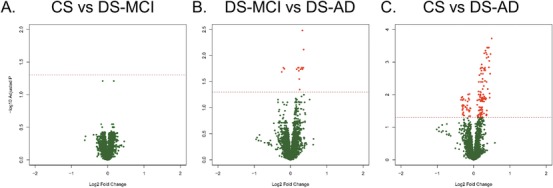
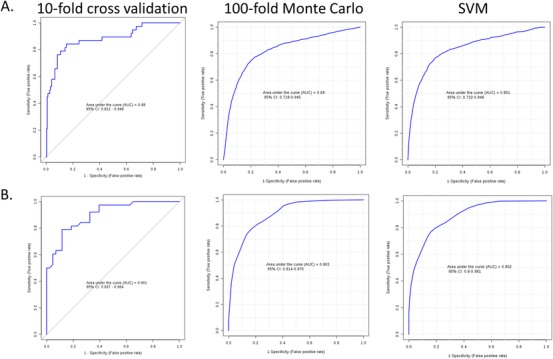
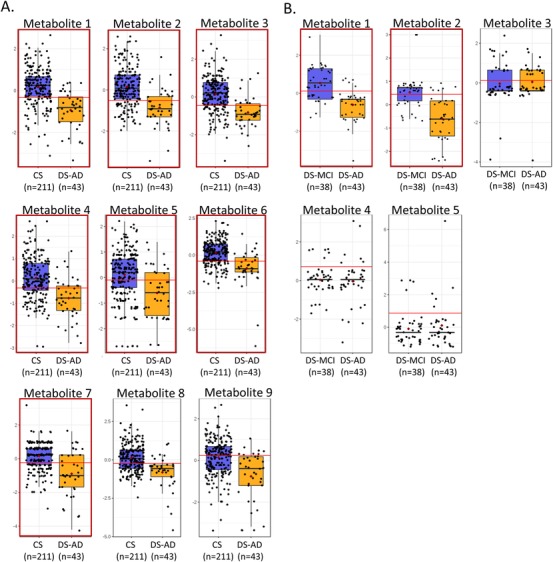
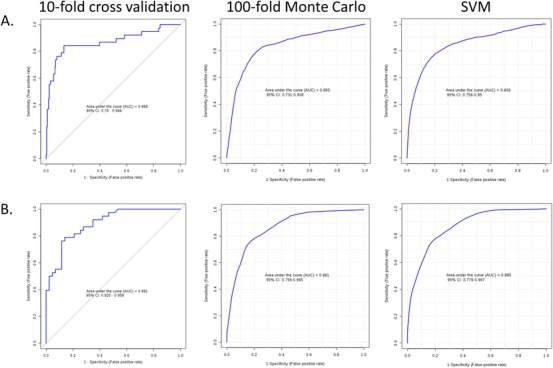
We measured relative abundance of 8,805 features using MS and 180 putative metabolites were differentially expressed (DE) among the groups at false discovery rate-corrected < 0.05. From the DE features, a nine-feature classifier model classified the CS and DS-AD groups with receiver operating characteristic area under the curve (ROC AUC) of 0.86 and a two-feature model classified the DS-MCI and DS-AD groups with ROC AUC of 0.88. Metabolite set enrichment analysis across the three groups suggested alterations in fatty acid and carbohydrate metabolism.
Our results reveal metabolic alterations in DS-AD that are similar to those seen in LOAD. The pattern of results in this cross-sectional DS cohort suggests a dynamic time course of metabolic dysregulation which evolves with clinical progression from non-demented, to MCI, to AD. Metabolomic markers may be useful for staging progression of DS-AD.
代谢功能紊乱是晚发型阿尔茨海默病(LOAD)的一个公认特征。我们试图确定类似的代谢途径是否与患阿尔茨海默病(AD)风险增加的唐氏综合征(DS)成年人有关。
我们使用非靶向质谱(MS)检查了292名参与唐氏综合征阿尔茨海默病生物标志物联盟(ABC-DS)基线评估的DS参与者的外周血。我们的样本包括38名符合AD共识标准的个体(DS-AD)、43名符合轻度认知障碍标准的个体(DS-MCI)以及211名认知未受影响且状态稳定的个体(CS)。
我们使用MS测量了8805个特征的相对丰度,在错误发现率校正<0.05的情况下,180种假定代谢物在各组之间差异表达(DE)。从DE特征中,一个九特征分类器模型对CS组和DS-AD组进行分类,曲线下面积(ROC AUC)为0.86,一个两特征模型对DS-MCI组和DS-AD组进行分类,ROC AUC为0.88。对三组进行的代谢物集富集分析表明脂肪酸和碳水化合物代谢存在改变。
我们的结果揭示了DS-AD中与LOAD相似的代谢改变。这个横断面DS队列的结果模式表明代谢失调存在动态时间进程,它随着临床进展从非痴呆发展到MCI再到AD而演变。代谢组学标志物可能有助于DS-AD进展的分期。