Kim Min, Hong Myunghee, Kim Jong-Youn, Kim In-Soo, Yu Hee Tae, Kim Tae-Hoon, Uhm Jae-Sun, Joung Boyoung, Lee Moon-Hyoung, Pak Hui-Nam
Division of Cardiology, Yonsei University Health System, Seoul, Republic of Korea.
Int J Cardiol Heart Vasc. 2020 Apr 2;27:100507. doi: 10.1016/j.ijcha.2020.100507. eCollection 2020 Apr.
Anemia is a known adverse prognostic factor among patients with cardiovascular diseases. We investigated whether the hemoglobin level was associated with the rhythm outcome after atrial fibrillation (AF) catheter ablation (AFCA).
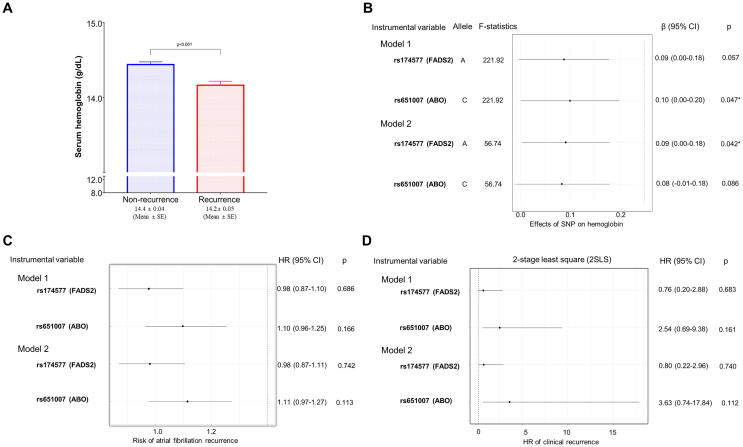
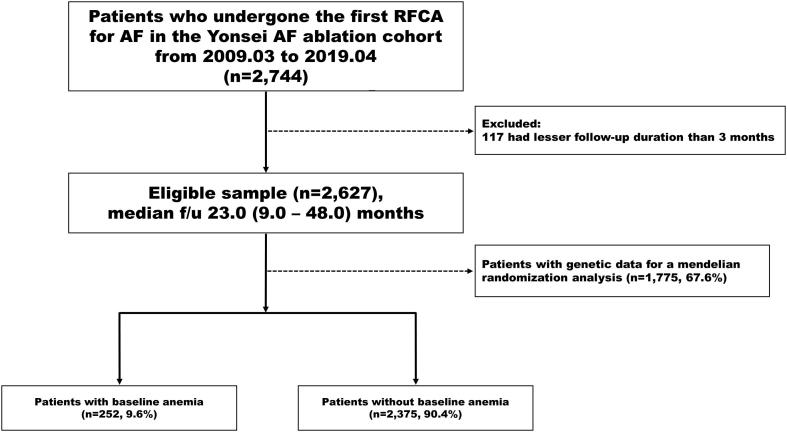
We included 2627 patients who underwent AFCA and a guidelines-based rhythm follow-up (age 58 ± 10.9 years, 73% men, 30.6% with persistent AF), and evaluated the association of pre-AFCA anemia (haemoglobin <13 g/dL in men and <12 g/dL in women) and rhythm outcomes. We studied the mechanistic relationship between anemia and AF recurrence using a Mendelian randomization analysis (1775 subjects with genome-wide association study) after reviewing already proven 12 hemoglobin-associated genetic polymorphisms.
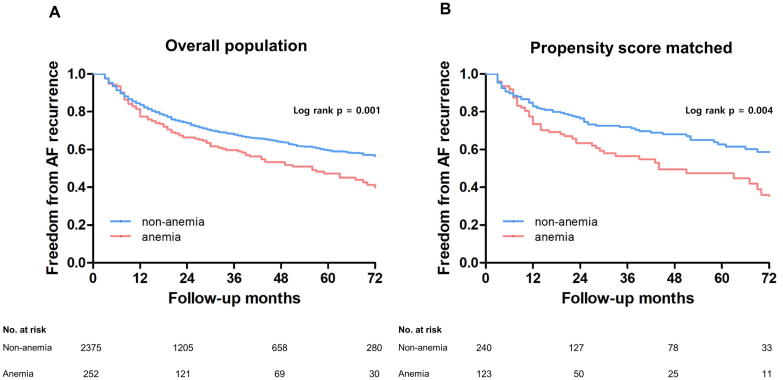
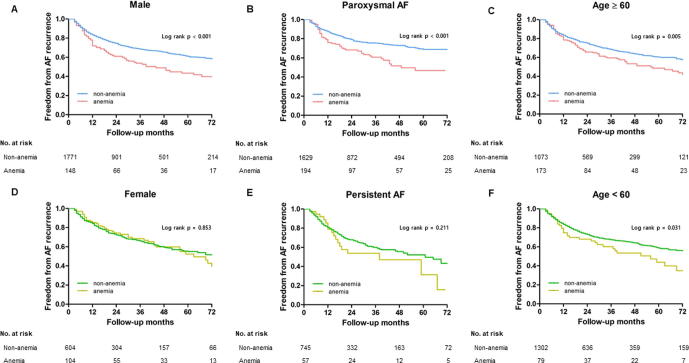
The body mass index, paroxysmal AF, warfarin use, and baseline red cell distribution width were independently associated with anemia in patients with AF. During a 23-month follow-up (interval OR 9-48 months), the clinical AF recurrence rate was significantly higher in patients with than without anemia (log-rank p = 0.001; propensity score-matched log-rank p = 0.004). This pattern was more significant in male patients (Log-rank p < 0.001) or patients with paroxysmal AF (Log-rank p < 0.001). Anemia (hazard ratio [HR] 1.45 [1.17-1.80], p = 0.001), left atrial diameter (HR 1.03 [1.01-1.04], p < 0.001), a female sex (HR 1.17 [1.00-1.36], p = 0.047), and persistent AF (HR 1.58 [1.36-1.84], p < 0.001) were independently associated with post-AFCA clinical recurrence. In the Mendelian randomization, we could not find a significant direct causal relationship between anemia and AF recurrence at the genetic level.
Pre-AFCA anemia is an independent predictor of post-AFCA clinical recurrence, especially in male patients, without a genetically direct causal relationship.
贫血是心血管疾病患者已知的不良预后因素。我们研究了血红蛋白水平与心房颤动(AF)导管消融(AFCA)后的节律转归是否相关。
我们纳入了2627例行AFCA并进行基于指南的节律随访的患者(年龄58±10.9岁,73%为男性,30.6%为持续性AF),并评估AFCA前贫血(男性血红蛋白<13 g/dL,女性血红蛋白<12 g/dL)与节律转归的相关性。在回顾已证实的12种与血红蛋白相关的基因多态性后,我们使用孟德尔随机化分析(1775名进行全基因组关联研究的受试者)研究贫血与AF复发之间的机制关系。
房颤患者的体重指数、阵发性AF、华法林使用和基线红细胞分布宽度与贫血独立相关。在23个月的随访期间(间隔OR为9 - 48个月),贫血患者的临床AF复发率显著高于无贫血患者(对数秩检验p = 0.001;倾向评分匹配对数秩检验p = 0.004)。这种模式在男性患者(对数秩检验p < 0.001)或阵发性AF患者(对数秩检验p < 0.001)中更为显著。贫血(风险比[HR] 1.45 [1.17 - 1.80],p = 0.001)、左心房直径(HR 1.03 [1.01 - 1.04],p < 0.001)、女性(HR 1.17 [1.00 - 1.36],p = 0.047)和持续性AF(HR 1.58 [1.36 - 1.84],p < 0.001)与AFCA后临床复发独立相关。在孟德尔随机化分析中,我们在基因水平上未发现贫血与AF复发之间存在显著的直接因果关系。
AFCA前贫血是AFCA后临床复发的独立预测因素,尤其是在男性患者中,且不存在基因层面的直接因果关系。