School of Geography, Earth and Environmental Sciences, University of Birmingham, Edgbaston, Birmingham B15 2TT, UK.
Department of Earth Sciences, University of Oxford, Oxford OX1 3AN, UK.
Proc Biol Sci. 2020 Apr 8;287(1924):20200372. doi: 10.1098/rspb.2020.0372.
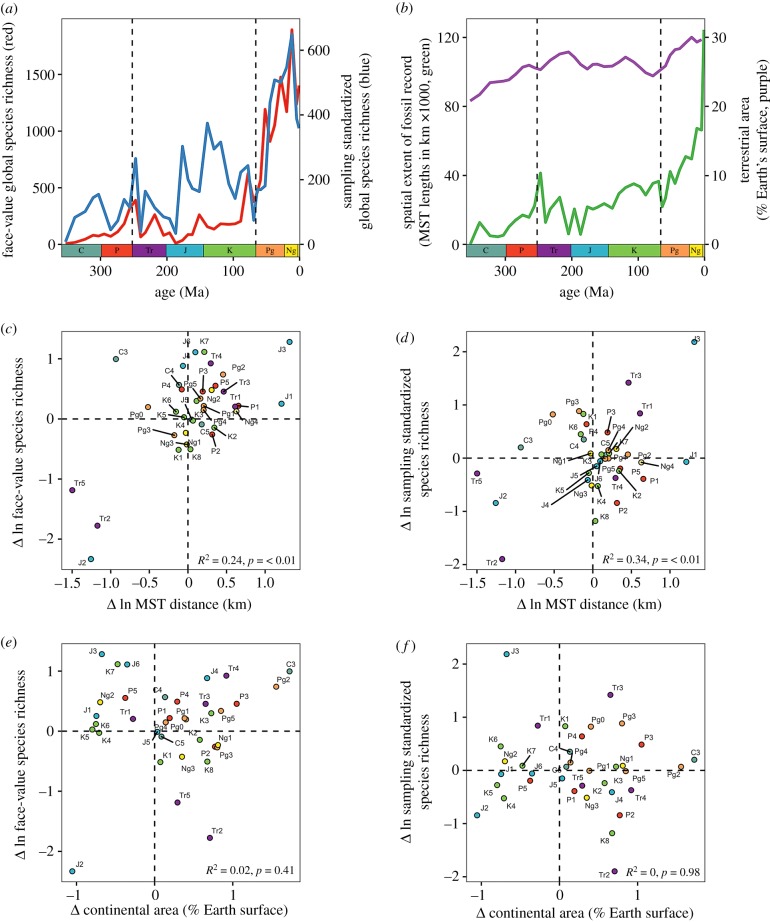
There is no consensus about how terrestrial biodiversity was assembled through deep time, and in particular whether it has risen exponentially over the Phanerozoic. Using a database of 60 859 fossil occurrences, we show that the spatial extent of the worldwide terrestrial tetrapod fossil record itself expands exponentially through the Phanerozoic. Changes in spatial sampling explain up to 67% of the change in known fossil species counts, and these changes are decoupled from variation in habitable land area that existed through time. Spatial sampling therefore represents a real and profound sampling bias that cannot be explained as redundancy. To address this bias, we estimate terrestrial tetrapod diversity for palaeogeographical regions of approximately equal size. We find that regional-scale diversity was constrained over timespans of tens to hundreds of millions of years, and similar patterns are recovered for major subgroups, such as dinosaurs, mammals and squamates. Although the Cretaceous/Palaeogene mass extinction catalysed an abrupt two- to three-fold increase in regional diversity 66 million years ago, no further increases occurred, and recent levels of regional diversity do not exceed those of the Palaeogene. These results parallel those recovered in analyses of local community-level richness. Taken together, our findings strongly contradict past studies that suggested unbounded diversity increases at local and regional scales over the last 100 million years.
关于陆地生物多样性是如何在长时间内形成的,特别是它是否在显生宙期间呈指数级增长,目前还没有共识。利用一个包含 60859 个化石出现的数据,我们表明,全球陆地四足动物化石记录本身的空间范围在显生宙期间呈指数级扩展。空间采样的变化解释了已知化石物种数量变化的高达 67%,这些变化与随着时间而存在的可居住土地面积的变化无关。因此,空间采样代表了一种真实而深刻的采样偏差,不能简单地解释为冗余。为了解决这个偏差,我们估计了大约具有相同大小的古地理区域的陆地四足动物多样性。我们发现,区域尺度的多样性在数千万年到数亿年的时间跨度内受到限制,类似的模式也在主要亚群(如恐龙、哺乳动物和蜥蜴)中得到恢复。尽管白垩纪/古近纪大灭绝导致了 6600 万年前区域多样性的突然增加了两到三倍,但此后没有进一步增加,而最近的区域多样性水平并未超过古近纪的水平。这些结果与局部社区水平丰富度分析中得到的结果相吻合。总之,我们的发现强烈反驳了过去的研究,这些研究表明在过去的 1 亿年里,局部和区域尺度的多样性呈无限制的增长。