Marín-Sanz Miriam, Giménez María J, Barro Francisco, Savin Roxana
Department of Plant Breeding, Institute for Sustainable Agriculture (IAS-CSIC), Córdoba, Spain.
Department of Crop and Forest Sciences, University of Lleida, Lleida, Spain.
Front Plant Sci. 2020 Mar 20;11:314. doi: 10.3389/fpls.2020.00314. eCollection 2020.
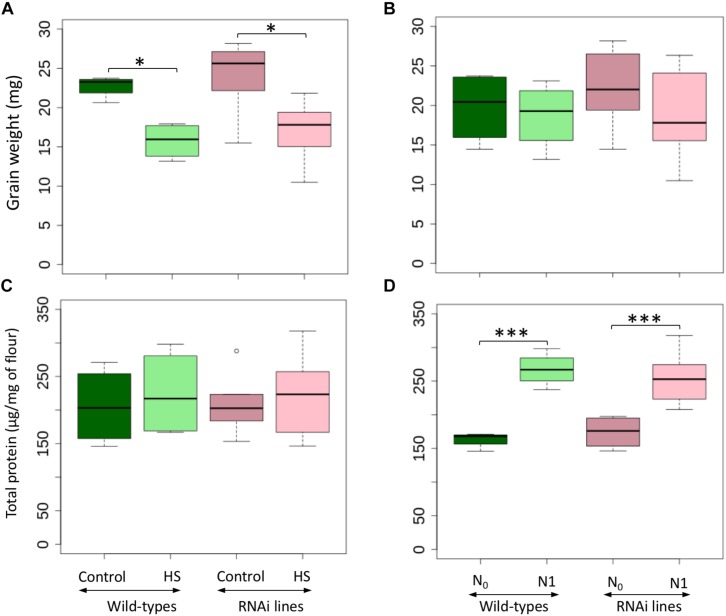
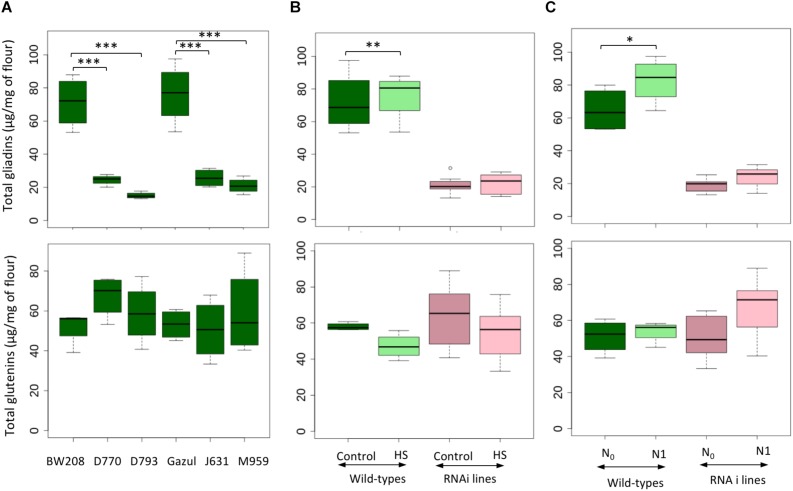
Temperature and nitrogen (N) availability are two important environmental factors that may produce important changes in grain composition during grain filling of bread wheat. In this study, four wheat lines with the down-regulation of gliadins by means of RNA interference (RNAi) have been characterized to determine the effect of thermal stress and N availability on grain weight and quality; with focus on gliadin and glutenin protein fractions. Grain weight was reduced with heat stress (HS) in all RNAi lines, whereas gliadin content was increased in the wild-types. With respect to gliadin content, RNAi lines responded to HS and N availability differently from their respective wild-types, except for ω-gliadin content, indicating a very clear stability of silencing under different environmental conditions. In a context of increased temperature and HS events, and in environments with different N availability, the RNAi lines with down-regulated gliadins seem well suited for the production of wheat grain with low gliadin content.
温度和氮素有效性是两个重要的环境因素,它们可能在面包小麦灌浆期使籽粒组成产生重要变化。在本研究中,对通过RNA干扰(RNAi)下调醇溶蛋白的四个小麦品系进行了特性分析,以确定热胁迫和氮素有效性对粒重和品质的影响;重点关注醇溶蛋白和谷蛋白组分。所有RNAi品系的粒重均因热胁迫(HS)而降低,而野生型中的醇溶蛋白含量增加。就醇溶蛋白含量而言,除ω-醇溶蛋白含量外,RNAi品系对热胁迫和氮素有效性的反应与其各自的野生型不同,这表明在不同环境条件下沉默具有非常明显的稳定性。在温度升高和热胁迫事件增加的背景下,以及在氮素有效性不同的环境中,醇溶蛋白下调的RNAi品系似乎非常适合用于生产低醇溶蛋白含量的小麦籽粒。