Economopoulos Kostas J, Kweon Christopher Y, Gee Albert O, Morris Suzanne T, Hassebrock Jeffrey D, Chhabra Anikar
Orthopaedic Clinic Association, Phoenix, Arizona, U.S.A.
Department of Orthopaedics and Sports Medicine, University of Washington, Seattle, Washington, U.S.A.
Arthrosc Sports Med Rehabil. 2019 Nov 13;1(1):e67-e74. doi: 10.1016/j.asmr.2019.07.006. eCollection 2019 Nov.
To define a distraction distance (pull length) cut-off that would differentiate those patients with hip microinstability and those without the disorder, called the Pull-Out Test.
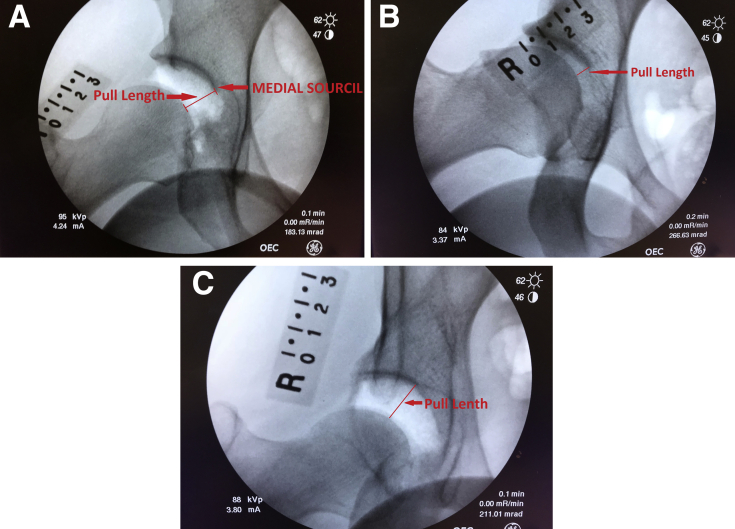
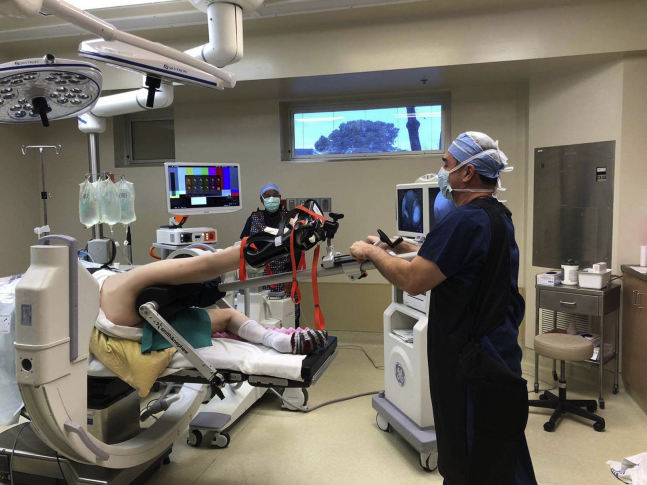
In total, 100 consecutive patients undergoing hip arthroscopy were included in the study. Patients were separated into a hip microinstability group (HMI) and non-hip microinstability group (NHI) based on the results of Beighton's score, the abduction-extension-external rotation test, hip extension-external rotation examination, and the prone instability test. Inclusion criteria were patients with an magnetic resonance imaging-proven labral tear who did not respond to conservative treatment and underwent hip arthroscopy. Exclusion criteria included those patients undergoing revision hip arthroscopy, had a previous surgery on the ipsilateral hip, or had severe arthritis in the hip. The Pull-Out Test was performed before surgery with the hip in 30° of abduction and the foot in 30° of external rotation. A blinded examiner places gross axial traction on the leg until a firm end point is reached. The distraction distance between the femoral head and acetabulum is the pull length.
In total, 32 patients made up the HMI group whereas 68 patients were in the NHI group. The average pull length for the NHI group was 0.9 ± 0.1 cm and 1.7 ± 0.4 cm for the HMI group ( < .001). Subtracting the standard deviation from the HMI group average, when defined a cut off for hip microinstability as 1.3 cm. Using this value, we found the Pull-Out Test to have a sensitivity of 0.91 and specificity of 0.96. The positive predictive value for the Pull Test was 0.91 and the negative predictive value 0.97.
The Pull-Out Test is a useful test in identifying and confirming the presence of hip microinstability in patients undergoing hip arthroscopy. A pull-length of 1.3 cm or greater is consistent with the presence of microinstability with a specificity of 94% and a sensitivity of 96%.
Level IV, diagnostic, case-control study.
确定一种牵引距离(牵拉长度)的临界值,以区分髋关节微不稳定患者和无该病症的患者,此即拔出试验。
本研究共纳入100例连续接受髋关节镜检查的患者。根据贝ighton评分、外展-伸展-外旋试验、髋关节伸展-外旋检查及俯卧位不稳定试验结果,将患者分为髋关节微不稳定组(HMI)和非髋关节微不稳定组(NHI)。纳入标准为经磁共振成像证实存在盂唇撕裂且对保守治疗无反应并接受髋关节镜检查的患者。排除标准包括接受髋关节翻修镜检查的患者、同侧髋关节曾接受手术的患者或髋关节患有严重关节炎的患者。术前在髋关节外展30°且足部外旋30°的情况下进行拔出试验。一位不知情的检查者对腿部施加轴向总牵引力,直至达到一个坚实的终点。股骨头与髋臼之间的牵引距离即为牵拉长度。
HMI组共有32例患者,NHI组有68例患者。NHI组的平均牵拉长度为0.9±0.1厘米,HMI组为1.7±0.4厘米(P<0.001)。从HMI组平均值中减去标准差,将髋关节微不稳定的临界值定义为1.3厘米。使用该值时,我们发现拔出试验的敏感性为0.91,特异性为0.96。牵拉试验的阳性预测值为0.91,阴性预测值为0.97。
拔出试验对于识别和确认接受髋关节镜检查患者中髋关节微不稳定的存在是一项有用的试验。牵拉长度为1.3厘米或更长与微不稳定的存在相符,特异性为94%,敏感性为96%。
IV级,诊断性病例对照研究。