Flies Anne, Denecke Timm, Kraus Natascha, Kruppa Philipp, Provencher Matthew T, Becker Roland, Kopf Sebastian
Center for Musculoskeletal Surgery, Charité - University Medicine Berlin, Berlin, Germany.
Department of Radiology, Charité - University Medicine Berlin, Berlin, Germany.
J Exp Orthop. 2020 Apr 7;7(1):19. doi: 10.1186/s40634-020-00236-8.
The gracilis tendon (GT) is a commonly used autologous graft in Orthopaedic surgery. The majority of information on knee function and outcomes after hamstring harvest is related to both semitendinosus and GT harvest. Little is known regarding isolated harvest of a GT. It was hypothesized that isolated GT harvest would lead to altered gait patterns (e.g. augmented anterior-posterior translation or rotation in the tibiofemoral joint) and consequently a higher prevalence of cartilage lesions and meniscal tears in knees.
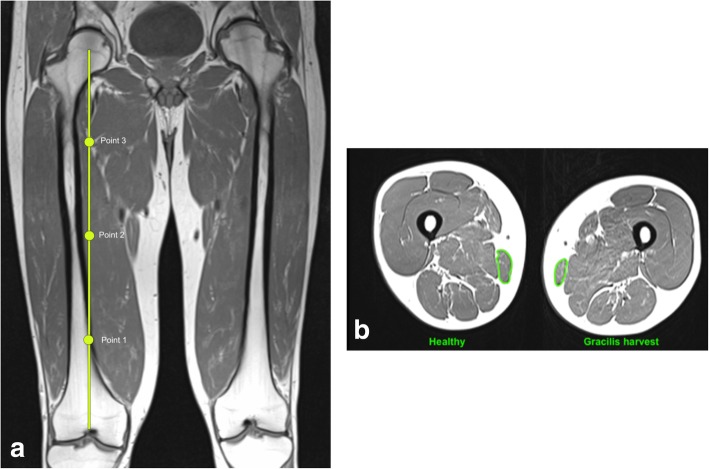
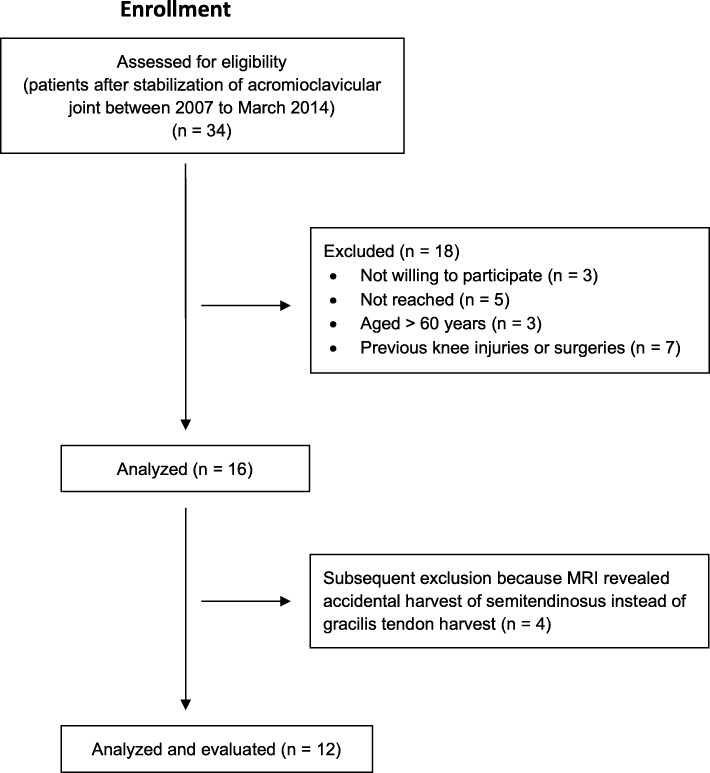
GT harvesting was performed on patients with chronic acromioclavicular joint instability without previous knee injuries or surgeries. MRI of both knees and thighs were performed. Knee MRI were evaluated using the Whole-Organ Magnetic Resonance Imaging Score (WORMS). Inter- and intraobserver reliabilities, cross-sectional areas of different muscles, fatty infiltration of the gracilis muscle (GM) and GT regeneration were evaluated. The contralateral limb served as reference. The observers were blinded towards the identity of the patients and the operatively treated side.
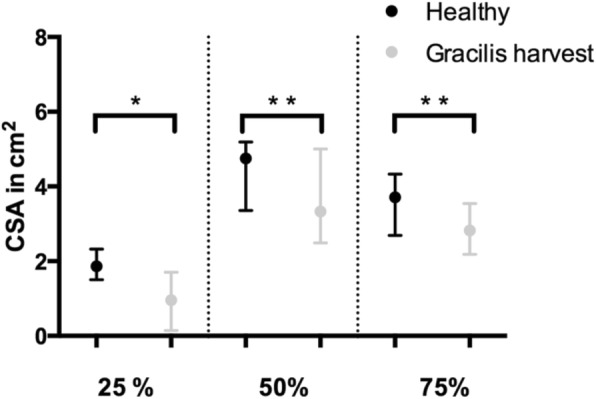
After a mean time of 44 months after surgery testing was performed on 12 patients. No significant side-to-side differences were found using WORMS, although there was a trend towards increased cartilage lesions after GT harvest (median healthy knee 4.8 and GT harvested knee 7.8 p = 0.086). Inter- and intraobserver repeatability was high with 0.899 (95% confidence interval (CI) 0.708-0.960) and 0.988 (95% CI 0.973-0.995), respectively. A significant hypotrophy of the GM with a mean decrease of 25.3%, 18.4% and 16.9% occurred at 25% (p = 0.016), 50% (p = 0.007) and 75% (p = 0.002) of the length of the femur from distal. No compensatory hypertrophy of other thigh muscles or increased fatty infiltration of the GM was found. Tendon regeneration took place in eight out of 12 patients. In case of regeneration, the regenerated tendon inserted in a more proximal place.
Isolated harvest of the GT for shoulder procedures did not affect knee MRI significantly indicating therefore in general suitable graft utilization for surgeries outside of the knee. GT regenerated in most patients with just a more proximal insertion and a hypotrophy of the muscle belly.
股薄肌腱(GT)是骨科手术中常用的自体移植物。关于腘绳肌取材后膝关节功能和结果的大多数信息都与半腱肌和GT取材有关。关于单独取材GT的情况知之甚少。据推测,单独取材GT会导致步态模式改变(例如胫股关节前后平移或旋转增加),从而导致膝关节软骨损伤和半月板撕裂的患病率更高。
对既往无膝关节损伤或手术史的慢性肩锁关节不稳患者进行GT取材。对双膝关节和大腿进行MRI检查。使用全器官磁共振成像评分(WORMS)对膝关节MRI进行评估。评估观察者间和观察者内的可靠性、不同肌肉的横截面积、股薄肌(GM)的脂肪浸润和GT再生情况。对侧肢体作为对照。观察者对患者身份和手术治疗侧不知情。
术后平均44个月对12例患者进行了测试。使用WORMS未发现明显的双侧差异,尽管GT取材后软骨损伤有增加的趋势(健康膝关节中位数为4.8,GT取材膝关节中位数为7.8,p = 0.086)。观察者间和观察者内的重复性较高,分别为0.899(95%置信区间(CI)0.708 - 0.960)和0.988(95%CI 0.973 - 0.995)。GM出现明显萎缩,在股骨远端长度的25%(p = 0.016)、50%(p = 0.007)和75%(p = 0.002)处平均分别下降25.3%、18.4%和16.9%。未发现其他大腿肌肉的代偿性肥大或GM脂肪浸润增加。12例患者中有8例发生肌腱再生。再生的情况下,再生肌腱插入位置更靠近近端。
为肩部手术单独取材GT对膝关节MRI无明显影响,因此总体上表明该移植物适用于膝关节以外的手术。大多数患者的GT再生,只是插入位置更靠近近端且肌腹萎缩。