Institute of Applied Health Research, University of Birmingham, Birmingham, UK
Institute of Applied Health Research, University of Birmingham, Birmingham, UK.
Heart. 2020 Jun;106(11):810-816. doi: 10.1136/heartjnl-2019-316091. Epub 2020 Apr 9.
The objective of this study is to use latent class analysis of up to 20 comorbidities in patients with a diagnosis of ischaemic heart disease (IHD) to identify clusters of comorbidities and to examine the associations between these clusters and mortality.
Longitudinal analysis of electronic health records in the health improvement network (THIN), a UK primary care database including 92 186 men and women aged ≥18 years with IHD and a median of 2 (IQR 1-3) comorbidities.
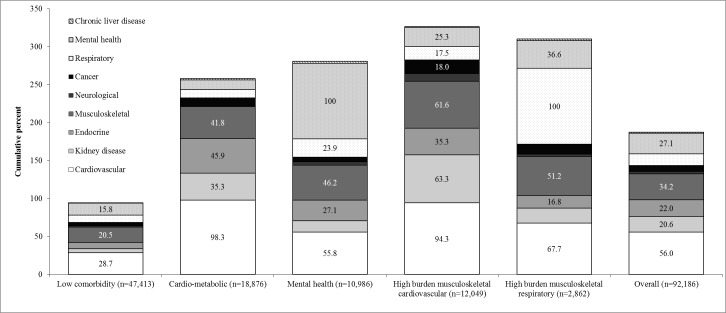
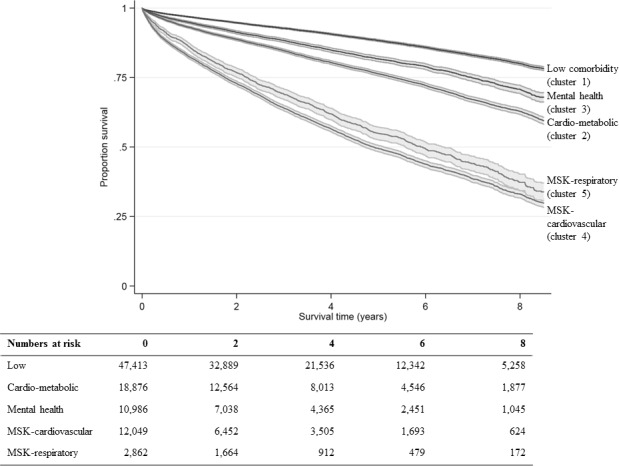
Latent class analysis revealed five clusters with half categorised as a low-burden comorbidity group. After a median follow-up of 3.2 (IQR 1.4-5.8) years, 17 645 patients died. Compared with the low-burden comorbidity group, two groups of patients with a high-burden of comorbidities had the highest adjusted HR for mortality: those with vascular and musculoskeletal conditions, HR 2.38 (95% CI 2.28 to 2.49) and those with respiratory and musculoskeletal conditions, HR 2.62 (95% CI 2.45 to 2.79). Hazards of mortality in two other groups of patients characterised by cardiometabolic and mental health comorbidities were also higher than the low-burden comorbidity group; HR 1.46 (95% CI 1.39 to 1.52) and 1.55 (95% CI 1.46 to 1.64), respectively.
This analysis has identified five distinct comorbidity clusters in patients with IHD that were differentially associated with risk of mortality. These analyses should be replicated in other large datasets, and this may help shape the development of future interventions or health services that take into account the impact of these comorbidity clusters.
本研究旨在通过对缺血性心脏病(IHD)患者的多达 20 种合并症进行潜在类别分析,确定合并症聚类,并探讨这些聚类与死亡率之间的关系。
对英国初级保健数据库健康改善网络(THIN)中的电子健康记录进行纵向分析,该数据库纳入了 92186 名年龄≥18 岁、患有 IHD 且中位数合并症为 2(IQR 1-3)的男性和女性。
潜在类别分析显示有五个聚类,其中一半被归类为低负担合并症组。在中位数为 3.2(IQR 1.4-5.8)年的随访后,有 17645 名患者死亡。与低负担合并症组相比,两个高负担合并症组的患者死亡率调整后的 HR 最高:患有血管和肌肉骨骼疾病的患者 HR 为 2.38(95%CI 2.28-2.49),患有呼吸和肌肉骨骼疾病的患者 HR 为 2.62(95%CI 2.45-2.79)。具有心血管代谢和心理健康合并症的另外两组患者的死亡风险也高于低负担合并症组:HR 分别为 1.46(95%CI 1.39-1.52)和 1.55(95%CI 1.46-1.64)。
本分析确定了 IHD 患者的五个不同的合并症聚类,这些聚类与死亡率风险的相关性不同。这些分析应在其他大型数据集上进行复制,这可能有助于为未来的干预措施或医疗服务的发展提供参考,以考虑这些合并症聚类的影响。