Key Laboratory of Tropical Marine Bio-resources and Ecology, Guangdong Provincial Key Laboratory of Applied Marine Biology, Chinese Academy of Science, South China Sea Institute of Oceanology, Guangzhou, China.
University of Chinese Academy of Sciences, Beijing, China.
PLoS One. 2020 Apr 10;15(4):e0231399. doi: 10.1371/journal.pone.0231399. eCollection 2020.
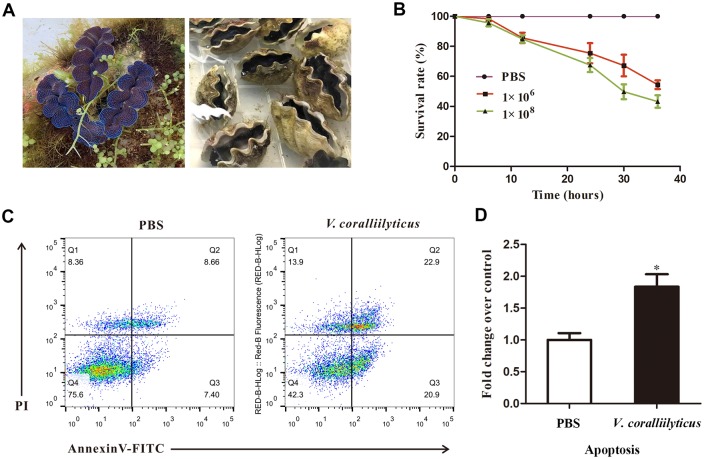
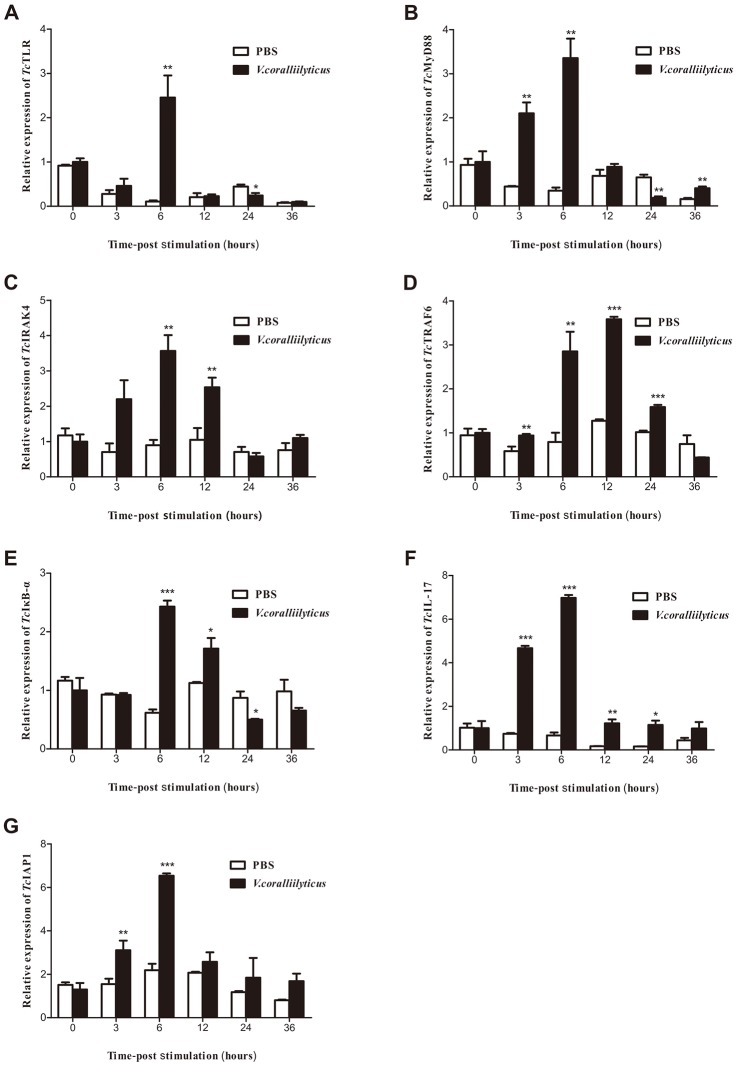
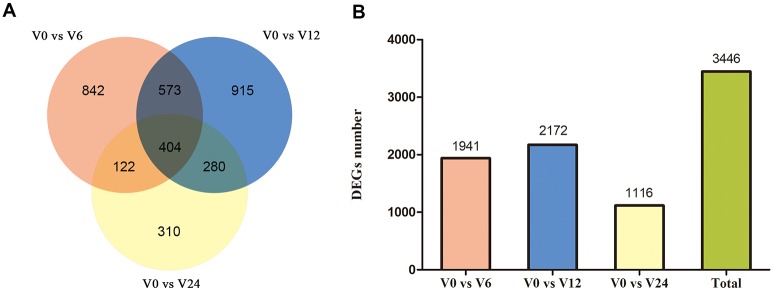
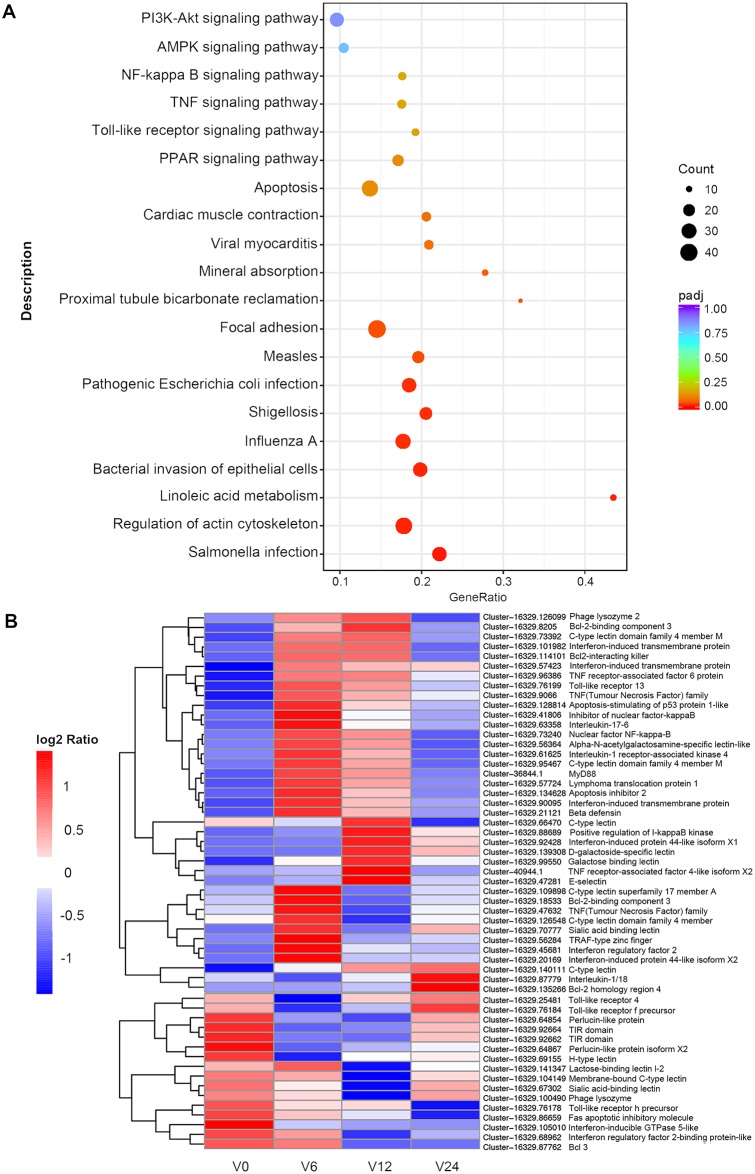
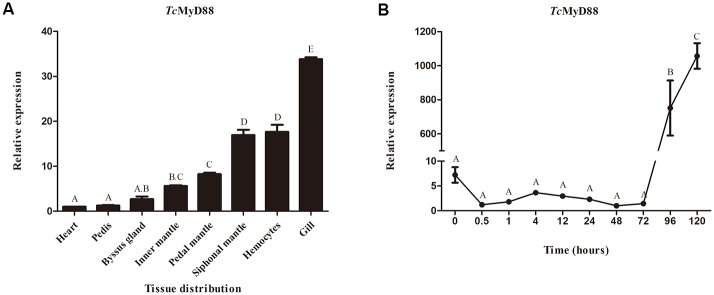
Vibrio coralliilyticus is a pathogen of coral and mollusk, contributing to dramatic losses worldwide. In our study, we found that V. coralliilyticus challenge could directly affect adult Tridacna crocea survival; there were dead individuals appearing at 6 h post infection, and there were 45.56% and 56.78% mortality rates in challenged groups after 36 h of infection. The apoptosis rate of hemocytes was significantly increased by 1.8-fold at 6 h after V. coralliilyticus injection. To shed light on the mechanistic molecular responses of T. crocea to V. coralliilyticus infection, we used transcriptome sequencing analysis and other relevant techniques to analyze T. crocea hemocytes at 0 h, 6 h, 12 h and 24 h after V. coralliilyticus challenge. Our results revealed that the total numbers of unigenes and DEGs were 195651 and 3446, respectively. Additional details were found by KEGG pathway enrichment analysis, where DEGs were significantly enriched in immune-related signaling pathways, such as the TLR signaling pathway, and some were associated with signaling related to apoptosis. Quantitative validation results illustrated that with exposure to V. coralliilyticus, the expression of TLR pathway members, TLR, MyD88, IRAK4, TRAF6, and IкB-α, were significantly upregulated (by 22.9-, 9.6-, 4.0-, 3.6-, and 3.9-fold, respectively) at 6 h. The cytokine-related gene IL-17 exhibited an increase of 6.3-fold and 10.5-fold at 3 h and 6 h, respectively. The apoptosis-related gene IAP1 was dramatically increased by 2.99-fold at 6 h. These results indicate that adult T. crocea could initiate the TLR pathway to resist V. coralliilyticus, which promotes the release of inflammatory factors such as IL-17 and leads to the activation of a series of outcomes, such as apoptosis. The response mechanism is related to the T. crocea immunoreaction stimulated by V. coralliilyticus, providing a theoretical basis for understanding T. crocea immune response mechanisms.
珊瑚弧菌是珊瑚和软体动物的病原体,导致全球范围内的大量损失。在我们的研究中,我们发现珊瑚弧菌的挑战可以直接影响成年砗磲的存活;感染后 6 小时出现死亡个体,感染 36 小时后实验组死亡率分别为 45.56%和 56.78%。感染后 6 小时,血细胞的凋亡率显著增加了 1.8 倍。为了揭示砗磲对珊瑚弧菌感染的分子机制反应,我们使用转录组测序分析和其他相关技术,分析了珊瑚弧菌感染后 0 小时、6 小时、12 小时和 24 小时的砗磲血细胞。我们的结果表明,总 unigenes 和 DEGs 的数量分别为 195651 和 3446。KEGG 途径富集分析发现了更多细节,DEGs 在免疫相关信号通路中显著富集,如 TLR 信号通路,其中一些与凋亡相关的信号有关。定量验证结果表明,暴露于珊瑚弧菌后,TLR 通路成员 TLR、MyD88、IRAK4、TRAF6 和 IкB-α的表达在 6 小时时显著上调(分别上调 22.9 倍、9.6 倍、4.0 倍、3.6 倍和 3.9 倍)。细胞因子相关基因 IL-17 在 3 小时和 6 小时时分别增加了 6.3 倍和 10.5 倍。凋亡相关基因 IAP1 在 6 小时时急剧增加了 2.99 倍。这些结果表明,成年砗磲可以启动 TLR 途径抵抗珊瑚弧菌,促进 IL-17 等炎症因子的释放,并导致一系列后果,如凋亡。该反应机制与珊瑚弧菌刺激砗磲产生的免疫反应有关,为理解砗磲免疫反应机制提供了理论依据。