Department of Hematology and Oncology, Ulsan University Hospital, University of Ulsan College of Medicine, Ulsan, Korea.
Department of Hematology, Asan Medical Center, University of Ulsan College of Medicine, Seoul, Korea.
Korean J Intern Med. 2021 Jan;36(1):194-204. doi: 10.3904/kjim.2019.210. Epub 2020 Apr 14.
BACKGROUND/AIMS: Compared with Western countries, chronic lymphocytic leukemia (CLL) rarely occurs in Asia and has different clinical characteristics. Thus, we aimed to evaluate the clinical characteristics, treatment outcomes, and prognostic significance of Korean patients with CLL.
We retrospectively analyzed 90 patients with CLL who had received chemotherapy at 6 centers in Korea between 2000 and 2012.
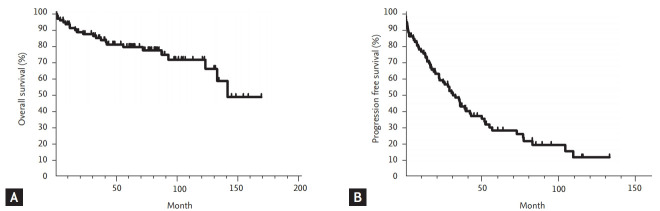
Compared with Western patients with CLL, Korean patients with CLL express lambda (42.0%) and atypical markers such as CD22 and FMC7 (76.7% and 40.0%, respectively) more frequently. First-line chemotherapy regimens included chlorambucil (n = 43), fludarabine and cyclophosphamide (FC) (n = 20), fludarabine (n = 13), rituximab-FC (n = 4). The remaining patients were treated with other various regimens (n = 10). The 5-year overall survival (OS) and progression-free survival (PFS) rates were 79.3% and 28.1%, respectively. Multivariate analyses showed that hyperleukocytosis (≥ 100 × 103/μL), extranodal involvement, and the Binet C stage were significant negative prognostic factors for OS (hazard ratio [HR] 4.75, p = 0.039; HR 21.6, p = 0.002; and HR 4.35, p = 0.034, respectively). Cytogenetic abnormalities including complex karyotypes (≥ 3), del(11q), and del(17) had a significantly adverse impact on both OS and PFS (p < 0.001 and p = 0.010, respectively).
Initial hyperleukocytosis, extranodal involvement, complex karyotype, del(17) and del(11q) need to be considered in the risk stratification system for CLL.
背景/目的:与西方国家相比,慢性淋巴细胞白血病(CLL)在亚洲很少见,且具有不同的临床特征。因此,我们旨在评估韩国 CLL 患者的临床特征、治疗结果和预后意义。
我们回顾性分析了 2000 年至 2012 年间,韩国 6 家中心接受化疗的 90 例 CLL 患者。
与西方 CLL 患者相比,韩国 CLL 患者更常表达 lambda(42.0%)和非典型标志物,如 CD22 和 FMC7(分别为 76.7%和 40.0%)。一线化疗方案包括苯丁酸氮芥(n = 43)、氟达拉滨和环磷酰胺(FC)(n = 20)、氟达拉滨(n = 13)、利妥昔单抗-FC(n = 4)。其余患者接受了其他各种方案治疗(n = 10)。5 年总生存率(OS)和无进展生存率(PFS)分别为 79.3%和 28.1%。多因素分析显示,白细胞增多(≥100×103/μL)、结外侵犯和 Binet C 期是 OS 的显著负预后因素(危险比[HR] 4.75,p = 0.039;HR 21.6,p = 0.002;HR 4.35,p = 0.034)。包括复杂核型(≥3)、del(11q)和 del(17)在内的细胞遗传学异常对 OS 和 PFS 均有显著不良影响(p<0.001 和 p = 0.010)。
初始白细胞增多、结外侵犯、复杂核型、del(17)和 del(11q)需要纳入 CLL 的风险分层系统。