Hazell Sarah Z, Hu Chen, Alcorn Sara R, Asiedu Kingsley O, Pulido Gillian, Frassica Deborah A, Meyer Christian, Levin Adam S, Morris Carol D, Terezakis Stephanie A
Department of Radiation Oncology and Molecular Radiation Sciences, Johns Hopkins University School of Medicine, Baltimore, Maryland.
Johns Hopkins University School of Medicine, Baltimore, Maryland.
Adv Radiat Oncol. 2019 Oct 7;5(2):231-237. doi: 10.1016/j.adro.2019.08.015. eCollection 2020 Mar-Apr.
Patients with large, high-grade soft tissue sarcomas are commonly treated with aggressive limb preservation regimens. This study aimed to assess cancer control outcomes of patients treated with neoadjuvant chemoradiation (CRT) compared with radiation therapy (RT) alone.
We reviewed records of patients with high-grade extremity or trunk soft tissue sarcomas ≥5 cm who were treated with neoadjuvant radiation with or without chemotherapy. Patient and disease characteristics were compared using test and χ tests. Standardized mortality ratio weighted method was used to compare overall survival (OS), local control, and disease-free (DFS) survival. Acute radiation and surgical toxicity were reported.
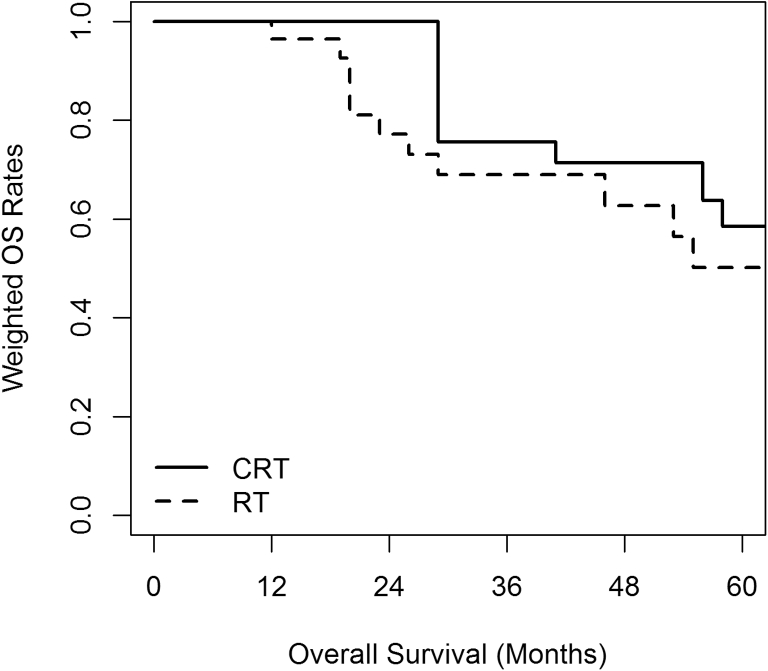
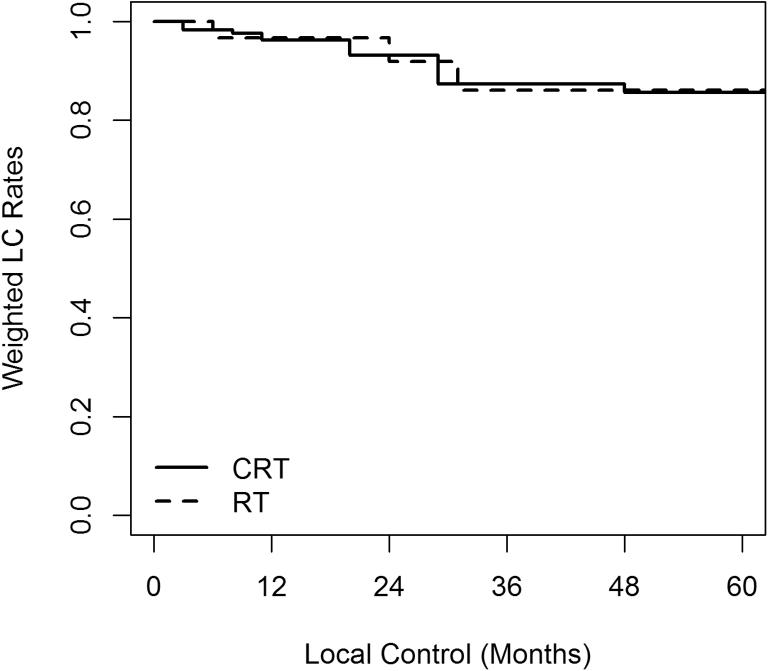
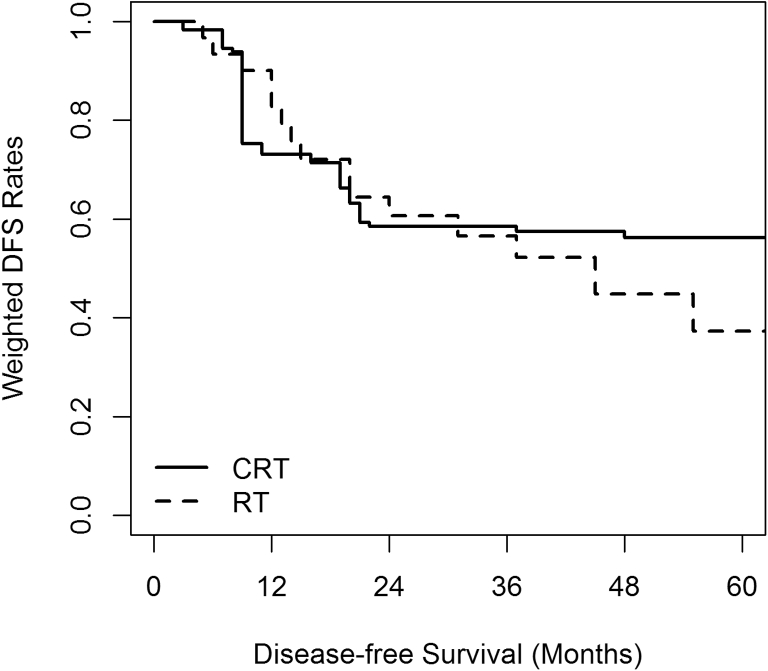
In the study, 64 patients (34 CRT and 30 RT) treated between 1997 and 2015 were analyzed. In the RT group compared with the CRT group, the patient population was older, with a median age of 65 versus 50 years ( < .001), and more likely to have cardiovascular disease (CVD; 30% vs 0%, < .001). At a median follow-up of 41 months, after adjusting for propensity score of receiving RT, the 3-year LC was 87.3% versus 86.1%, DFS was 58.5% versus 56.6%, and OS was 75.6% versus 69.0% for the CRT and RT groups, respectively ( > .05). Acute dermatitis occurred in 18% versus 3% and surgical complications occurred in 32% versus 17% of CRT and RT patients, respectively.
In this study, patients receiving RT alone were more likely to be older and have comorbid cardiovascular disease. When controlling for baseline differences, neoadjuvant CRT and RT provided similar rates of LC, DFS, and OS.
患有大型高级别软组织肉瘤的患者通常采用积极的保肢治疗方案。本研究旨在评估接受新辅助放化疗(CRT)与单纯放疗(RT)的患者的癌症控制效果。
我们回顾了接受新辅助放疗(无论是否联合化疗)的≥5 cm高级别四肢或躯干软组织肉瘤患者的记录。使用t检验和χ²检验比较患者和疾病特征。采用标准化死亡率比加权法比较总生存期(OS)、局部控制率和无病生存期(DFS)。报告了急性放疗和手术毒性。
本研究分析了1997年至2015年间治疗的64例患者(34例CRT和30例RT)。与CRT组相比,RT组患者年龄更大,中位年龄为65岁对50岁(P<0.001),且更有可能患有心血管疾病(CVD;30%对0%,P<0.001)。中位随访41个月,在调整接受RT的倾向评分后,CRT组和RT组的3年局部控制率分别为87.3%对86.1%,DFS分别为58.5%对56.6%,OS分别为75.6%对69.0%(P>0.05)。CRT组和RT组急性皮炎的发生率分别为18%和3%,手术并发症的发生率分别为32%和17%。
在本研究中,单纯接受RT的患者年龄更大且合并心血管疾病。在控制基线差异时,新辅助CRT和RT的局部控制率、DFS和OS相似。