Speech and Language Pathology Unit, Institute of Neuroscience and Physiology, University of Gothenburg, Box 452, 405 30, Gothenburg, Sweden.
Gillberg Neuropsychiatry Centre, Institute of Neuroscience and Physiology, University of Gothenburg, Gothenburg, Sweden.
J Psycholinguist Res. 2020 Jun;49(3):475-489. doi: 10.1007/s10936-020-09703-w.
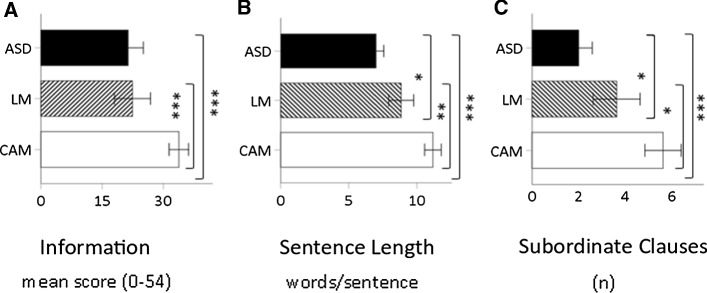
Recent research has suggested that temporal sequencing of narrative events might be a domain-general ability that underlies oral narrative capacities. The current study investigated this issue in a group of children with known pragmatic and narrative difficulties, namely Autism Spectrum Disorder (ASD). We hypothesized (1) that children with ASD (n = 45) would retell narratives of poorer quality than both chronological age-matched (CAM) children and younger children matched on sentence-level language skills (LM), and (2) that nonverbal temporal sequencing skills would uniquely predict individual differences in oral narrative performance in children with ASD. The results show that children with ASD performed poorer on all measures of oral narrative quality compared with the CAM group, and on eight of ten measures compared with the LM group. Thus, our first hypothesis was confirmed, suggesting that narrative difficulties in ASD cannot be fully explained by impaired language. The second hypothesis was only partly confirmed: nonverbal temporal sequencing explained significant or marginally significant variance in some, but not all, aspects of oral narrative performance of children with ASD. These results are discussed from theoretical and clinical/educational perspectives, in relation to the heterogeneity of language skills in ASD and to domain-general features of narrative processing.
最近的研究表明,叙事事件的时间顺序可能是一种普遍存在的能力,它是口语叙事能力的基础。本研究在一群有明确语用和叙事困难的儿童中调查了这个问题,即自闭症谱系障碍(ASD)。我们假设:(1)与年龄匹配的对照组(CAM)相比,ASD 儿童(n=45)在叙述故事时质量较差,与语言技能匹配的年轻儿童(LM)相比,质量也较差;(2)非言语时间排序技能将独特地预测 ASD 儿童口语叙事表现的个体差异。结果表明,与 CAM 组相比,ASD 儿童在所有口头叙事质量测量上的表现都较差,与 LM 组相比,有八项测量的表现也较差。因此,我们的第一个假设得到了证实,这表明 ASD 中的叙事困难不能完全用语言障碍来解释。第二个假设只得到了部分证实:非言语时间排序解释了 ASD 儿童口语叙事表现的某些方面(但不是所有方面)的显著或边缘显著差异。这些结果从理论和临床/教育的角度进行了讨论,涉及到 ASD 中语言技能的异质性和叙事处理的普遍特征。