Pruitt Jonathan N, Keiser Carl N
Department of Biological Sciences, University of Pittsburgh, Pittsburgh, PA, U.S.A.
Anim Behav. 2014 Jul;93:87-95. doi: 10.1016/j.anbehav.2014.04.017. Epub 2014 May 28.
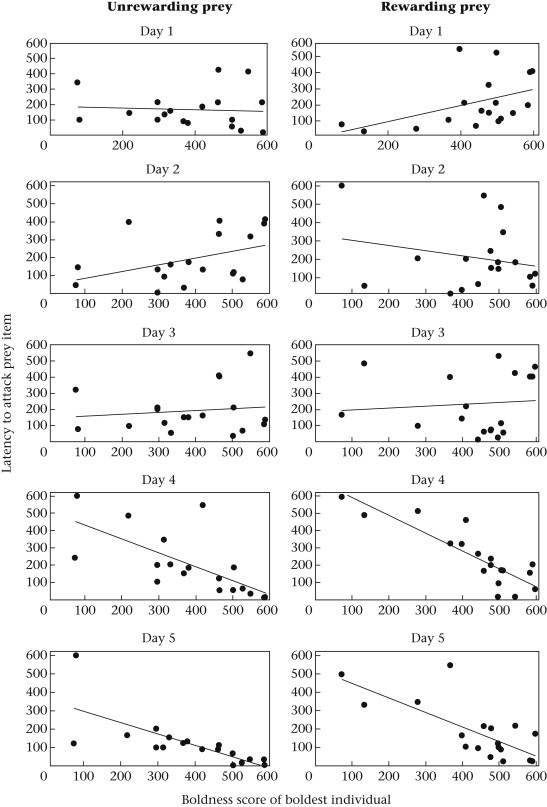
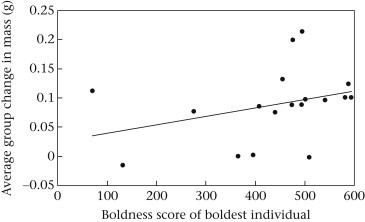
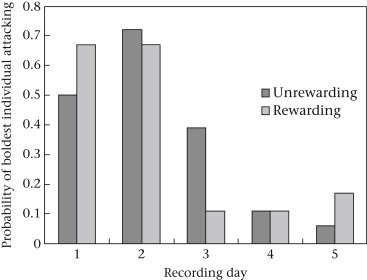
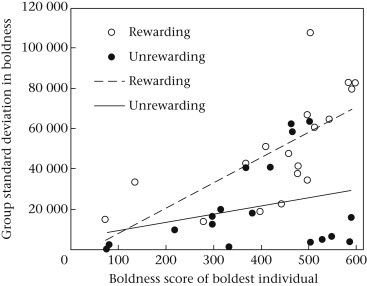
Behavioural ecologists often note that one or a few group members appear to shape the collective behaviour of social groups differentially. Our understanding of these keystone individuals is largely taken from meticulous field observations and semi-scientific anecdotes. In this study we experimentally test whether the behavioural tendencies of putative keystone individuals shift the collective behaviour of colonies using the social spider . Prior studies on demonstrated that the single best predictor of colonies' collective behaviour is the behaviour of colonies' boldest individual. Here, we probe the causal relationship between the traits of extremely bold individuals and colonies' collective behaviour by experimentally creating colonies of identical size and personality composition in the laboratory and then adding a single individual of varying boldness (the putative keystone individual). Experimentally adding just one extremely bold individual increased the foraging aggressiveness of entire colonies and altered the total mass gained by fellow group members, relative to the addition of a less bold individual. Additionally, our data suggest that bold individuals are capable of such influence because they catalyse variation in the behavioural tendencies of fellow group members.
行为生态学家常常指出,一个或几个群体成员似乎会以不同方式塑造社会群体的集体行为。我们对这些关键个体的理解很大程度上来自细致的实地观察和半科学的轶事。在本研究中,我们通过社会蜘蛛实验测试假定关键个体的行为倾向是否会改变群体的集体行为。先前关于 的研究表明,群体集体行为的最佳单一预测指标是群体中最胆大个体的行为。在此,我们通过在实验室中创建大小和个性组成相同的群体,然后添加一个胆量各异的个体(假定关键个体),来探究极其胆大个体的特质与群体集体行为之间的因果关系。相对于添加一个胆量较小的个体,实验性地仅添加一个极其胆大的个体就会增加整个群体的觅食攻击性,并改变其他群体成员获得的总质量。此外,我们的数据表明,胆大的个体能够产生这种影响是因为它们催化了其他群体成员行为倾向的变化。