Chen Chun, Liu Wei, Lin Chao-Hsin, Chen Qingyan
School of Mechanical Engineering, Purdue University, West Lafayette, IN, 47907, USA.
Tianjin Key Laboratory of Indoor Air Environmental Quality Control, School of Environmental Science and Engineering, Tianjin University, Tianjin, 300072, China.
Build Environ. 2015 Aug;90:30-36. doi: 10.1016/j.buildenv.2015.03.024. Epub 2015 Mar 28.
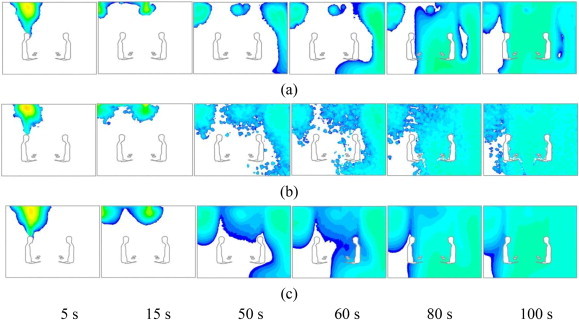
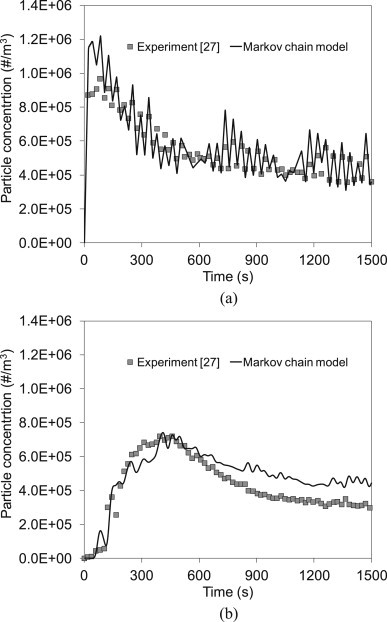
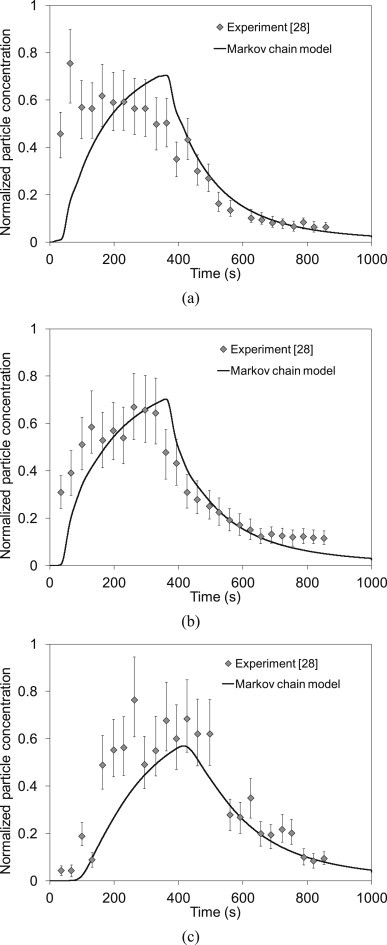
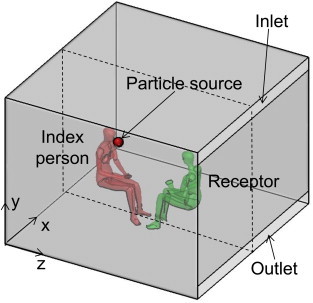
Obtaining information about particle dispersion in a room is crucial in reducing the risk of infectious disease transmission among occupants. This study developed a Markov chain model for quickly obtaining the information on the basis of a steady-state flow field calculated by computational fluid dynamics. When solving the particle transport equations, the Markov chain model does not require iterations in each time step, and thus it can significantly reduce the computing cost. This study used two sets of experimental data for transient particle transport to validate the model. In general, the trends in the particle concentration distributions predicted by the Markov chain model agreed reasonably well with the experimental data. This investigation also applied the model to the calculation of person-to-person particle transport in a ventilated room. The Markov chain model produced similar results to those of the Lagrangian and Eulerian models, while the speed of calculation increased by 8.0 and 6.3 times, respectively, in comparison to the latter two models.
获取室内颗粒扩散信息对于降低居住者之间传染病传播风险至关重要。本研究基于计算流体动力学计算的稳态流场,开发了一种马尔可夫链模型,用于快速获取相关信息。在求解颗粒输运方程时,马尔可夫链模型在每个时间步不需要迭代,因此可以显著降低计算成本。本研究使用两组瞬态颗粒输运的实验数据来验证该模型。总体而言,马尔可夫链模型预测的颗粒浓度分布趋势与实验数据相当吻合。本研究还将该模型应用于通风房间内人与人之间颗粒输运的计算。马尔可夫链模型产生的结果与拉格朗日模型和欧拉模型相似,而计算速度分别比后两种模型提高了8.0倍和6.3倍。