Sydney School of Health Sciences The University of Sydney Camperdown New South Wales Australia.
Sydney Medical School The University of Sydney Camperdown New South Wales Australia.
J Am Heart Assoc. 2020 Apr 21;9(8):e015639. doi: 10.1161/JAHA.119.015639. Epub 2020 Apr 15.
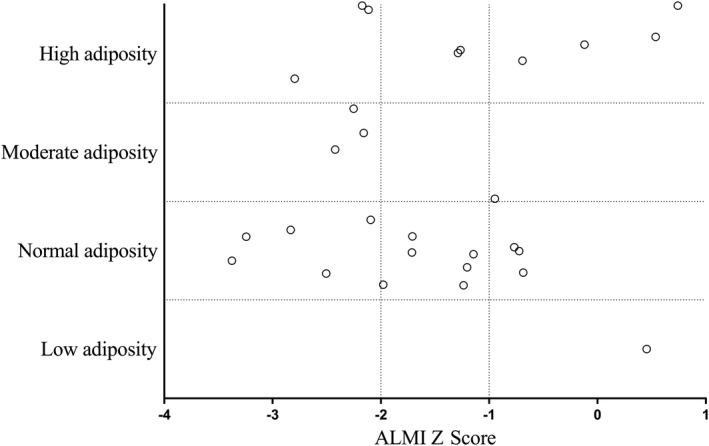
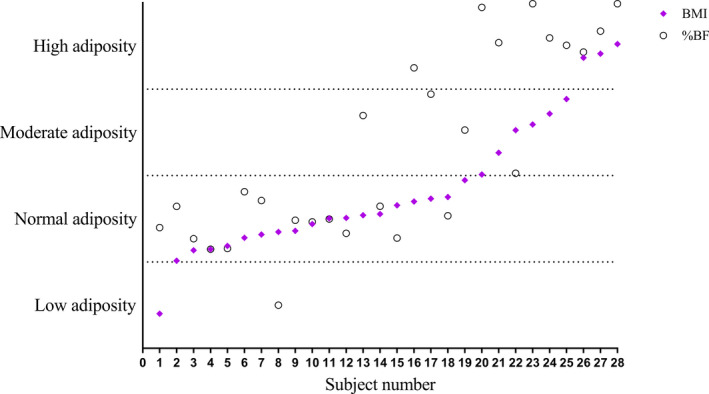
Background We sought to characterize body composition abnormalities in young patients living with a Fontan circulation and explore potential pathophysiologic associations. Methods and Results Twenty-eight patients with a Fontan circulation were prospectively recruited in this cross-sectional study. Participants underwent cardiopulmonary exercise testing, dual-energy X-ray absorptiometry, echocardiography, and biochemical assessment. Mean age was 26±7 years. Skeletal muscle mass, estimated by appendicular lean mass index Z score, was reduced compared with reference data (-1.49±1.10, <0.001). Percentage body fat Z score overall was within normal range (0.23±1.26, =0.35), although 46% had elevated adiposity. Those with reduced skeletal muscle mass (appendicular lean mass index Z score of -1 or lower) had lower percent predicted oxygen pulse (55±15 versus 76±16%, =0.002). Overall agreement between body mass index and dual-energy X-ray absorptiometry to assess adiposity was fair only (weighted [linear] κ coefficient: 0.53; 95% CI, 0.34-0.73) and slight in the setting of muscle mass deficiency (weighted κ coefficient: 0.32; 95% CI, 0.13-0.50). Appendicular lean mass was independently associated with absolute peak VO (β=70.6 mL/min, =0.001). Appendicular lean mass index Z score was inversely associated with hemoglobin (=-0.4, =0.04), and the degree of muscle deficit was associated with ventricular systolic impairment. Conclusions Young patients with a Fontan circulation have a body composition characterized by reduced skeletal muscle mass, which is associated with peak exercise capacity. Increased adiposity is common despite a normal body mass index. Low skeletal muscle mass is associated with systolic dysfunction and compensatory erythrocytosis.
背景 我们旨在描述患有 Fontan 循环的年轻患者的身体成分异常,并探讨潜在的病理生理关联。
方法和结果 这项横断面研究前瞻性招募了 28 名患有 Fontan 循环的患者。参与者接受心肺运动测试、双能 X 射线吸收法、超声心动图和生化评估。平均年龄为 26±7 岁。四肢骨骼肌质量(通过四肢瘦体重指数 Z 评分评估)与参考数据相比减少(-1.49±1.10,<0.001)。整体体脂 Z 评分在正常范围内(0.23±1.26,=0.35),尽管 46%的患者存在肥胖。四肢瘦体重减少(四肢瘦体重指数 Z 评分低于-1)的患者氧脉搏预测百分比较低(55±15 与 76±16%,=0.002)。体重指数和双能 X 射线吸收法评估体脂的总体一致性仅为中等(加权[线性]κ系数:0.53;95%CI,0.34-0.73),而在肌肉质量不足的情况下则为轻度(加权κ系数:0.32;95%CI,0.13-0.50)。四肢瘦体重与绝对峰值 VO2 独立相关(β=70.6mL/min,=0.001)。四肢瘦体重指数 Z 评分与血红蛋白呈负相关(=-0.4,=0.04),肌肉缺陷程度与心室收缩功能障碍相关。
结论 患有 Fontan 循环的年轻患者的身体成分表现为骨骼肌质量减少,这与峰值运动能力相关。尽管体重指数正常,但肥胖很常见。低骨骼肌质量与收缩功能障碍和代偿性红细胞增多症相关。