Department of Community Health Sciences (CHS), Aga Khan University (AKU), Karachi, Pakistan.
Department of Pediatrics & Child Health, Aga Khan University Hospital, Karachi, Pakistan.
BMC Public Health. 2020 Apr 14;20(1):481. doi: 10.1186/s12889-020-08511-0.
Poor personal hygiene and inadequate sanitation practices among young children leads to communicable diseases. There remains a gap in the holistic assessment of school children's hygiene literacy, practices and effectiveness of school-based hygiene interventions in Pakistan. Therefore, a school-based intervention protocol has been designed to promote personal and environmental hygiene practices for primary school children. Towards improving children's hygiene behaviors, the study will also focus on enhancing mothers' hygiene knowledge and practices.
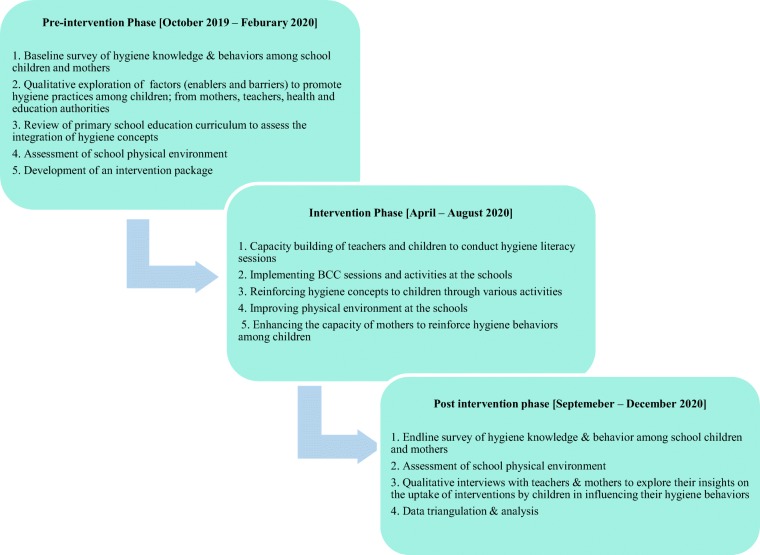
Using quasi-experimental design with mixed methods data collection approaches, this study will be conducted in schools located in an urban squatter settlements in Pakistan. To assess primary grade children and their mothers' hygiene status, a survey will be held in the pre-intervention phase. This phase also includes qualitative exploration of key stakeholders (mothers, teachers, health & education authorities representatives') perceptions about the factors facilitating and impeding the adaption of hygiene behaviors among school children. In-depth guides and focus group discussion tools will be used for this purpose. This will be followed by multi-component intervention phase with behavior change strategies to improve children's and mothers' hygiene literacy and behaviors. The post-intervention phase will assess the intervention effectiveness in terms of enhancing hygiene knowledge and practices among school children and mothers, alongside exploration of mothers and teachers' insights into whether or not the intervention has been effective in improving hygiene practices among children. Paired t-test will be applied pre and post-intervention to measure the differences between the mothers and children's hygiene literacy and knowledge scores. Similar test will be performed to assess the differences in children's hygiene knowledge and practice scores, pre and post-intervention (< 50 = poor, 50-75 = good and > 75 = excellent). Thematic analysis will be carried out for qualitative data.
Multi-component intervention aimed at improving personal and environmental hygiene among primary school children offers an opportunity to design and test various behavioral change strategies at school and in home settings. The study findings will be significant in assessing the intervention's effectiveness in improving children's overall hygiene.
Retrospectively registered with ClinicalTrials.gov (NCT03942523) on 5th May 2019.
儿童个人卫生习惯差、环境卫生条件差会导致传染病。在巴基斯坦,儿童卫生知识、实践和学校卫生干预效果的整体评估仍存在差距。因此,设计了一项基于学校的干预方案,以促进小学生的个人和环境卫生实践。为了改善儿童的卫生行为,该研究还将重点提高母亲的卫生知识和实践。
本研究采用准实验设计,结合混合方法数据收集方法,在巴基斯坦城市棚户区的学校进行。为了评估小学一、二年级儿童及其母亲的卫生状况,将在干预前阶段进行调查。这一阶段还包括对主要利益攸关方(母亲、教师、卫生和教育部门代表)对促进和阻碍儿童适应卫生行为的因素的看法进行定性探索。将使用深入指南和焦点小组讨论工具来进行。然后,将进行多方面的干预阶段,采用行为改变策略来提高儿童和母亲的卫生素养和行为。在干预后阶段,将评估干预在提高儿童和母亲的卫生知识和实践方面的效果,同时探讨母亲和教师的看法,了解干预是否有效地提高了儿童的卫生习惯。将在干预前后应用配对 t 检验来衡量母亲和儿童的卫生素养和知识得分之间的差异。将对儿童的卫生知识和实践得分进行类似的测试,以评估干预前后的差异(<50=差,50-75=良,>75=优)。将对定性数据进行主题分析。
旨在改善小学生个人和环境卫生的多方面干预措施为在学校和家庭环境中设计和测试各种行为改变策略提供了机会。该研究结果将对评估干预措施在提高儿童整体卫生方面的效果具有重要意义。
2019 年 5 月 5 日在 ClinicalTrials.gov(NCT03942523)进行了回顾性注册。