Charité - Universitätsmedizin Berlin, corporate member of Freie Universität Berlin, Humboldt-Universität zu Berlin, and Berlin Institute of Health, Center for Musculoskeletal Surgery (CMSC), Charitéplatz 1, 10117, Berlin, Germany.
Department of Orthopaedics and Trauma Surgery, Medical University of Vienna, Spitalgasse 23, 1090, Vienna, Austria.
BMC Microbiol. 2020 Apr 14;20(1):88. doi: 10.1186/s12866-020-01741-7.
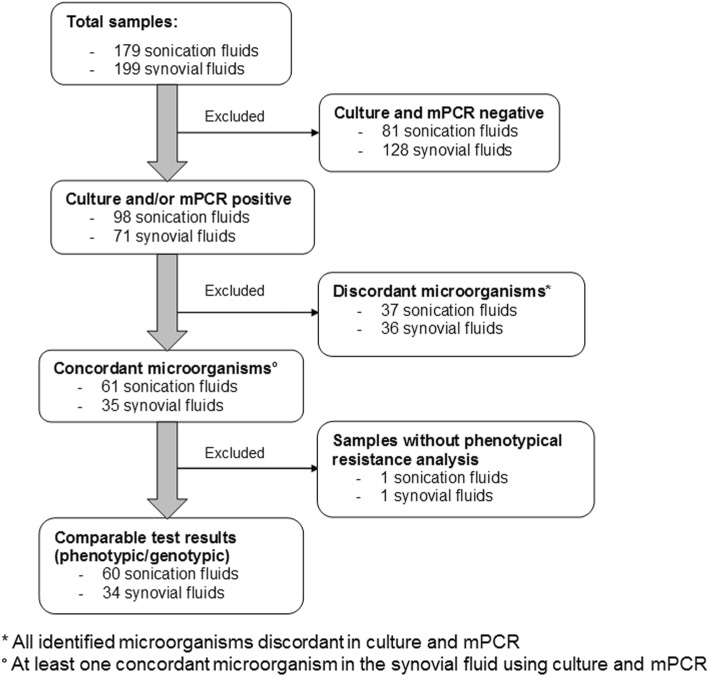
The performance of multiplex PCR (mPCR) for detection of antimicrobial resistance from clinical isolates is unknown. We assessed the ability of mPCR to analyse resistance genes directly from clinical samples. Patients with orthopedic infections were prospectively included. Phenotypical and genotypical resistance was evaluated in clinical samples (synovial and sonication fluid) where identical pathogens were identified by culture and mPCR.
A total of 94 samples were analysed, including 60 sonication fluid and 34 synovial fluid samples. For coagulase-negative staphylococcus strains, mPCR detected resistance to oxacillin in 10 of 23 isolates (44%) and to rifampin in none of 6 isolates. For S. aureus isolates, detection rate of oxacillin and rifampin-resistance was 100% (2/2 and 1/1, respectively). Fluoroquinolone-resistance was confirmed by mPCR in all 3 isolates of Enterobacteriaceae, in enterococci resistance to aminoglycoside-high level was detected in 1 of 3 isolates (33%) and in streptococci resistance to macrolides/lincosamides in none of 2 isolates. The overall sensitivity for different pathogens and antimicrobials was 46% and specificity 95%, the median concordance was 80% (range, 57-100%). Full agreement was observed for oxacillin in S. aureus, vancomycin in enterococci, carbapenems/cephalosporins in Enterobacteriaceae and rifampin in Cutibacterium species.
The overall sensitivity for detection of antimicrobial resistance by mPCR directly from clinical samples was low. False-negative mPCR results occurred mainly in coagulase-negative staphylococci, especially for oxacillin and rifampin. However, the specificity of mPCR was high and a positive result reliably predicted antimicrobial resistance. Including universal primers in the PCR test assay may improve the detection rate but requires additional sequencing step.
www.clinicaltrials.gov No. NCT02530229, registered at 21 August 2015 (retrospectively registered).
多重聚合酶链反应(mPCR)检测临床分离物中抗菌药物耐药性的性能尚不清楚。我们评估了 mPCR 直接从临床样本中分析耐药基因的能力。前瞻性纳入骨科感染患者。在培养和 mPCR 均鉴定出相同病原体的临床样本(关节液和超声液)中评估表型和基因型耐药性。
共分析了 94 份样本,包括 60 份超声液和 34 份关节液样本。对于凝固酶阴性葡萄球菌株,mPCR 检测到 23 株中的 10 株(44%)对苯唑西林耐药,6 株中无 1 株对利福平耐药。金黄色葡萄球菌分离株的苯唑西林和利福平耐药检测率均为 100%(分别为 2/2 和 1/1)。氟喹诺酮类耐药性通过 mPCR 在 3 株肠杆菌科中均得到确认,3 株肠球菌中有 1 株(33%)对氨基糖苷类高水平耐药,2 株链球菌中均无大环内酯类/林可酰胺类耐药。不同病原体和抗菌药物的总敏感性为 46%,特异性为 95%,中位一致性为 80%(范围,57-100%)。金黄色葡萄球菌中苯唑西林、肠球菌中万古霉素、肠杆菌科中碳青霉烯类/头孢菌素类和棒状杆菌属中利福平的一致性均为 100%。
mPCR 直接从临床样本中检测抗菌药物耐药性的总敏感性较低。假阴性 mPCR 结果主要发生在凝固酶阴性葡萄球菌中,尤其是苯唑西林和利福平。然而,mPCR 的特异性很高,阳性结果可靠地预测了抗菌药物耐药性。在 PCR 检测试验中加入通用引物可能会提高检测率,但需要额外的测序步骤。
www.clinicaltrials.gov 编号 NCT02530229,于 2015 年 8 月 21 日注册(回顾性注册)。