Centre for Medical Imaging, University College London, London, UK.
Arthritis Research UK Centre for Adolescent Rheumatology, University College London, London, UK.
Eur Radiol. 2020 Sep;30(9):5099-5109. doi: 10.1007/s00330-020-06785-x. Epub 2020 Apr 14.
To demonstrate proof-of-concept for a quantitative MRI method using histographic analysis to assess bone marrow oedema and fat metaplasia in the sacroiliac joints.
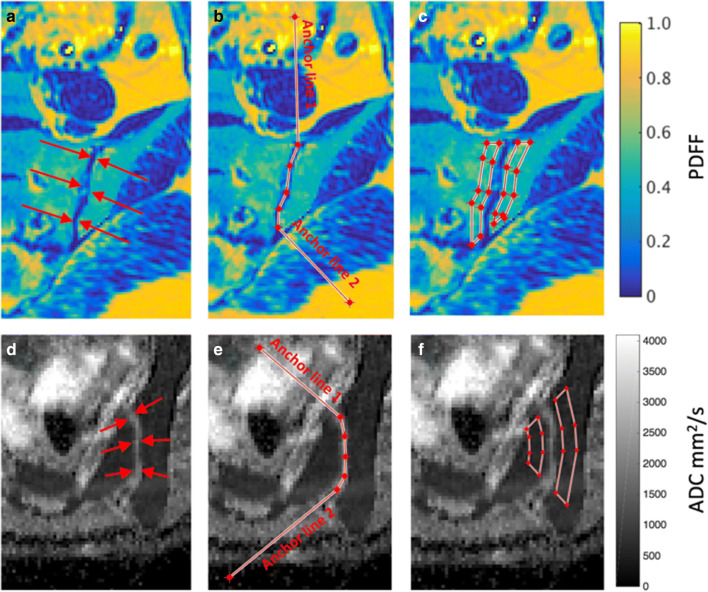
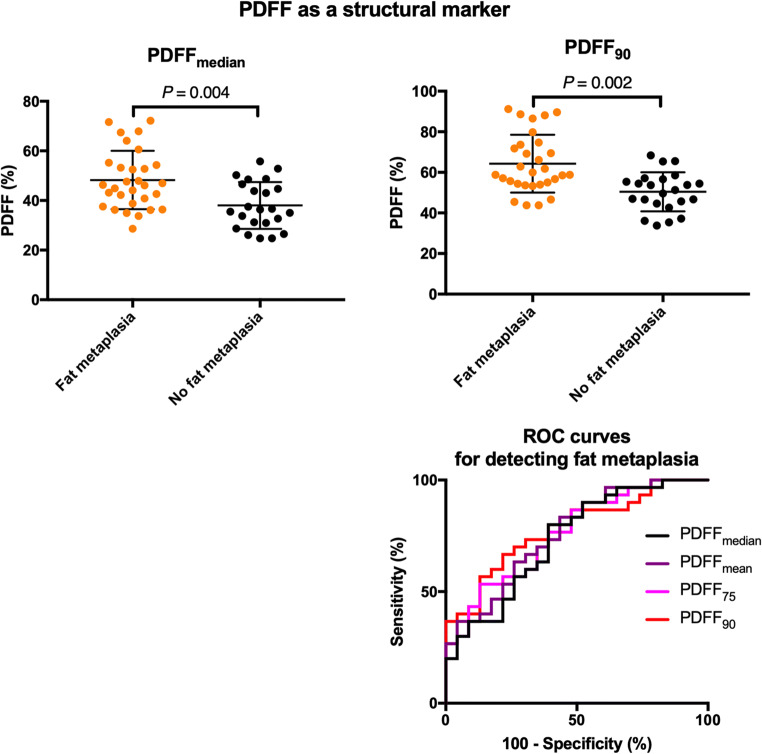
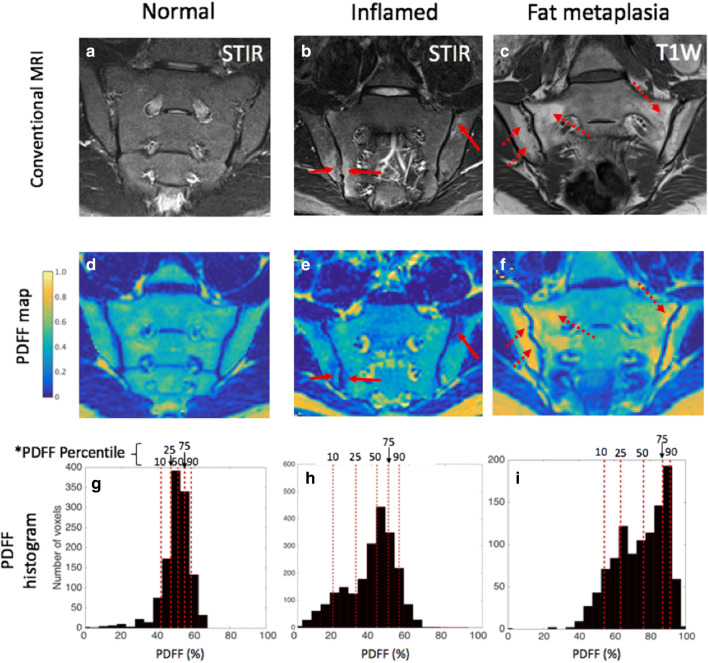
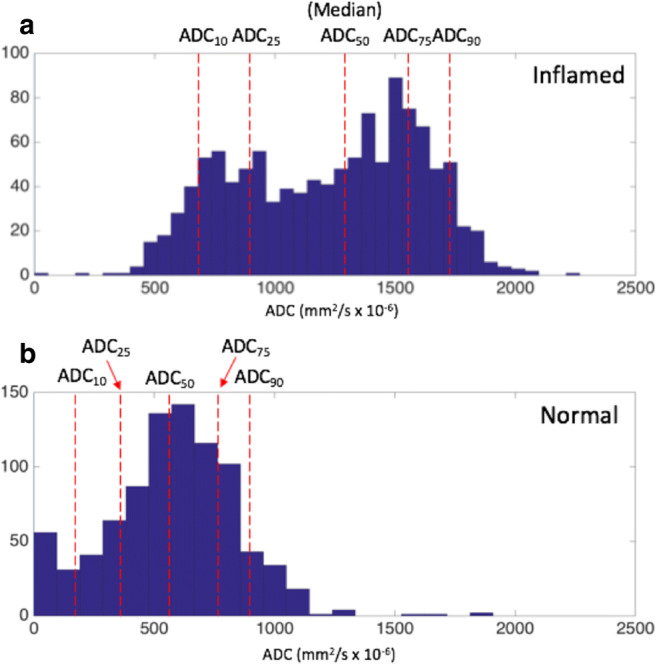
Fifty-three adolescents aged 12-23 with known or suspected sacroiliitis were prospectively recruited and underwent quantitative MRI (qMRI) scans, consisting of chemical shift-encoded (at 3 T) and diffusion-weighted imaging (at 1.5 T), plus conventional MRI (at 1.5 T) and clinical assessment. qMRI scans produced proton-density fat fraction (PDFF) and apparent diffusion coefficient (ADC) maps of the sacroiliac joints (SIJs), which were analysed using an in-house software tool enabling partially automated ROI definition and histographic analysis. Logistic regression and receiver operating characteristic (ROC) analyses assessed the predictive performance of ADC- and PDFF-based parameters in identifying active inflammation (oedema) and structural damage (fat metaplasia).
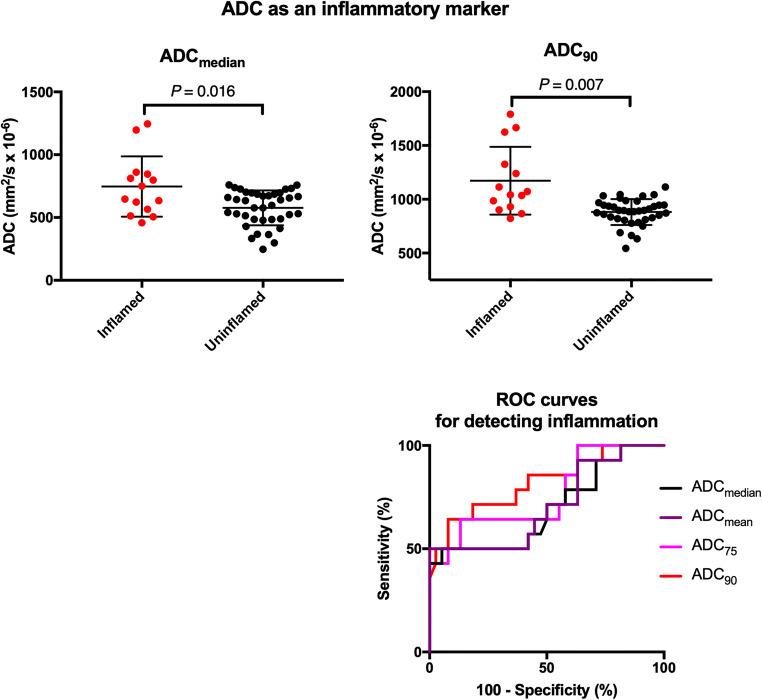
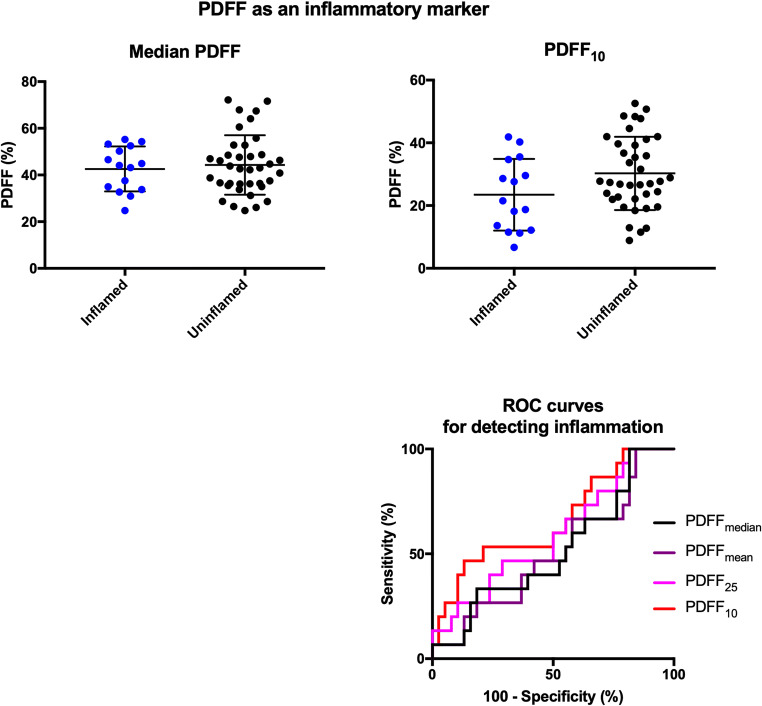
ADC-based parameters were associated with increased odds of oedema (all p < 0.05); ROC-AUC was higher for histographic parameters representing the upper end of the ADC distribution than for simple averages. Similarly, PDFF-based parameters were associated with increased odds of fat metaplasia (all p < 0.05); ROC area-under-the-curve was higher for histographic parameters representing the upper end of the PDFF distribution than for simple averages. Both ADC- and PDFF-based histographic parameters demonstrated excellent inter- and intra-observer agreement (ICC > 0.9).
ADC-based parameters can differentiate patients with bone marrow oedema from those without, whilst PDFF-based parameters can differentiate patients with fat metaplasia from those without. Histographic analysis might improve performance compared with simple averages such as the mean and median and offers excellent agreement within and between observers.
• Quantitative MRI with histographic analysis can identify bone marrow oedema (an active inflammatory lesion) and fat metaplasia (a 'chronic' inflammatory lesion) in patients with spondyloarthritis. • The use of histographic analysis might improve the performance of quantitative MRI for detecting bone marrow oedema and fat metaplasia compared with simple averages such as the mean and median. • Bone marrow oedema and fat metaplasia are known to be of diagnostic and prognostic significance, and the proposed method could support clinical decisions around biologic (and other) therapies in spondyloarthritis.
通过使用直方图分析来证明一种定量 MRI 方法的概念验证,以评估骶髂关节中的骨髓水肿和脂肪化生。
53 名年龄在 12-23 岁之间的已知或疑似骶髂关节炎的青少年前瞻性入组并接受定量 MRI(qMRI)扫描,包括化学位移编码(3T)和弥散加权成像(1.5T),加上常规 MRI(1.5T)和临床评估。qMRI 扫描产生骶髂关节(SIJ)的质子密度脂肪分数(PDFF)和表观扩散系数(ADC)图,使用内部软件工具对其进行分析,该工具可实现部分自动 ROI 定义和直方图分析。逻辑回归和受试者工作特征(ROC)分析评估了基于 ADC 和 PDFF 的参数在识别活跃炎症(水肿)和结构损伤(脂肪化生)方面的预测性能。
基于 ADC 的参数与水肿的可能性增加相关(均 p<0.05);代表 ADC 分布上限的直方图参数的 ROC-AUC 高于简单平均值。同样,基于 PDFF 的参数与脂肪化生的可能性增加相关(均 p<0.05);代表 PDFF 分布上限的直方图参数的 ROC 曲线下面积高于简单平均值。基于 ADC 和 PDFF 的直方图参数均表现出极好的观察者内和观察者间一致性(ICC>0.9)。
基于 ADC 的参数可区分骨髓水肿患者与无骨髓水肿患者,而基于 PDFF 的参数可区分脂肪化生患者与无脂肪化生患者。与平均值(如均值和中位数)相比,直方图分析可能会提高性能,并在观察者内和观察者间提供极好的一致性。
• 定量 MRI 结合直方图分析可识别出患有脊柱关节炎的患者中的骨髓水肿(活跃炎症病变)和脂肪化生(慢性炎症病变)。• 与平均值(如均值和中位数)相比,直方图分析可能会提高定量 MRI 检测骨髓水肿和脂肪化生的性能。• 骨髓水肿和脂肪化生具有诊断和预后意义,所提出的方法可以支持脊柱关节炎中生物(和其他)治疗的临床决策。