Guangdong Lung Cancer Institute, Guangdong Provincial Key Laboratory of Translational Medicine in Lung Cancer, Guangdong Provincial People's Hospital & Guangdong Academy of Medical Sciences, School of Medicine, South China University of Technology, Guangzhou, China.
The Second School of Clinical Medicine, Southern Medical University, Guangzhou, China.
Thorac Cancer. 2020 Jun;11(6):1512-1521. doi: 10.1111/1759-7714.13419. Epub 2020 Apr 14.
Tyrosine kinase domain (TKD) mutation and particularly exon 20 insertion mutations of ERBB2 have been extensively reported in non-small cell lung cancer (NSCLC). Due to the increased accessibility of next-generation sequencing, more ERBB2 mutations within the non-TKD can be detected in clinical practice. Nevertheless, the clinical significance of non-TKD mutations remains unknown. Hence, this study was designed to comprehensively outline the landscape and characteristics of ERBB2 mutations in NSCLC.
A total of 1934 patients with NSCLC from cBioPortal were included in the study. An ERBB2 mutation cohort was identified, while subsequent analyses revealed clinical and genomic characteristics.
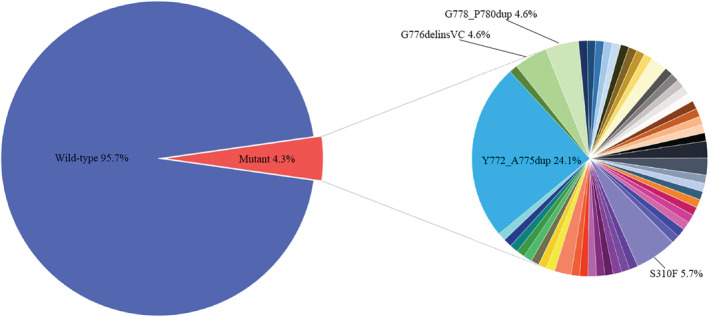
The frequency of ERBB2 mutation was 4.5%, and it was determined to be more likely to occur in never-smokers. ERBB2 mutations occurring in the non-TKD accounted for 57.5% of ERBB2 mutations. In the non-TKD, missense mutation was the most recurrent mutation type, and S310F was the most recurrent mutation variant. ERBB2 mutations within non-TKD also had a strong oncogenic ability where up to 37.5% of ERBB2 oncogenic mutations were within non-TKD. The co-mutation of EGFR or KRAS was higher in the non-TKD mutation compared to the TKD mutation. Shorter overall survival was observed in ERBB2-mutant patients compared with ERBB2 wild-type patients. There was no significant difference in overall survival between patients with non-TKD mutations and TKD mutations.
The present study showed that a considerable portion of non-TKD mutations were oncogenic. ERBB2 mutation was a poor prognostic factor. The non-TKD mutation might also be used as a therapeutic target in ERBB2-directed target therapy.
• Significant findings of the study ERBB2 mutations were more abundant within a nontyrosine domain than those within the tyrosine domain. Up to 37.5% of ERBB2 oncogenic mutations were within the nontyrosine domain. ERBB2 mutation was a poor prognostic factor. • What this study adds The frequency of EGFR or KRAS co-mutations were significantly higher in ERBB2 mutations within the nontyrosine kinase domain compared to ERBB2 mutations within the tyrosine kinase domain. Nontyrosine domain mutations confer equal overall survival to tyrosine domain mutations.
在非小细胞肺癌(NSCLC)中,已广泛报道了 ERBB2 酪氨酸激酶结构域(TKD)突变,尤其是外显子 20 插入突变。由于下一代测序技术的普及,在临床实践中可以检测到更多非 TKD 中的 ERBB2 突变。然而,非 TKD 突变的临床意义尚不清楚。因此,本研究旨在全面概述 NSCLC 中 ERBB2 突变的情况和特征。
本研究纳入了 cBioPortal 中的 1934 例 NSCLC 患者。确定了 ERBB2 突变队列,随后的分析揭示了临床和基因组特征。
ERBB2 突变的频率为 4.5%,并且更可能发生在从不吸烟者中。非 TKD 中的 ERBB2 突变占 ERBB2 突变的 57.5%。在非 TKD 中,错义突变是最常见的突变类型,S310F 是最常见的突变变体。非 TKD 中的 ERBB2 突变也具有很强的致癌能力,高达 37.5%的 ERBB2 致癌突变发生在非 TKD 中。与 TKD 突变相比,非 TKD 突变中 EGFR 或 KRAS 的共突变更高。与 ERBB2 野生型患者相比,ERBB2 突变患者的总生存期更短。非 TKD 突变与 TKD 突变患者的总生存期无显著差异。
本研究表明,相当一部分非 TKD 突变具有致癌性。ERBB2 突变是一个不良预后因素。非 TKD 突变也可能作为 ERBB2 定向靶向治疗的治疗靶点。
研究的重要发现:非 TKD 中的 ERBB2 突变比 TKD 中的 ERBB2 突变更为丰富。高达 37.5%的 ERBB2 致癌突变发生在非 TKD 中。ERBB2 突变是一个不良预后因素。
本研究的补充内容:与 TKD 中的 ERBB2 突变相比,非 TKD 中的 ERBB2 突变中 EGFR 或 KRAS 的共突变显著更高。非 TKD 突变与 TKD 突变患者的总生存期相当。