National Institute of Biomedical Genomics, P.O. NSS, Kalyani, Nadia, West Bengal, 741251, India.
BMC Cancer. 2020 Apr 15;20(1):309. doi: 10.1186/s12885-020-06774-9.
Sepsis and cancer are both leading causes of death, and occurrence of any one, increases the likelihood of the other. While cancer patients are susceptible to sepsis, survivors of sepsis are also susceptible to develop certain cancers. This mutual dependence for susceptibility suggests shared biology between the two disease categories. Earlier analysis had revealed a cancer-related pathway to be up-regulated in Septic Shock (SS), an advanced stage of sepsis. This has motivated a more comprehensive comparison of the transcriptomes of SS and cancer.
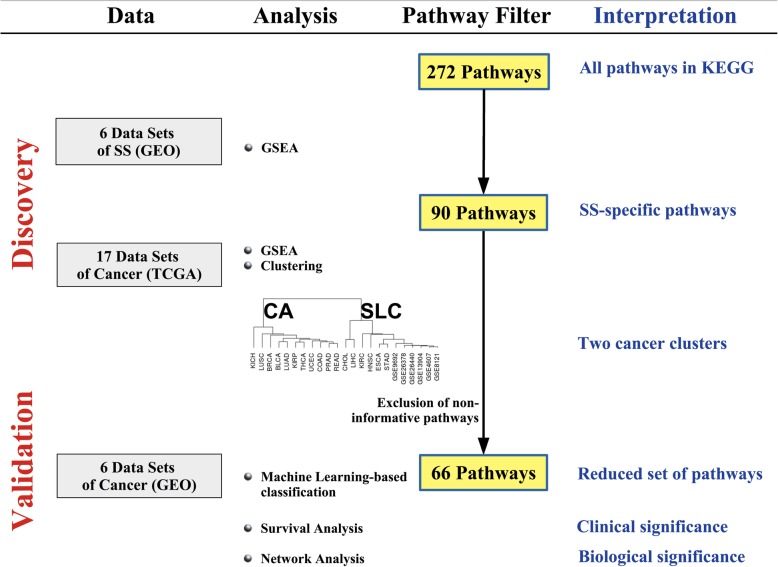
Gene Set Enrichment Analysis was performed to detect the pathways enriched in SS and cancer. Thereafter, hierarchical clustering was applied to identify relative segregation of 17 cancer types into two groups vis-a-vis SS. Biological significance of the selected pathways was explored by network analysis. Clinical significance of the pathways was tested by survival analysis. A robust classifier of cancer groups was developed based on machine learning.
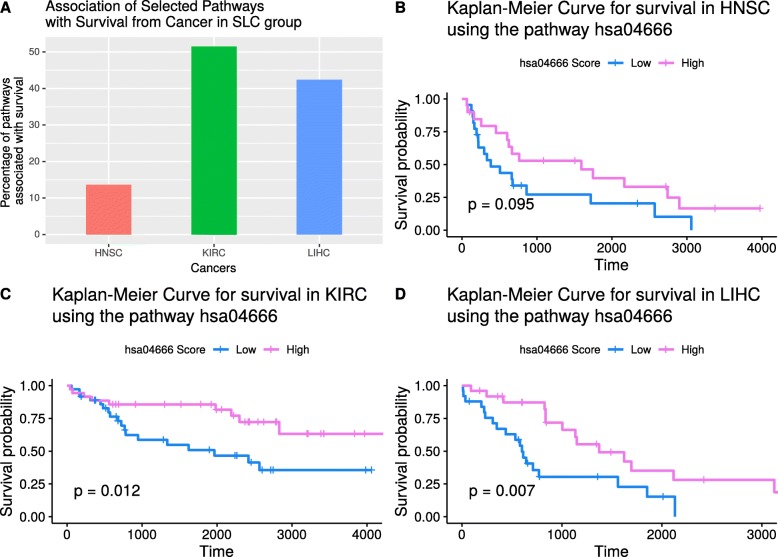
A total of 66 pathways were observed to be enriched in both SS and cancer. However, clustering segregated cancer types into two categories based on the direction of transcriptomic change. In general, there was up-regulation in SS and one group of cancer (termed Sepsis-Like Cancer, or SLC), but not in other cancers (termed Cancer Alone, or CA). The SLC group mainly consisted of malignancies of the gastrointestinal tract (head and neck, oesophagus, stomach, liver and biliary system) often associated with infection. Machine learning classifier successfully segregated the two cancer groups with high accuracy (> 98%). Additionally, pathway up-regulation was observed to be associated with survival in the SLC group of cancers.
Transcriptome-based systems biology approach segregates cancer into two groups (SLC and CA) based on similarity with SS. Host response to infection plays a key role in pathogenesis of SS and SLC. However, we hypothesize that some component of the host response is protective in both SS and SLC.
脓毒症和癌症都是主要的死亡原因,其中一种疾病的发生会增加另一种疾病的发生概率。癌症患者易患脓毒症,脓毒症幸存者也易患某些癌症。这种易感性的相互依赖性表明这两种疾病类别之间存在共同的生物学基础。早期分析显示,在脓毒性休克(SS)中,一种严重的脓毒症阶段,一种与癌症相关的途径被上调。这促使人们对 SS 和癌症的转录组进行更全面的比较。
进行基因集富集分析以检测 SS 和癌症中富集的途径。然后,应用层次聚类将 17 种癌症类型分为两组,一组是 SS,另一组是癌症。通过网络分析探讨所选途径的生物学意义。通过生存分析测试途径的临床意义。基于机器学习开发了癌症组的稳健分类器。
共观察到 66 条途径在 SS 和癌症中均被富集。然而,聚类根据转录组变化的方向将癌症类型分为两类。一般来说,SS 和一组癌症(称为脓毒症样癌症,或 SLC)上调,但其他癌症(称为仅癌症,或 CA)没有上调。SLC 组主要由胃肠道(头颈部、食管、胃、肝和胆道系统)的恶性肿瘤组成,这些肿瘤通常与感染有关。机器学习分类器成功地以高准确率(>98%)将这两种癌症组分开。此外,通路的上调与 SLC 组癌症的生存相关。
基于转录组的系统生物学方法根据与 SS 的相似性将癌症分为两类(SLC 和 CA)。宿主对感染的反应在 SS 和 SLC 的发病机制中起着关键作用。然而,我们假设宿主反应的某些成分在 SS 和 SLC 中都具有保护作用。