Department of Medical oncology, Sichuan Cancer Hospital, Medical School of University of Electronic Science and Technology of China, Chengdu, 610041, People's Republic of China.
Department of Medical oncology, Wuming Hospital Affiliated to Guangxi Medical University, Nanning, 530000, China.
BMC Cancer. 2020 Apr 15;20(1):315. doi: 10.1186/s12885-020-06818-0.
The enrichment of cancer stem cell-like cells (CSCs) has been considered to be responsible for tumor progression after an initial response to epidermal growth factor receptor (EGFR) tyrosine kinase inhibitors (EGFR-TKIs) in patients with non-small cell lung adenocarcinoma (NSCLC/ADC). CSCs with ALDH1A1 /CD44 expression contribute to the TKIs resistance in NSCLC/ADC cells. All-trans retinoic acid (ATRA) has been shown to be a potential targeted therapy against CSCs due to its ability to inhibit ALDH1A1 activity. We therefore investigated whether ATRA could circumvent the resistance to improve the response to gefitinib in NSCLC/ADC cells.
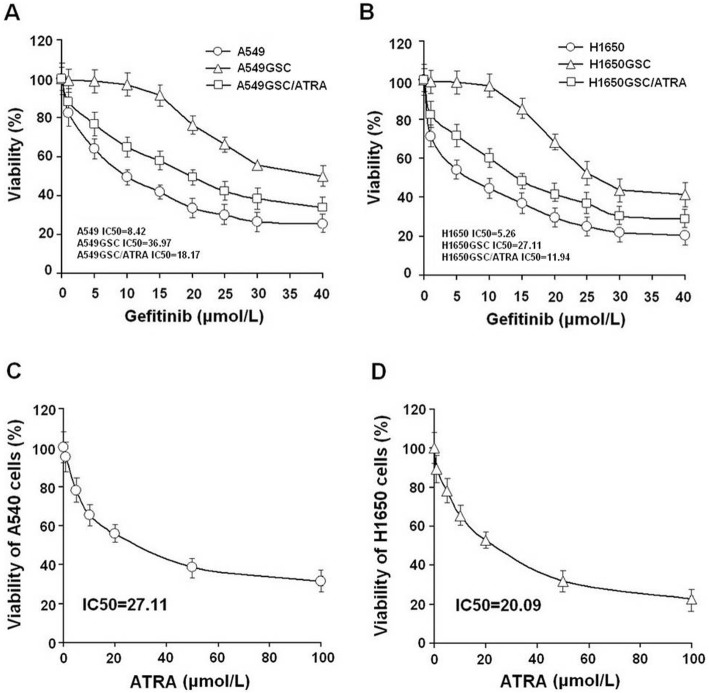
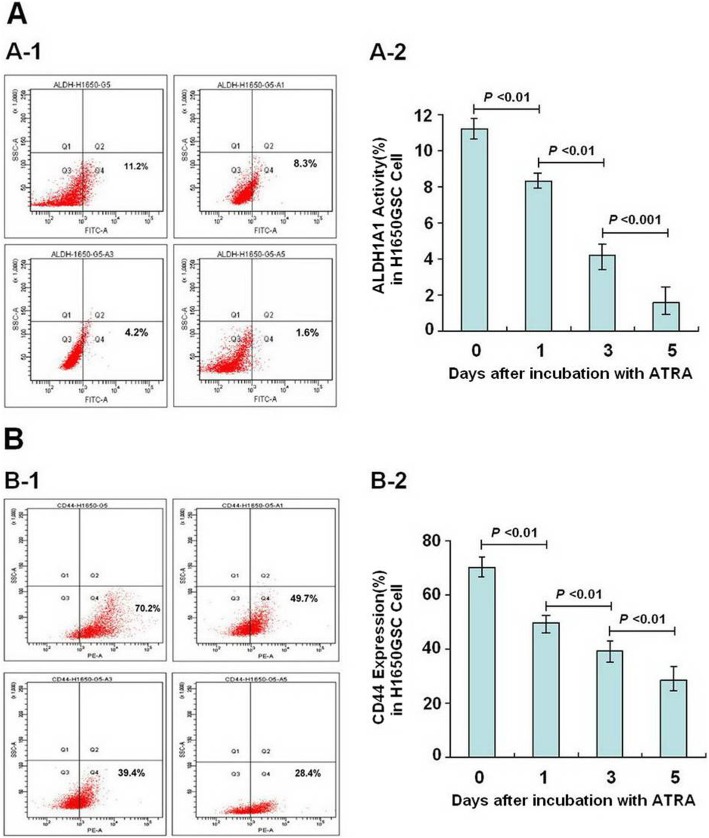
Treatment of NSCLC/ADC A549 and H1650 cells with gefitinib enriched the gefitinib surviving cells (GSCs). The expression of ALDH1A1 and CD44 and the IC50 values for gefitinib were determined by flow cytometry (FCM) and crystal violet assay in GSCs and ATRA-treated GSCs, respectively. Using DEAB as the positive control, direct inhibitory effect of ATRA on ALDH1A1 activity was determined by ALDEFLUOR assay, RESULTS: GSCs showed higher expression of ALDH1A1 and CD44 and IC50 values for gefitinib than their respective parental cells, suggesting that gefitinib can lead to propagation of CSC-enriched gefitinib-resistant cells. Treatment with ATRA was found to significantly reduce the increased expression of ALDH1A1 and CD44 and the IC50 values for gefitinib in A549GSC and H1650GSC cells, and ATRA could directly inhibit active ALDH1A1 as compared to DEAB.
Our findings suggest that combination treatment with ATRA prevents gefitinib-induced enrichment of ALDH1A1/CD44 CSCs and enhances gefitinib-induced growth inhibition of NSCLC/ADC cells.
在非小细胞肺癌腺癌细胞(NSCLC/ADC)患者中,表皮生长因子受体(EGFR)酪氨酸激酶抑制剂(EGFR-TKIs)初始反应后,肿瘤进展被认为是癌症干细胞样细胞(CSC)富集的结果。具有 ALDH1A1/CD44 表达的 CSC 有助于 NSCLC/ADC 细胞对 TKIs 的耐药性。全反式视黄酸(ATRA)已被证明是一种针对 CSC 的潜在靶向治疗药物,因为它能够抑制 ALDH1A1 的活性。因此,我们研究了 ATRA 是否可以规避耐药性,从而提高 NSCLC/ADC 细胞对吉非替尼的反应。
用吉非替尼处理 NSCLC/ADC A549 和 H1650 细胞,富集吉非替尼存活细胞(GSCs)。通过流式细胞术(FCM)和结晶紫测定法分别测定 GSCs 和 ATRA 处理的 GSCs 中 ALDH1A1 和 CD44 的表达以及吉非替尼的 IC50 值。使用 DEAB 作为阳性对照,通过 ALDEFLUOR 测定法测定 ATRA 对 ALDH1A1 活性的直接抑制作用。
GSCs 比其相应的亲本细胞表现出更高的 ALDH1A1 和 CD44 表达以及吉非替尼的 IC50 值,表明吉非替尼可以导致 CSC 富集的吉非替尼耐药细胞的增殖。发现 ATRA 处理可显著降低 A549GSC 和 H1650GSC 细胞中 ALDH1A1 和 CD44 表达的增加以及吉非替尼的 IC50 值,并且与 DEAB 相比,ATRA 可以直接抑制活性 ALDH1A1。
我们的研究结果表明,ATRA 联合治疗可防止吉非替尼诱导的 ALDH1A1/CD44 CSC 富集,并增强吉非替尼诱导的 NSCLC/ADC 细胞生长抑制。