Graduate School of Informatics and Engineering, The University of Electro-Communications, 1-5-1 Chofugaoka, Chofu, Tokyo 182-8585, Japan.
Takasaka Clinic, Fukushima 973-8407, Japan.
Sensors (Basel). 2020 Apr 13;20(8):2171. doi: 10.3390/s20082171.
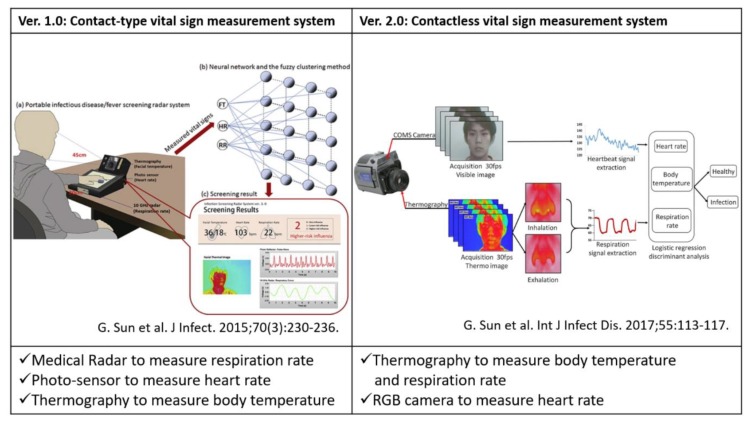
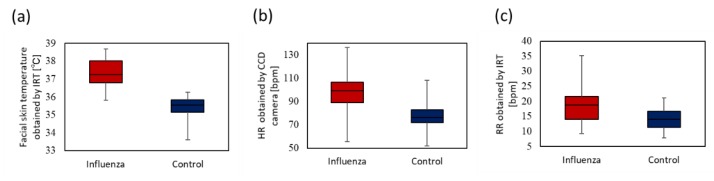
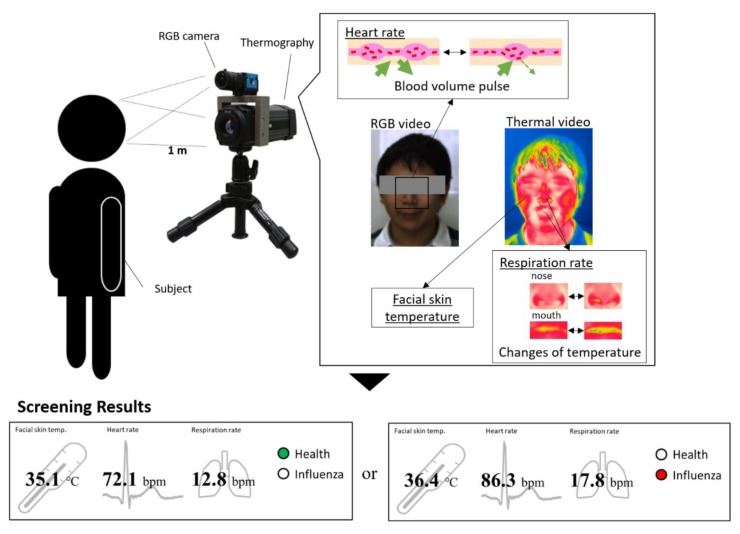
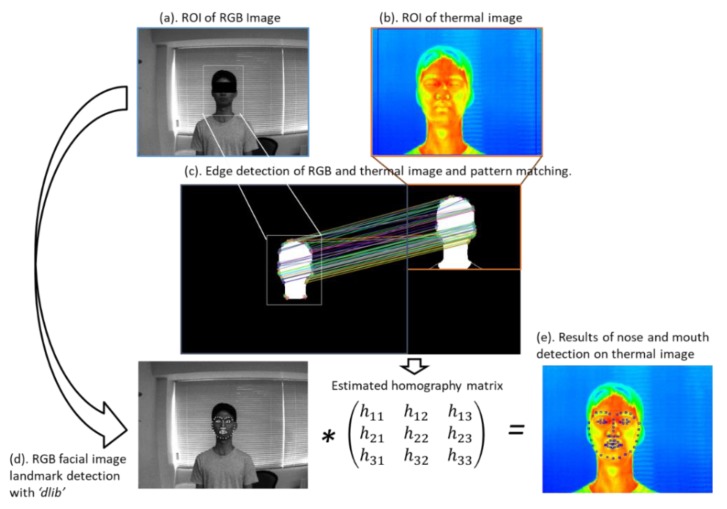
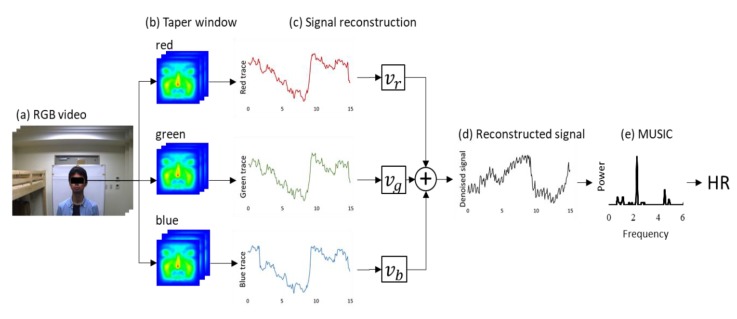
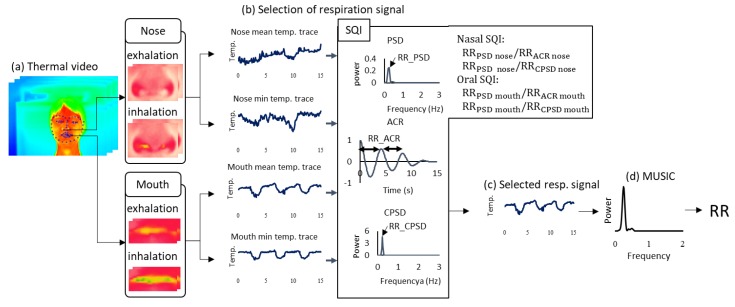
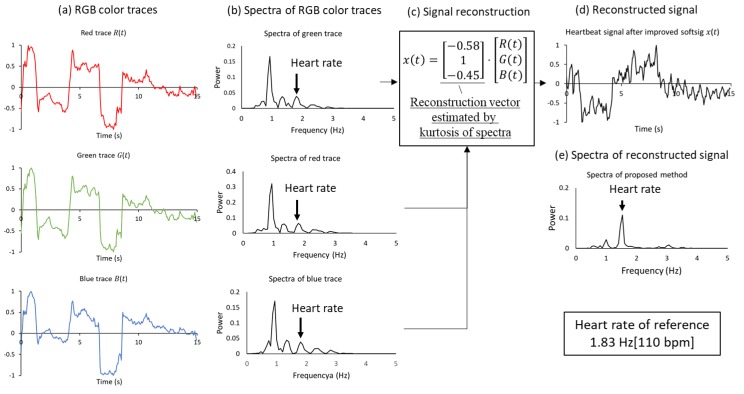
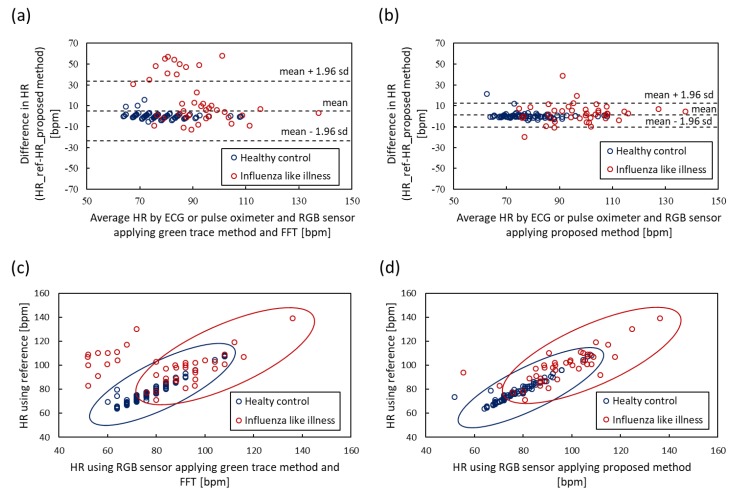
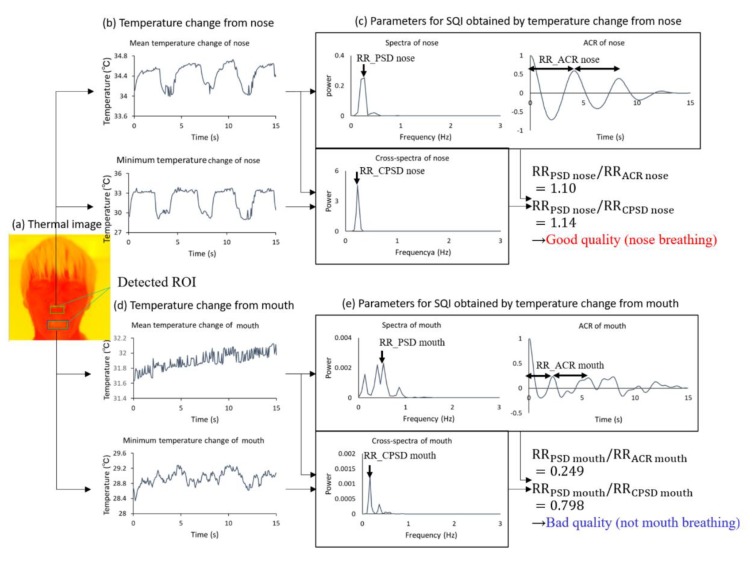
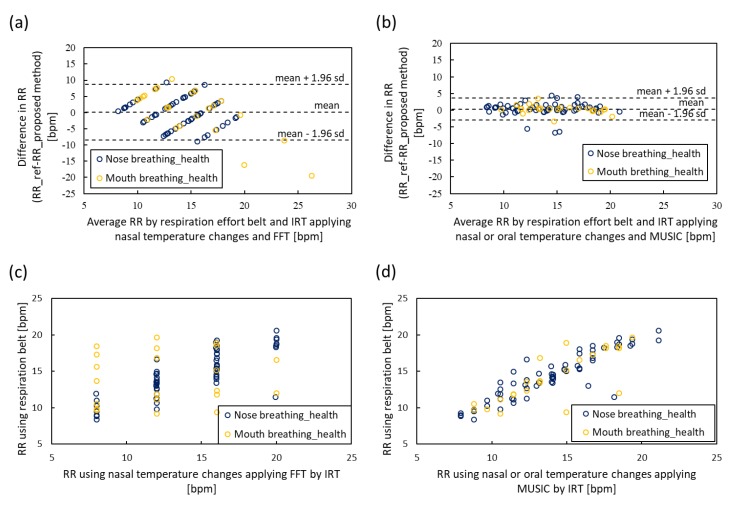
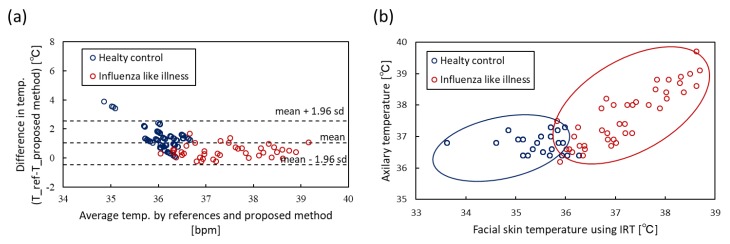
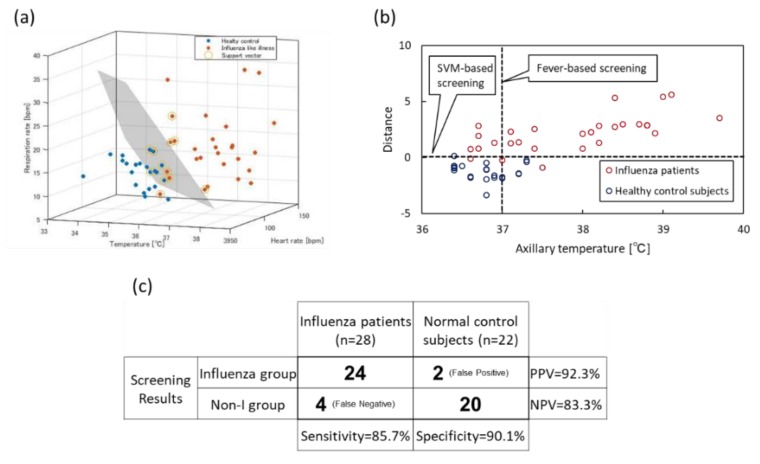
In the last two decades, infrared thermography (IRT) has been applied in quarantine stations for the screening of patients with suspected infectious disease. However, the fever-based screening procedure employing IRT suffers from low sensitivity, because monitoring body temperature alone is insufficient for detecting infected patients. To overcome the drawbacks of fever-based screening, this study aims to develop and evaluate a multiple vital sign (i.e., body temperature, heart rate and respiration rate) measurement system using RGB-thermal image sensors. The RGB camera measures blood volume pulse (BVP) through variations in the light absorption from human facial areas. IRT is used to estimate the respiration rate by measuring the change in temperature near the nostrils or mouth accompanying respiration. To enable a stable and reliable system, the following image and signal processing methods were proposed and implemented: (1) an RGB-thermal image fusion approach to achieve highly reliable facial region-of-interest tracking, (2) a heart rate estimation method including a tapered window for reducing noise caused by the face tracker, reconstruction of a BVP signal with three RGB channels to optimize a linear function, thereby improving the signal-to-noise ratio and multiple signal classification (MUSIC) algorithm for estimating the pseudo-spectrum from limited time-domain BVP signals within 15 s and (3) a respiration rate estimation method implementing nasal or oral breathing signal selection based on signal quality index for stable measurement and MUSIC algorithm for rapid measurement. We tested the system on 22 healthy subjects and 28 patients with seasonal influenza, using the support vector machine (SVM) classification method. : The body temperature, heart rate and respiration rate measured in a non-contact manner were highly similarity to those measured via contact-type reference devices (i.e., thermometer, ECG and respiration belt), with Pearson correlation coefficients of 0.71, 0.87 and 0.87, respectively. Moreover, the optimized SVM model with three vital signs yielded sensitivity and specificity values of 85.7% and 90.1%, respectively. : For contactless vital sign measurement, the system achieved a performance similar to that of the reference devices. The multiple vital sign-based screening achieved higher sensitivity than fever-based screening. Thus, this system represents a promising alternative for further quarantine procedures to prevent the spread of infectious diseases.
在过去的二十年中,红外热成像(IRT)已应用于检疫站,用于筛查疑似传染病患者。然而,基于发热的 IRT 筛查程序灵敏度较低,因为仅监测体温不足以检测出感染患者。为了克服基于发热的筛查的缺点,本研究旨在开发和评估一种使用 RGB-热图像传感器的多生命体征(即体温、心率和呼吸率)测量系统。RGB 相机通过测量人体面部区域的光吸收率变化来测量血流脉搏(BVP)。IRT 用于通过测量伴随呼吸的鼻孔或口部附近的温度变化来估计呼吸率。为了实现稳定可靠的系统,提出并实现了以下图像和信号处理方法:(1)RGB-热图像融合方法,实现高度可靠的面部感兴趣区域跟踪;(2)一种心率估计方法,包括锥形窗口,用于减少面部跟踪器引起的噪声,使用三个 RGB 通道重建 BVP 信号,优化线性函数,从而提高信噪比和多信号分类(MUSIC)算法,从 15 秒内有限时域 BVP 信号中估计伪谱;(3)一种呼吸率估计方法,基于信号质量指数实现鼻或口呼吸信号选择,用于稳定测量和 MUSIC 算法用于快速测量。我们使用支持向量机(SVM)分类方法,在 22 名健康受试者和 28 名季节性流感患者身上测试了该系统。非接触式测量的体温、心率和呼吸率与通过接触式参考设备(即温度计、心电图和呼吸带)测量的结果高度相似,皮尔逊相关系数分别为 0.71、0.87 和 0.87。此外,使用三个生命体征优化的 SVM 模型的灵敏度和特异性分别为 85.7%和 90.1%。用于非接触式生命体征测量,该系统的性能与参考设备相似。基于多生命体征的筛查比基于发热的筛查具有更高的灵敏度。因此,该系统为进一步的检疫程序提供了一种有前途的替代方案,以防止传染病的传播。