Wen Xuejiao, Qiu Xiaolan
Laboratory of spatial information intelligent processing system, Institute of Electronics, Chinese Academy of Sciences, Suzhou 215000, China.
Institute of Electronics, Chinese Academy of Sciences, Beijing 100190, China.
Sensors (Basel). 2020 Apr 13;20(8):2201. doi: 10.3390/s20082201.
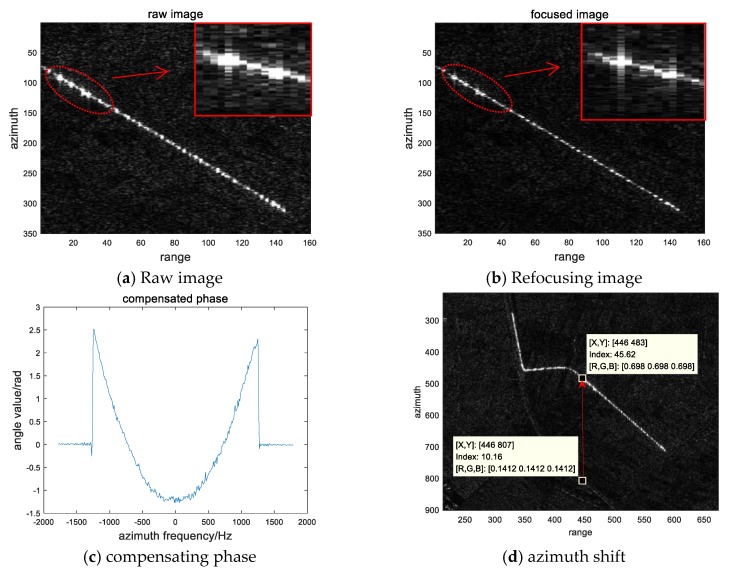
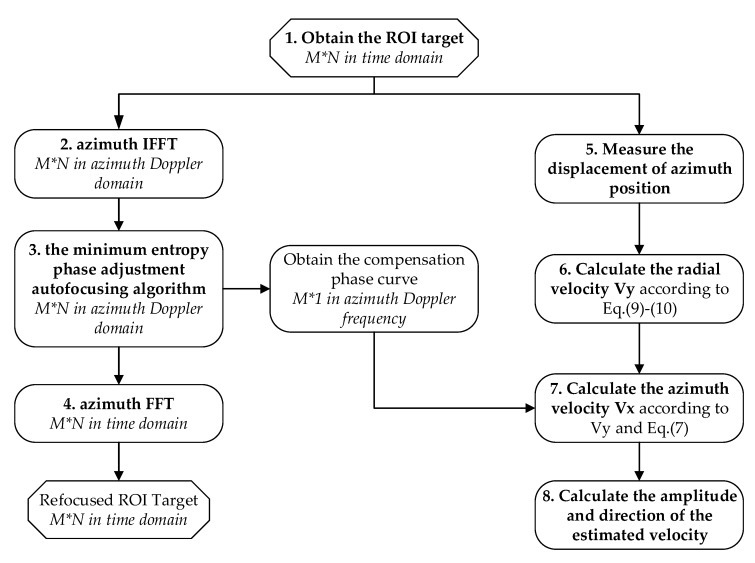
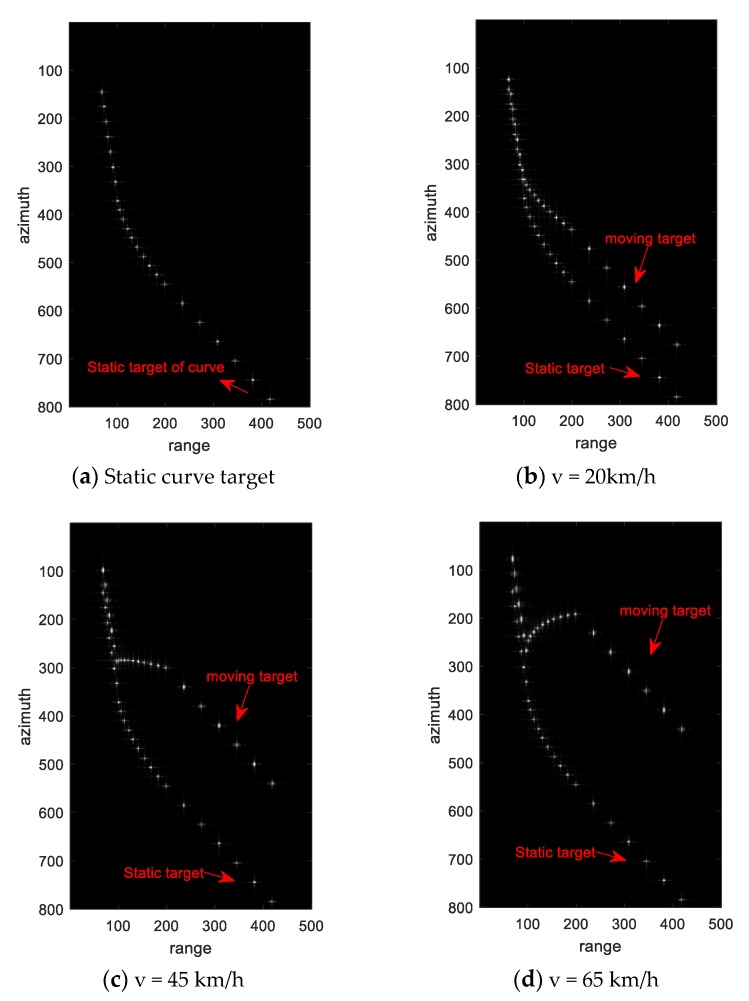
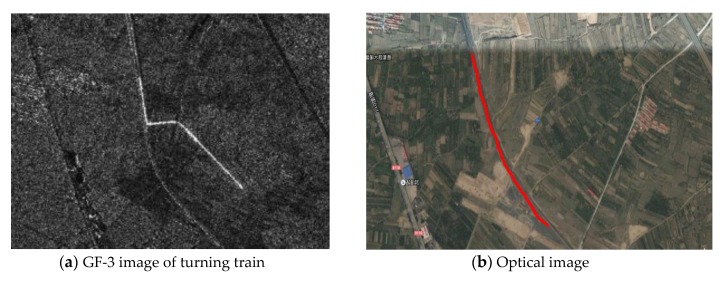
The development of high resolution SAR makes the influence of moving target more prominent, which results in defocusing and other unexplained phenomena. This paper focuses on the research of imaging signatures and velocity estimation of turning motion targets. In this paper, the turning motion is regarded as the straight line motion of continuous change of moving direction. Through the analysis of the straight line motion with constant velocity and the geometric modeling of the turning motion in spaceborne SAR, the imaging signatures of the turning motion target are obtained, such as the broken line phenomenon at the curve. Furthermore, a method for estimating the turning velocity is proposed here. The radial velocity is calculated by the azimuth offset of the turning motion target and the azimuth velocity is calculated by the phase error compensated in the refocusing process. The amplitude and direction of the velocity can be obtained by using both of them. The results of simulation and GF-3 data prove the accuracy of the analysis of turning motion imaging signatures, and they also show the accuracy and validity of the velocity estimation method in this paper.
高分辨率合成孔径雷达(SAR)的发展使得运动目标的影响更加突出,这导致了图像散焦等无法解释的现象。本文重点研究转弯运动目标的成像特征和速度估计。本文将转弯运动视为运动方向连续变化的直线运动。通过对匀速直线运动的分析以及星载SAR中转弯运动的几何建模,得到了转弯运动目标的成像特征,如曲线上的折线现象。此外,本文还提出了一种转弯速度估计方法。通过转弯运动目标的方位偏移计算径向速度,并通过重聚焦过程中补偿的相位误差计算方位速度。利用两者可得到速度的大小和方向。仿真结果和高分三号(GF-3)数据证明了转弯运动成像特征分析的准确性,同时也表明了本文速度估计方法的准确性和有效性。