Sanofi Genzyme, Cambridge, MA, USA.
Sanofi Genzyme, Reading, Berkshire, UK.
Orphanet J Rare Dis. 2020 Apr 15;15(1):92. doi: 10.1186/s13023-020-01354-3.
The GM2 gangliosidoses (GM2), Tay-Sachs and Sandhoff diseases, are rare, autosomal recessive genetic disorders caused by mutations in the lysosomal enzyme β-hexosaminidase A (HEXA) or β-hexosaminidase B (HEXB) genes, respectively. A minority of patients have a late-onset form of disease that presents from late-childhood to adulthood and has a slowly progressive course with prolonged survival. Little research has been published documenting patient experiences with late-onset Tay-Sachs and Sandhoff diseases and how the disease impacts their daily lives and functioning. This study explored the most frequent symptoms and functional impacts experienced by patients with late-onset GM2 gangliosidosis through interviews with patients and caregivers.
A qualitative research study design was employed, using three focus groups and 18 one-on-one interviews with patients who were recruited at the National Tay-Sachs and Allied Diseases Annual Family Conference. Transcripts were generated from the discussions, and patient quotes were analyzed using a content analysis approach. Concepts were aggregated into symptom and functional impacts, and the frequency of mention in the focus groups and individual interviews was calculated.
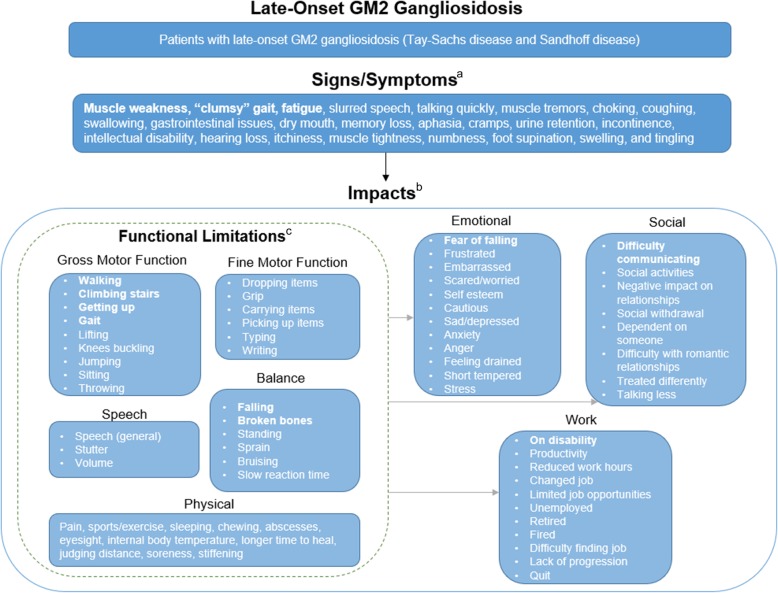
Many of the frequently described symptoms [muscle weakness (n = 19, 95%), "clumsy" gait (n = 12, 60%), fatigue (n = 10, 50%)] and impacts [difficulty walking (n = 19, 95%), falling (n = 17, 85%), and climbing stairs (n = 16, 80%)] disclosed by patients and caregivers were similar to those previously reported in the literature. However, less frequently described symptoms such as gastrointestinal issues (n = 4, 20%) and coughing fits (n = 5, 25%) have been expanded upon. This study evaluated the immediate impact of these symptoms on the patients' lives to highlight the burden of these symptoms and the functional limitations on daily living activities, independence, and emotional well-being. The findings were used to develop a conceptual disease model that could serve as a foundation for patient-centered outcomes in clinical trials and provide insights to the medical community that may benefit patient care.
This study contributes to the current understanding of symptoms associated with late-onset GM2 gangliosidosis, and further identifies the many consequences and impacts of the disease. These symptoms and impacts could be measured in clinical trials to examine the effects of novel treatments from the patient perspective.
GM2 神经节苷脂贮积症(GM2),包括泰萨二氏症和桑德霍夫病,是由溶酶体酶β-己糖胺酶 A(HEXA)或β-己糖胺酶 B(HEXB)基因突变引起的罕见常染色体隐性遗传疾病。少数患者有晚发型疾病,从儿童晚期到成年期发病,具有缓慢进展的过程,生存期延长。关于晚发型泰萨二氏症和桑德霍夫病患者的经历以及疾病如何影响他们的日常生活和功能的研究较少。本研究通过对患者和护理人员的访谈,探讨了晚发型 GM2 神经节苷脂贮积症患者最常见的症状和功能影响。
采用定性研究设计,在全国泰萨二氏症和相关疾病年度家庭会议上招募患者,使用三个焦点小组和 18 个一对一访谈进行研究。讨论的记录被生成,使用内容分析方法对患者的引述进行分析。将概念归纳为症状和功能影响,并计算在焦点小组和个人访谈中的出现频率。
许多经常描述的症状[肌肉无力(n=19,95%)、“笨拙”步态(n=12,60%)、疲劳(n=10,50%)]和影响[行走困难(n=19,95%)、跌倒(n=17,85%)和爬楼梯(n=16,80%)],患者和护理人员都与文献中之前报道的相似。然而,报道较少的症状,如胃肠道问题(n=4,20%)和咳嗽发作(n=5,25%),已被进一步阐明。本研究评估了这些症状对患者生活的直接影响,以强调这些症状的负担以及对日常生活活动、独立性和情绪健康的功能限制。研究结果用于开发一个概念性疾病模型,该模型可以作为临床试验中以患者为中心的结果的基础,并为医疗社区提供可能有益于患者护理的见解。
本研究有助于进一步了解与晚发型 GM2 神经节苷脂贮积症相关的症状,并进一步确定疾病的许多后果和影响。这些症状和影响可以在临床试验中进行测量,从患者的角度检查新疗法的效果。