Molecular Diagnostics and Therapeutics Group, University College London, London, UK.
Trinity Translational Medicine Institute, St. James's Hospital Dublin, Dublin 8, Dublin, Ireland.
Signal Transduct Target Ther. 2020 Jan 31;5(1):7. doi: 10.1038/s41392-020-0109-y.
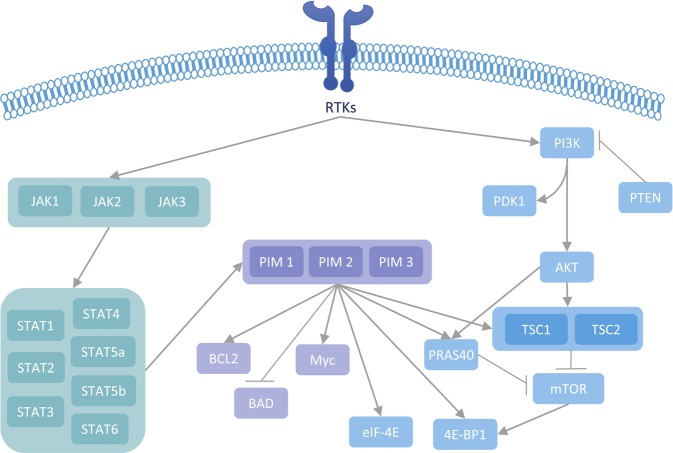
PIM kinases have been shown to play a role in prostate cancer development and progression, as well as in some of the hallmarks of cancer, especially proliferation and apoptosis. Their upregulation in prostate cancer has been correlated with decreased patient overall survival and therapy resistance. Initial efforts to inhibit PIM with monotherapies have been hampered by compensatory upregulation of other pathways and drug toxicity, and as such, it has been suggested that co-targeting PIM with other treatment approaches may permit lower doses and be a more viable option in the clinic. Here, we present the rationale and basis for co-targeting PIM with inhibitors of PI3K/mTOR/AKT, JAK/STAT, MYC, stemness, and RNA Polymerase I transcription, along with other therapies, including androgen deprivation, radiotherapy, chemotherapy, and immunotherapy. Such combined approaches could potentially be used as neoadjuvant therapies, limiting the development of resistance to treatments or sensitizing cells to other therapeutics. To determine which drugs should be combined with PIM inhibitors for each patient, it will be key to develop companion diagnostics that predict response to each co-targeted option, hopefully providing a personalized medicine pathway for subsets of prostate cancer patients in the future.
PIM 激酶已被证明在前列腺癌的发展和进展中发挥作用,以及在癌症的一些特征中发挥作用,特别是增殖和细胞凋亡。在前列腺癌中,它们的上调与患者总生存期的降低和治疗耐药性有关。最初用单药疗法抑制 PIM 的努力受到其他途径的代偿性上调和药物毒性的阻碍,因此,有人建议,用其他治疗方法联合靶向 PIM 可能允许使用更低剂量,并且在临床上更可行。在这里,我们提出了用 PI3K/mTOR/AKT、JAK/STAT、MYC、干性和 RNA 聚合酶 I 转录抑制剂联合靶向 PIM 的原理和基础,以及其他疗法,包括雄激素剥夺、放疗、化疗和免疫疗法。这种联合治疗方法可作为新辅助治疗,限制对治疗的耐药性发展或使细胞对其他治疗药物敏感。为了确定应将哪些药物与 PIM 抑制剂联合用于每位患者,开发预测对每种联合靶向选择反应的伴随诊断将是关键,有望为未来前列腺癌患者的亚组提供个性化药物途径。