Poirier Simon, Luong Ngoc-Du Martin, Anthoine Valérie, Guillou Sandrine, Membré Jeanne-Marie, Moriceau Nicolas, Rezé Sandrine, Zagorec Monique, Feurer Carole, Frémaux Bastien, Jeuge Sabine, Robieu Emeline, Champomier-Vergès Marie, Coeuret Gwendoline, Cauchie Emilie, Daube Georges, Korsak Nicolas, Coroller Louis, Desriac Noémie, Desmonts Marie-Hélène, Gohier Rodérick, Werner Dalal, Loux Valentin, Rué Olivier, Dohollou Marie-Hélène, Defosse Tatiana, Chaillou Stéphane
INRAE, AgroParisTech, Micalis Institute, Université Paris-Saclay, 78350, Jouy-en-Josas, France.
INRAE, UMR1014 Secalim, Oniris, Nantes, France.
Data Brief. 2020 Mar 20;30:105453. doi: 10.1016/j.dib.2020.105453. eCollection 2020 Jun.
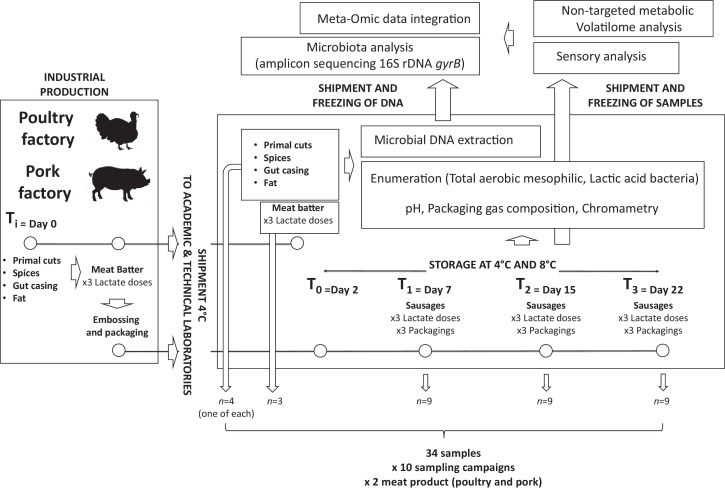
Data in this article provide detailed information on the diversity of bacterial communities present on 576 samples of raw pork or poultry sausages produced industrially in 2017. Bacterial growth dynamics and diversity were monitored throughout the refrigerated storage period to estimate the impact of packaging atmosphere and the use of potassium lactate as chemical preservative. The data include several types of analysis aiming at providing a comprehensive microbial ecology of spoilage during storage and how the process parameters do influence this phenomenon. The analysis includes: the gas content in packaging, pH, chromametric measurements, plate counts (total mesophilic aerobic flora and lactic acid bacteria), sensorial properties of the products, meta-metabolomic quantification of volatile organic compounds and bacterial community metagenetic analysis. Bacterial diversity was monitored using two types of amplicon sequencing (16S rRNA and GyrB encoding genes) at different time points for the different conditions (576 samples for gyrB and 436 samples for 16S rDNA). Sequencing data were generated by using Illumina MiSeq. The sequencing data have been deposited in the bioproject PRJNA522361. Samples accession numbers vary from SAMN10964863 to SAMN10965438 for gyrB amplicon and from SAMN10970131 to SAMN10970566 for 16S.
本文中的数据提供了关于2017年工业生产的576份生猪肉或禽肉香肠样本中存在的细菌群落多样性的详细信息。在冷藏储存期间监测细菌的生长动态和多样性,以评估包装气氛和使用乳酸钾作为化学防腐剂的影响。这些数据包括几种类型的分析,旨在提供储存期间腐败的全面微生物生态学,以及工艺参数如何影响这一现象。分析包括:包装中的气体含量、pH值、色度测量、平板计数(总嗜温需氧菌群和乳酸菌)、产品的感官特性、挥发性有机化合物的元代谢组学定量以及细菌群落宏基因组分析。在不同条件下的不同时间点,使用两种类型的扩增子测序(16S rRNA和编码GyrB的基因)监测细菌多样性(GyrB有576个样本,16S rDNA有436个样本)。测序数据通过Illumina MiSeq生成。测序数据已存入生物项目PRJNA522361。GyrB扩增子的样本登录号从SAMN10964863到SAMN10965438,16S的样本登录号从SAMN10970131到SAMN10970566。