Department of Neurosurgery, The Second Affiliated Hospital of Nanchang University, Nanchang, China.
East China Institute of Digital Medical Engineering, Shangrao, China.
J Cell Mol Med. 2020 May;24(10):5888-5900. doi: 10.1111/jcmm.15264. Epub 2020 Apr 17.
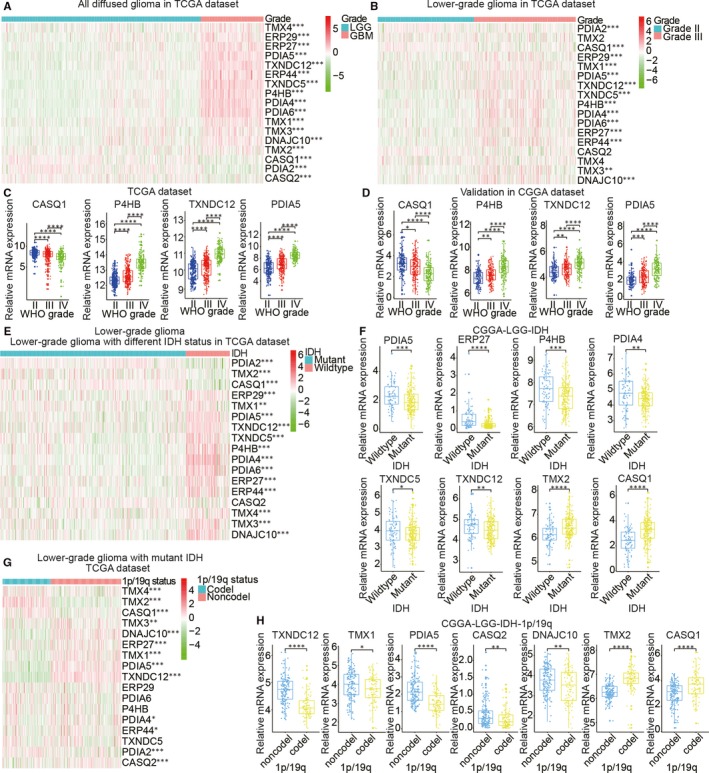
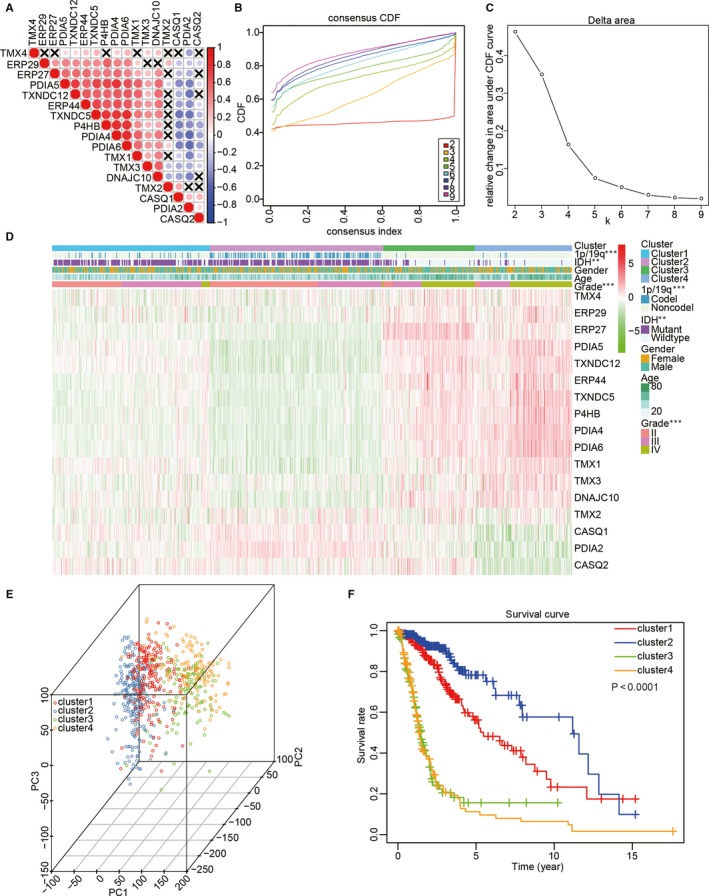
Increasing evidence from structural and functional studies has indicated that protein disulphide isomerase (PDI) has a critical role in the proliferation, survival and metastasis of several types of cancer. However, the molecular mechanisms through which PDI contributes to glioma remain unclear. Here, we aimed to investigate whether the differential expression of 17 PDI family members was closely related to the different clinicopathological features in gliomas from The Cancer Genome Atlas (TCGA) and Chinese Glioma Genome Atlas data sets. Additionally, four subgroups of gliomas (cluster 1/2/3/4) were identified based on consensus clustering of the PDI gene family. These findings not only demonstrated that a poorer prognosis, higher WHO grade, lower frequency of isocitrate dehydrogenase mutation and higher 1p/19q non-codeletion status were significantly correlated with cluster 4 compared with the other clusters, but also indicated that the malignant progression of glioma was closely correlated with the expression of PDI family members. Moreover, we also constructed an independent prognostic marker that can predict the clinicopathological features of gliomas. Overall, the results indicated that PDI family members may serve as possible diagnostic markers in gliomas.
越来越多的结构和功能研究证据表明,蛋白质二硫键异构酶(PDI)在多种类型癌症的增殖、存活和转移中具有关键作用。然而,PDI 促进神经胶质瘤的分子机制尚不清楚。在这里,我们旨在研究 17 种 PDI 家族成员的差异表达是否与 TCGA 和中国神经胶质瘤基因组图谱数据集的胶质瘤不同临床病理特征密切相关。此外,根据 PDI 基因家族的共识聚类,确定了四个胶质瘤亚组(簇 1/2/3/4)。这些发现不仅表明与其他簇相比,预后较差、WHO 分级较高、异柠檬酸脱氢酶突变频率较低和 1p/19q 非缺失状态较高与簇 4 显著相关,而且表明神经胶质瘤的恶性进展与 PDI 家族成员的表达密切相关。此外,我们还构建了一个独立的预后标志物,可以预测神经胶质瘤的临床病理特征。总的来说,结果表明 PDI 家族成员可能是神经胶质瘤的潜在诊断标志物。