Division of Gastroenterological Surgery, Department of General Surgical Science, Gunma University Graduate School of Medicine, Maebashi, Japan.
Department of Oncology Clinical Development, Gunma University Graduate School of Medicine, Maebashi, Japan.
Cancer Sci. 2020 Jun;111(6):1969-1978. doi: 10.1111/cas.14421. Epub 2020 May 12.
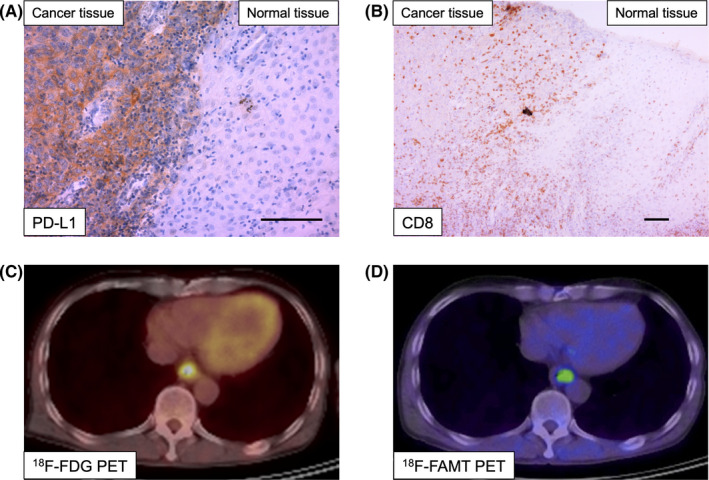
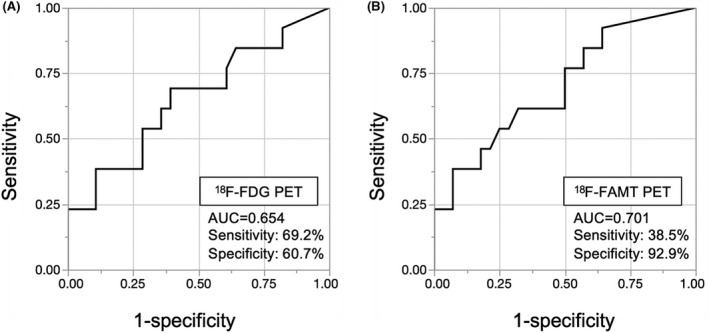
The relationship between the local immune status and cancer metabolism regarding F-FDG and F-FAMT uptake in esophageal squamous cell carcinoma (ESCC) remains unknown. The present study examined the correlations between tumor immune status, clinicopathological factors, and positron emission tomography (PET) tracer uptake in ESCC. Forty-one ESCC patients who underwent F-FDG PET and F-FAMT PET before surgery were enrolled in the study. Immunohistochemistry was conducted for programmed death 1 (PD-1), CD8, Ki-67, CD34, GLUT1 ( F-FDG transporter) and LAT1 ( F-FAMT transporter). ESCC specimens with high tumoral PD-L1 and high CD8-positive lymphocytes were considered to have "hot tumor immune status." High PD-L1 expression (53.7%) was significantly associated with tumor/lymphatic/venous invasion (P = 0.028, 0.032 and 0.018), stage (P = 0.041), CD8-positive lymphocytes (P < 0.001), GLUT1 (P < 0.001), LAT1 expression (P = 0.006), Ki-67 labelling index (P = 0.009) and CD34-positive vessel counts (P < 0.001). SUVmax of F-FDG was significantly higher in high PD-L1 cases than in low PD-L1 cases (P = 0.009). SUVmax of F-FAMT was significantly higher in high PD-L1 (P < 0.001), high CD8 (P = 0.012) and hot tumor groups (P = 0.028) than in other groups. High SUVmax of F-FAMT (≥4.15) was identified as the only predictor of hot tumor immune status. High PET tracer uptake was significantly associated with cancer aggressiveness and hot tumor immune status in ESCC. PET imaging may be an effective tool to predict tumor immune status in ESCC with respect to immune checkpoint inhibitor sensitivity.
食管癌(ESCC)中局部免疫状态与癌症代谢之间的关系尚不清楚, F-FDG 和 F-FAMT 摄取与肿瘤免疫状态、临床病理因素之间的相关性。本研究分析了 41 例 ESCC 患者术前 F-FDG PET 和 F-FAMT PET 检查结果与肿瘤免疫状态、临床病理因素的相关性。采用免疫组化法检测程序性死亡受体 1(PD-1)、CD8、Ki-67、CD34、葡萄糖转运蛋白 1( F-FDG 转运体)和溶质载体家族 19 成员 1( F-FAMT 转运体)。肿瘤 PD-L1 高表达和 CD8 阳性淋巴细胞浸润高的 ESCC 标本被认为具有“热肿瘤免疫状态”。PD-L1 高表达(53.7%)与肿瘤/淋巴管/静脉侵犯(P=0.028,0.032 和 0.018)、分期(P=0.041)、CD8 阳性淋巴细胞(P<0.001)、GLUT1(P<0.001)、LAT1 表达(P=0.006)、Ki-67 标记指数(P=0.009)和 CD34 阳性血管计数(P<0.001)显著相关。高 PD-L1 组 F-FDG 的 SUVmax 显著高于低 PD-L1 组(P=0.009)。高 PD-L1(P<0.001)、高 CD8(P=0.012)和热肿瘤组(P=0.028)的 F-FAMT 的 SUVmax 显著高于其他组。高 F-FAMT SUVmax(≥4.15)是热肿瘤免疫状态的唯一预测因子。高 PET 示踪剂摄取与 ESCC 的侵袭性和热肿瘤免疫状态显著相关。PET 成像可能是一种有效的工具,可用于预测 ESCC 肿瘤免疫状态及其对免疫检查点抑制剂的敏感性。