Department of Cardiac, Vascular and Endovascular Surgery and Transplantation, Silesian Center for Heart Diseases, Faculty of Medical Science in Zabrze, Medical University of Silesia, Katowice, Poland.
Department of Cardiology, Congenital Heart Diseases and Electrotherapy, Silesian Center for Heart Diseases, Faculty of Medical Science in Zabrze, Medical University of Silesia, Katowice, Poland.
Int J Cardiovasc Imaging. 2020 Aug;36(8):1429-1436. doi: 10.1007/s10554-020-01838-0. Epub 2020 Apr 17.
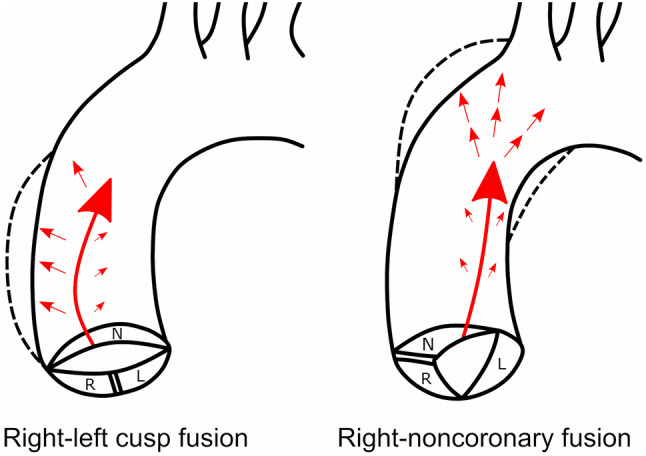
The ascending aorta dilatation in the bicuspid aortic valve (BAV) patients is often attributed to congenital abnormalities of the aortic wall, but it may be related to hemodynamic disturbances in the course of BAV disease. At present, ascending aortic diameter is used as almost sole but weak predictor of aortic dissection and rupture in BAV. We examined the association between aortic wall mechanics and severity of aortic valve disease including different cusps fusion patterns using conventional echocardiography and tissue Doppler imaging (TDI). We prospectively studied 106 BAV patients: 72 with right-left (R-L) coronary cusp fusion were matched 1:1 to 34 patients with right-noncoronary (R-N) cusp fusion obtaining 34 pairs of patients. Peak systolic radial velocity and acceleration of the ascending aortic wall, measured by TDI, were used as an index of hemodynamic stress imposed on the aorta. Paired analysis showed higher aortic wall radial velocity (4.71 ± 1.61 cm/s vs. 3.33 ± 1.44 cm/s, p = 0.001) and acceleration (1.08 ± 0.46 m/s vs. 0.80 ± 0.34 m/s, p = 0.015) in-R-L compared to R-N fusion. Pearson correlation showed association of ascending tubular aortic diameter with age (r = 0.258, p = 0.012), weight (r = 0.323, p = 0.001), peak aortic valve gradient (r = 0.386, p = 0.0001), aortic root diameter (r = 0.439, p < 0.0001), and R-N fusion pattern (r = 0.209, p = 0.043). Aortic root diameter was related to male gender (r = 0.296, p = 0.003), weight (r = 0.381, p = 0.0001), ascending aortic diameter (r = 0.439, p < 0.0001), and severity of aortic regurgitation (r = 0.337, p = 0.0009). Regional differences in aortic wall motion between different BAV cusp fusion patterns and association of aortic diameters with the severity of aortic valve disease, both suggest a deleterious hemodynamic impact of cusp fusion patterns and aortic valve dysfunction on ascending aortic wall. Assessment of aortic hemodynamic by TDI is feasible and could be potentially used to improve prediction of acute aortic complications, thus helping to establish optimal timing of aortic surgery in BAV patients.
升主动脉扩张在二叶式主动脉瓣(BAV)患者中通常归因于主动脉壁的先天性异常,但它可能与 BAV 疾病过程中的血流动力学紊乱有关。目前,升主动脉直径被用作 BAV 中主动脉夹层和破裂的几乎唯一但较弱的预测因子。我们使用常规超声心动图和组织多普勒成像(TDI)检查了主动脉壁力学与主动脉瓣疾病严重程度之间的关系,包括不同的瓣叶融合模式。我们前瞻性研究了 106 例 BAV 患者:72 例为右-左(R-L)冠状动脉瓣叶融合,与 34 例右-非冠状动脉(R-N)瓣叶融合相匹配,获得 34 对患者。通过 TDI 测量的升主动脉壁的收缩期径向速度和加速度峰值被用作施加在主动脉上的血流动力学应激的指标。配对分析显示,与 R-N 融合相比,R-L 融合中的主动脉壁径向速度更高(4.71 ± 1.61 cm/s 比 3.33 ± 1.44 cm/s,p = 0.001),加速度更高(1.08 ± 0.46 m/s 比 0.80 ± 0.34 m/s,p = 0.015)。Pearson 相关性显示,升主动脉管状直径与年龄(r = 0.258,p = 0.012)、体重(r = 0.323,p = 0.001)、峰值主动脉瓣梯度(r = 0.386,p = 0.0001)、主动脉根部直径(r = 0.439,p < 0.0001)和 R-N 融合模式(r = 0.209,p = 0.043)相关。主动脉根部直径与男性性别(r = 0.296,p = 0.003)、体重(r = 0.381,p = 0.0001)、升主动脉直径(r = 0.439,p < 0.0001)和主动脉瓣反流严重程度(r = 0.337,p = 0.0009)相关。不同 BAV 瓣叶融合模式之间主动脉壁运动的区域差异以及主动脉直径与主动脉瓣疾病严重程度的关系均表明,瓣叶融合模式和主动脉瓣功能障碍对升主动脉壁有有害的血流动力学影响。TDI 评估主动脉血流动力学是可行的,可能有助于提高急性主动脉并发症的预测能力,从而有助于确定 BAV 患者主动脉手术的最佳时机。