Department of Internal Medicine, Gangnam Severance Hospital, Yonsei University College of Medicine, 211 Eonju-ro, Gangnam-gu, Seoul, 06273, South Korea.
BMC Gastroenterol. 2020 Apr 18;20(1):113. doi: 10.1186/s12876-020-01236-9.
Hepatitis B e antigen (HBeAg) seroclearance has been considered as the treatment endpoint in HBeAg-positive patients with chronic hepatitis B (CHB). Although HBeAg seroclearance has been accomplished, some aspects are yet unclear. We investigated the cumulative incidence of hepatocellular carcinoma (HCC) and evaluated hepatitis B surface antigen (HBsAg) seroclearance in patients undergoing nucleos(t) ide analogue (NA)-induced HBeAg seroclearance.
In this retrospective cohort study, 203 patients with CHB were HBsAg and HBeAg seropositive before NA (entecavir or tenofovir) treatment. All patient who experienced NA -induced HBeAg seroclearance were recruited. Patients with documented HBeAg seroclearance were followed-up every 6 months. Baseline characteristics and laboratory results were recorded.
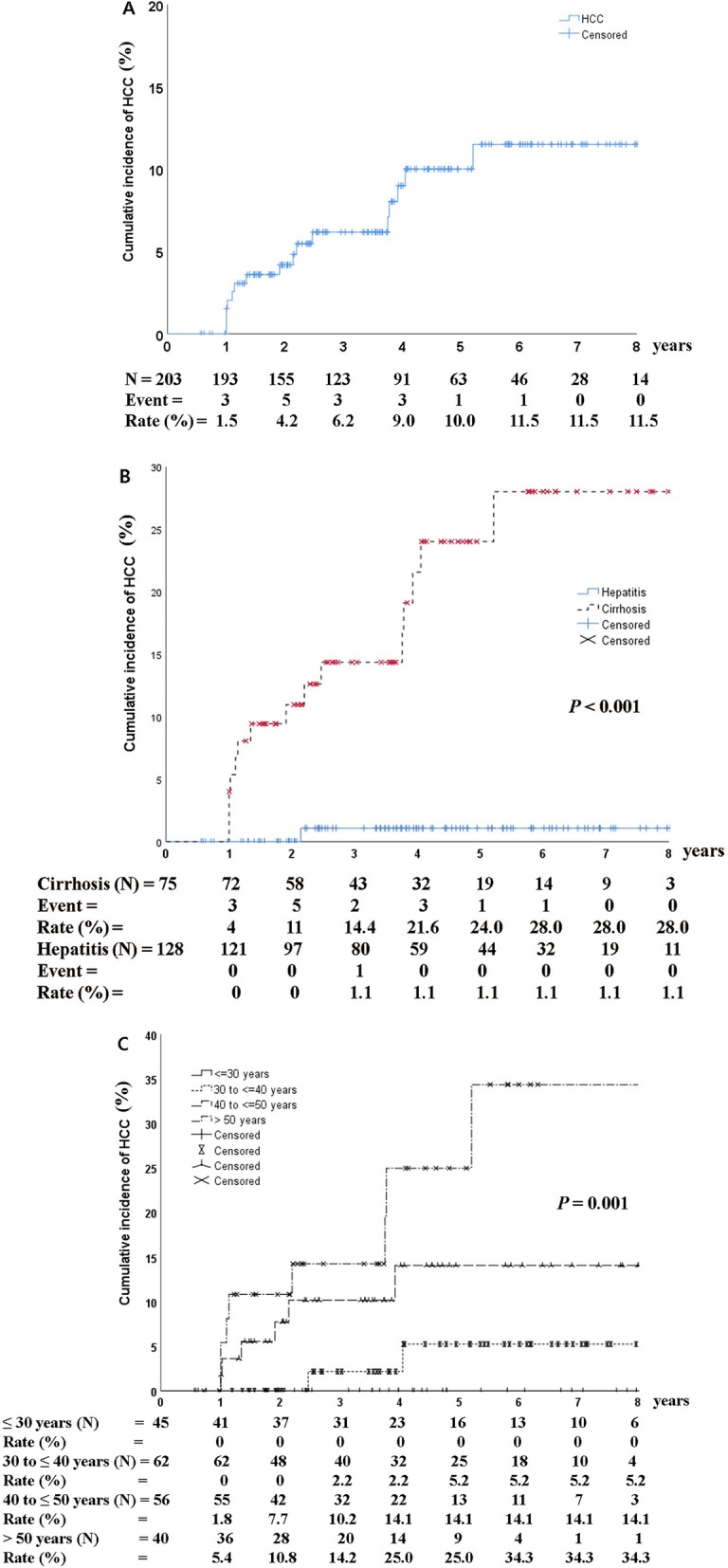
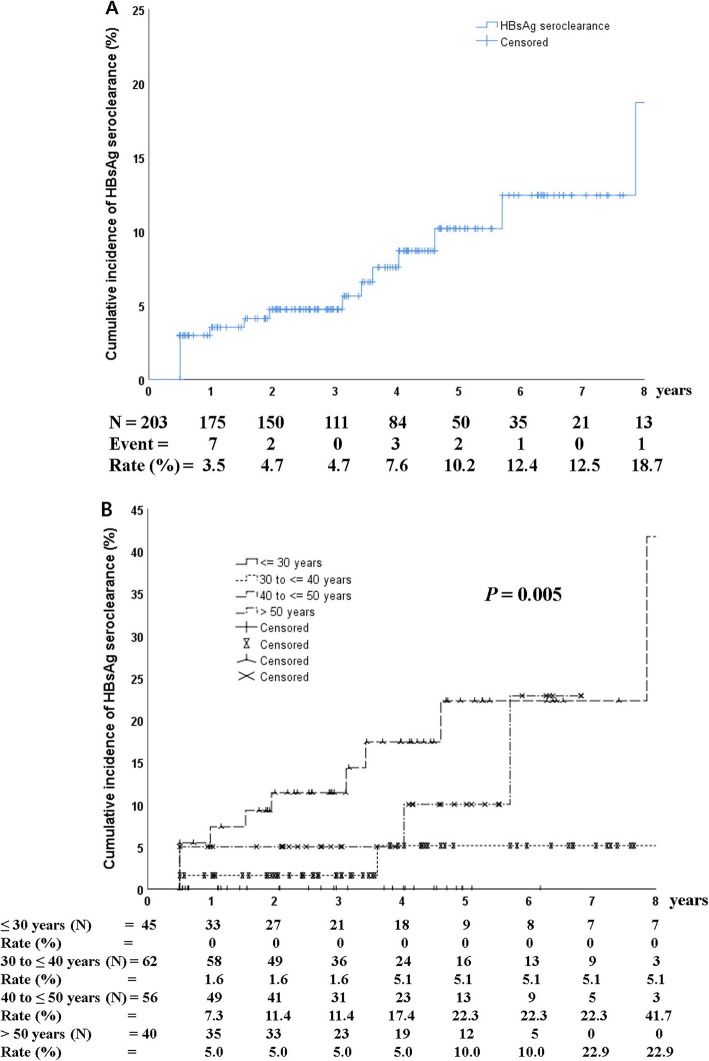
The mean age at HBeAg seroclearance was 40 years (range, 20-84), and the mean follow-up duration was 5 years (range, 2-11). The cumulative incidence of HCC was 1.5 to 11.5% at 1 to 8 years after HBeAg seroclearance. Cirrhosis was the only significant factor for HCC development (hazard ratio [HR], 24.651; confidence interval [CI], 3.018 to 201.365; P = 0.003). The cumulative incidence of HBsAg seroclearance was 3.5 to 18.7% after 1 to 8 years from HBeAg seroclearance.
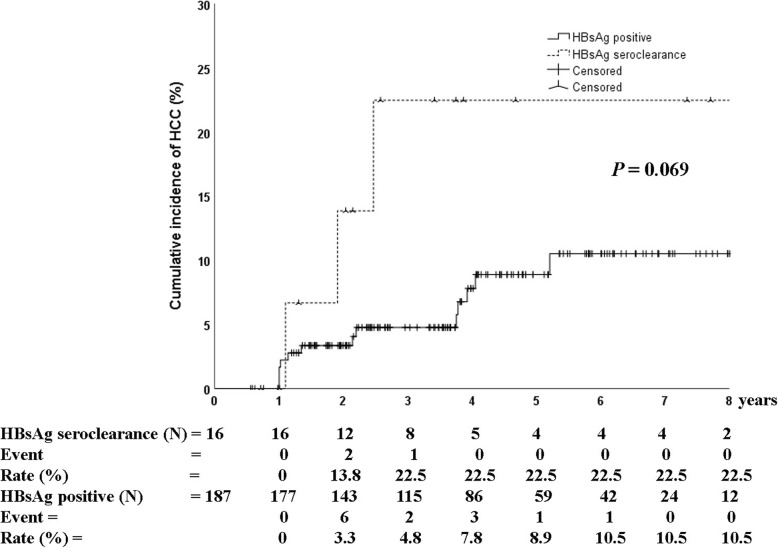
A significant proportion of patients developed HCC after NA-induced HBeAg seroclearance. The presence of liver cirrhosis at the time of HBeAg seroclearance serves as an independent factor for HCC development. Some patients with NA-induced HBeAg seroclearance achieved HBsAg seroclearance.
乙肝 e 抗原(HBeAg)血清学转换已被认为是慢性乙型肝炎(CHB)HBeAg 阳性患者的治疗终点。尽管已经实现了 HBeAg 血清学转换,但仍有一些方面尚不清楚。我们调查了接受核苷(酸)类似物(NA)诱导 HBeAg 血清学转换的患者中肝细胞癌(HCC)的累积发生率,并评估了乙型肝炎表面抗原(HBsAg)血清学转换。
在这项回顾性队列研究中,203 名 CHB 患者在 NA(恩替卡韦或替诺福韦)治疗前 HBsAg 和 HBeAg 均为阳性。所有经历过 NA 诱导 HBeAg 血清学转换的患者均被招募。有记录的 HBeAg 血清学转换的患者每 6 个月随访一次。记录了基线特征和实验室结果。
HBeAg 血清学转换时的平均年龄为 40 岁(范围,20-84),平均随访时间为 5 年(范围,2-11)。HBeAg 血清学转换后 1 至 8 年 HCC 的累积发生率为 1.5%至 11.5%。肝硬化是 HCC 发展的唯一显著因素(风险比[HR],24.651;置信区间[CI],3.018 至 201.365;P=0.003)。HBeAg 血清学转换后 1 至 8 年,HBsAg 血清学转换的累积发生率为 3.5%至 18.7%。
相当一部分患者在 NA 诱导的 HBeAg 血清学转换后发生 HCC。HBeAg 血清学转换时存在肝硬化是 HCC 发展的独立因素。一些接受 NA 诱导的 HBeAg 血清学转换的患者实现了 HBsAg 血清学转换。