Atalla Ahmed Ibrahim, AboulFotouh Mai Hamdy, Fahim Fady Hussein, Foda Manal Yehia
Department of Orthodontic, Faculty of Oral and Dental Medicine, Cairo University, Cairo, Egypt.
Contemp Clin Dent. 2019 Apr-Jun;10(2):372-381. doi: 10.4103/ccd.ccd_618_18.
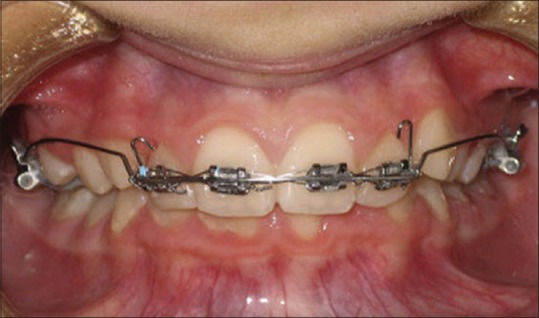
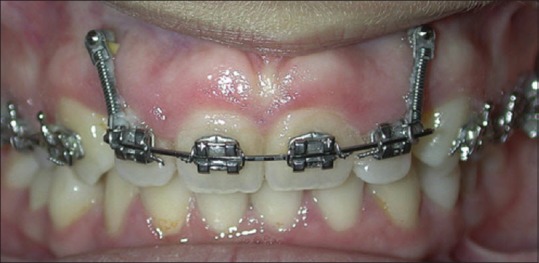
The aim of this systematic review was to compare the effectiveness of temporary anchorage devices (TADs) and conventional segmented arches (CSAs) during incisor intrusion in adult patients with a deep bite and their adverse effects.
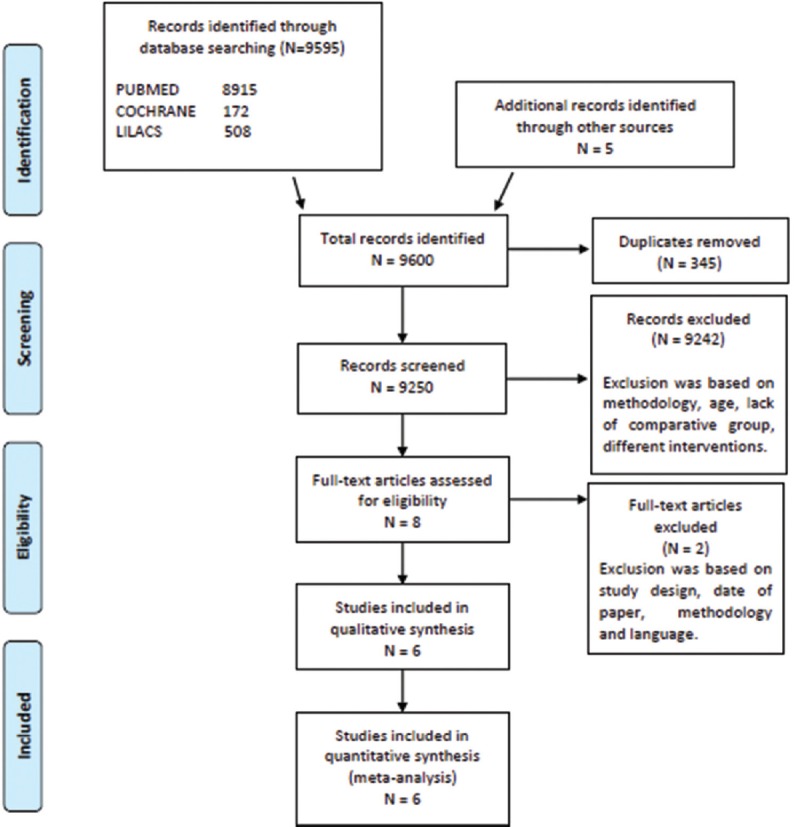
Four electronic databases were searched. In addition, articles were manually searched for using the reference lists of relevant articles, grey literature, and peer-reviewed orthodontic journals.
Data from the retrieved articles were selected and evaluated by two independent reviewers using a new systematic review software program, DistillerSR. A meta-analysis of raw mean differences was performed.
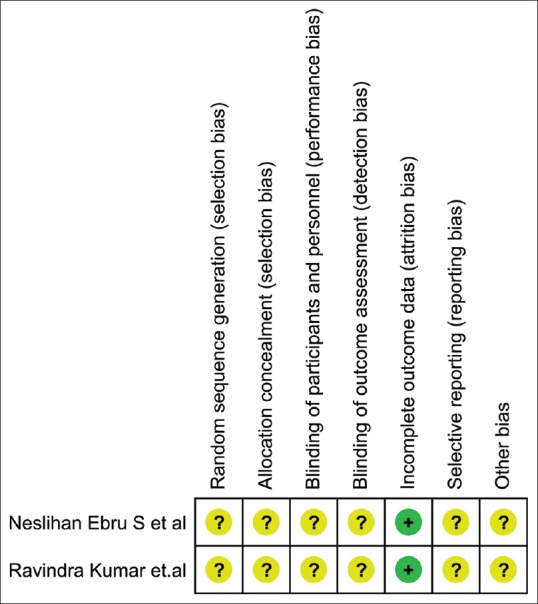
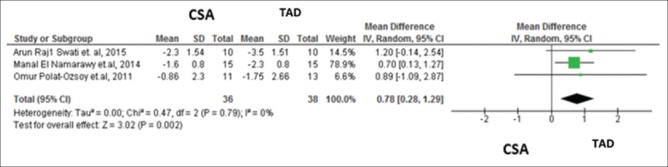
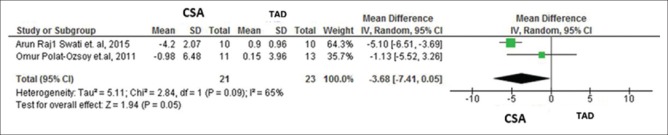
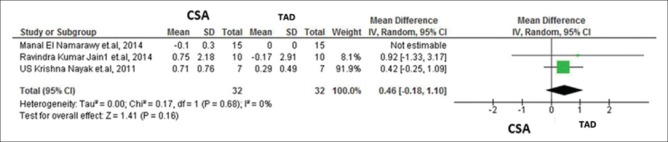
Initially, we retrieved 9600 articles, but the selection process resulted in six articles. The included studies ranged from low to high in quality. Meta-analysis showed that TADs enabled 0.78 mm more upper incisor intrusion than the conventional method (95% confidence interval [CI] = 0.28-1.29). There was no significant anchorage loss difference in the CSA group compared to the TAD group (mean difference [MD] -3.68; 95% CI -7.41-0.05). Furthermore, a significant molar tipping of 1.03° was observed in the CSA group ( = 0.008) compared to the TAD group (MD -1.03; 95% CI -1.79--0.27).
The results of this meta-analysis showed that patients receiving TADs had 0.78 mm greater upper incisor intrusion than patients receiving the conventional treatment. This was statistically significant, but not clinically relevant. No clinical difference was found between TADs and the conventional method of anchorage loss.
本系统评价旨在比较临时支抗装置(TADs)与传统片段弓(CSAs)在成年深覆合患者切牙内收过程中的有效性及其不良反应。
检索了四个电子数据库。此外,还通过相关文章的参考文献列表、灰色文献和同行评审的正畸期刊手动检索文章。
使用新的系统评价软件程序DistillerSR,由两名独立的评审员对检索到的文章数据进行选择和评估。对原始平均差异进行荟萃分析。
最初,我们检索到9600篇文章,但筛选过程后得到6篇文章。纳入的研究质量从低到高不等。荟萃分析表明,与传统方法相比,TADs可使上前牙多内收0.78mm(95%置信区间[CI]=0.28 - 1.29)。与TAD组相比,CSA组在支抗丧失方面无显著差异(平均差异[MD]-3.68;95%CI - 7.41 - 0.05)。此外,与TAD组相比,CSA组观察到显著的磨牙倾斜1.03°(P = 0.008)(MD - 1.03;95%CI - 1.79 - - 0.27)。
本荟萃分析结果表明,接受TADs治疗的患者上前牙内收比接受传统治疗的患者多0.78mm。这在统计学上具有显著性,但在临床上无相关性。在TADs与传统支抗丧失方法之间未发现临床差异。