1Department of Cardiovascular Surgery, The Second Hospital of Jilin University, Changchun, 130041 China.
2Department of Pathology and Laboratory Medicine, Western University, London, Ontario Canada.
Cell Mol Biol Lett. 2020 Apr 9;25:26. doi: 10.1186/s11658-020-00206-z. eCollection 2020.
Oxidative stress results in cell apoptosis/death and plays a detrimental role in disease development and progression. Stressors alter the miRNA expression profile and miRNAs play a role in the cell response to stress. We previously showed that miR-711 is significantly over-expressed in extended cold ischemia reperfusion injured hearts in heart transplant. In this study, we aimed to investigate the role of miR-711 in cardiac cell damage in response to oxidative stress and how miR-711 is regulated.
Rat cardiac cell line H9c2 cells were cultured and exposed to oxidative conditions (Antimycin A (AA), HO, CoCl, or cold hypoxia/reoxygenation (H/R)) in vitro. H9c2 cells were transfected with miR-711 mimics, miR-711 inhibitors, or small interference RNA, using transfection reagents. The expression of miR-711 was measured by quantitative reverse transcriptase-polymerase chain reaction (qRT-PCR). Cell apoptosis/death was detected by flow cytometry and an IncuCyte system. Mitochondrial damage was detected by measuring the mitochondria membrane potential by flow cytometry. Gene expression was detected by qRT-PCR at the mRNA level and Western blotting and immunocytochemistry staining at the protein level.
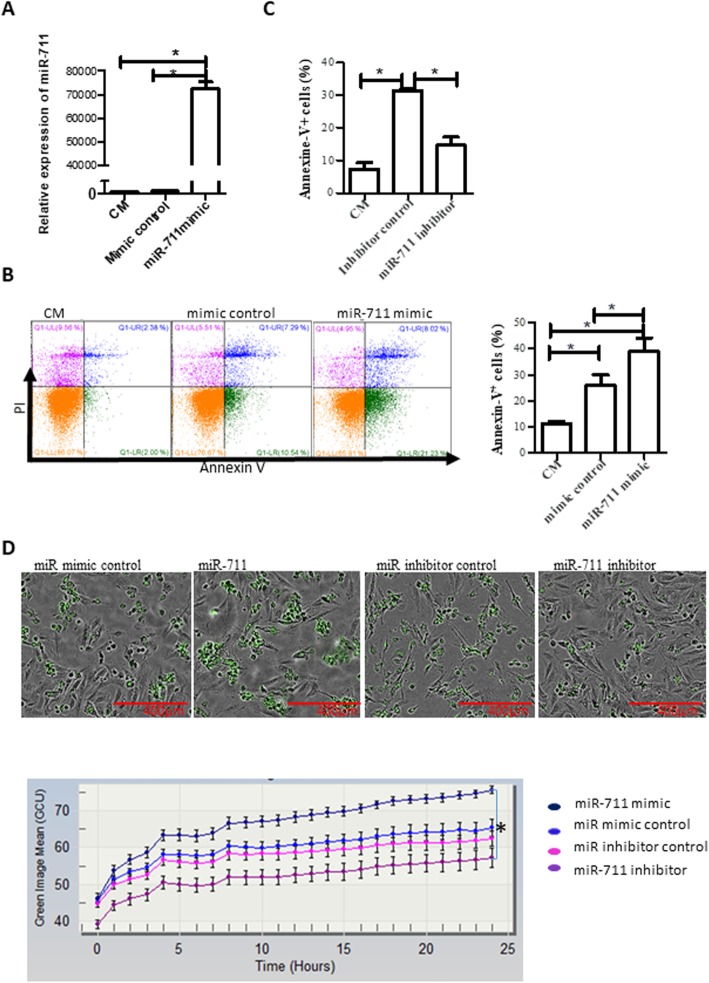
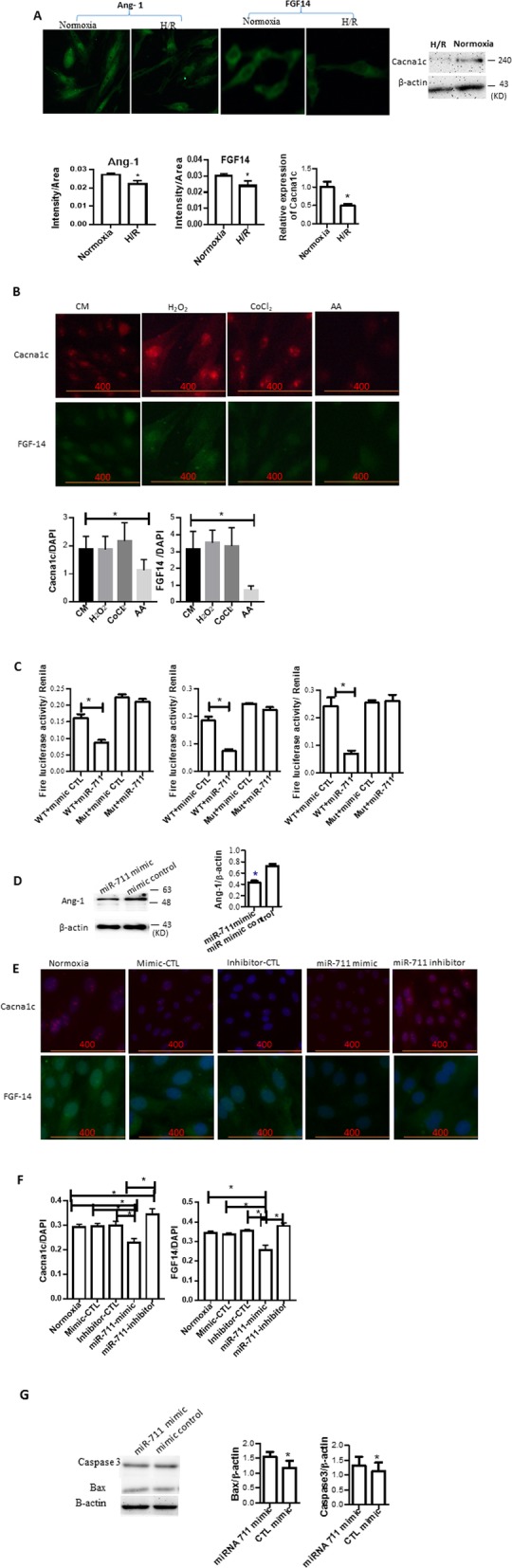
We found that miR-711 was significantly up-regulated in cells treated with HO, AA, CoCl, and cold H/R. Over-expression of miR-711 increased cell apoptosis/death induced by AA and H/R whereas cell death was reduced by miR-711 inhibitors. MiR-711 induced cell death through negative regulation of angiopoietin 1 (Ang-1), fibroblast growth factor 14 (FGF14) and calcium voltage-gated channel subunit alpha1C (Cacna1c) genes. Both knockdown of hypoxia inducible factor 1α (HIF-1α) and inactivation of the nuclear factor kappa-light-chain-enhancer of activated B cells (NFКB) pathway inhibited over-expression of miR-711.
Oxidative stress increases the expression of miR-711. Over-expression of miR-711 induces cell apoptosis/death. HIF-1α and NFКB regulate miR-711 in H9c2 cells during oxidative stress. miR-711 is a new target for preventing oxidative stress.
氧化应激导致细胞凋亡/死亡,并在疾病的发展和进展中起有害作用。应激源改变 miRNA 的表达谱,miRNA 在细胞对应激的反应中起作用。我们之前的研究表明,miR-711 在心脏移植中延长冷缺血再灌注损伤的心脏中显著过表达。在这项研究中,我们旨在研究 miR-711 在心脏细胞对氧化应激损伤中的作用以及 miR-711 是如何被调节的。
培养大鼠心肌细胞系 H9c2 细胞,并在体外暴露于氧化条件下(安替比林 A(AA)、HO、CoCl2 或冷缺氧/复氧(H/R))。使用转染试剂将 miR-711 模拟物、miR-711 抑制剂或小干扰 RNA 转染到 H9c2 细胞中。通过定量逆转录聚合酶链反应(qRT-PCR)测量 miR-711 的表达。通过流式细胞术和 IncuCyte 系统检测细胞凋亡/死亡。通过流式细胞术测量线粒体膜电位来检测线粒体损伤。通过 qRT-PCR 在 mRNA 水平、Western blot 和免疫细胞化学染色在蛋白质水平检测基因表达。
我们发现,HO、AA、CoCl2 和冷 H/R 处理的细胞中 miR-711 显著上调。miR-711 的过表达增加了 AA 和 H/R 诱导的细胞凋亡/死亡,而 miR-711 抑制剂则减少了细胞死亡。miR-711 通过负调控血管生成素 1(Ang-1)、成纤维细胞生长因子 14(FGF14)和钙电压门控通道亚基 alpha1C(Cacna1c)基因诱导细胞死亡。缺氧诱导因子 1α(HIF-1α)的敲低和核因子 kappa-轻链增强子的激活 B 细胞(NFκB)通路的失活均抑制了 miR-711 的过表达。
氧化应激增加了 miR-711 的表达。miR-711 的过表达诱导细胞凋亡/死亡。在 H9c2 细胞氧化应激过程中,HIF-1α 和 NFκB 调节 miR-711。miR-711 是预防氧化应激的新靶点。