Mandhwani Rajesh, Hanif Farina M, Lail Ghulamullah, Luck Nasir Hassan, Khalid Muhammad Ali, Ul Haque Muhammad Manzoor, Laeeq Syed Mudassir, Aziz Tahir
Department of Hepatogastroenterology, Sindh Institute of Urology and Transplantation, Karachi, Pakistan.
Department of Nephrology and Transplant Sciences, Sindh Institute of Urology and Transplantation, Karachi, Pakistan.
Gastroenterol Hepatol Bed Bench. 2020 Spring;13(2):141-146.
we aimed to determine the virological response and safety of Sofosbuvir-based direct-acting antiviral agents (DAAs) in chronic hepatitis C (CHC) patients on long-term hemodialysis (HD).
With the advent of interferon-free DAAs, the treatment of CHC has been revolutionized. Pakistan is among the countries where novel sofosbuvir (SOF)-free antiviral agents are not available.
This non-randomized, single-arm, open-label study enrolled all HD patients with chronic HCV infection after informed consent. They were treated with SOF in combination with Ribavirin (RBV) with either interferon (IFN group) or daclatasvir (DAC group), with the virological response assessed according to standard guidelines. Data were analyzed using SPSS version 20.00.
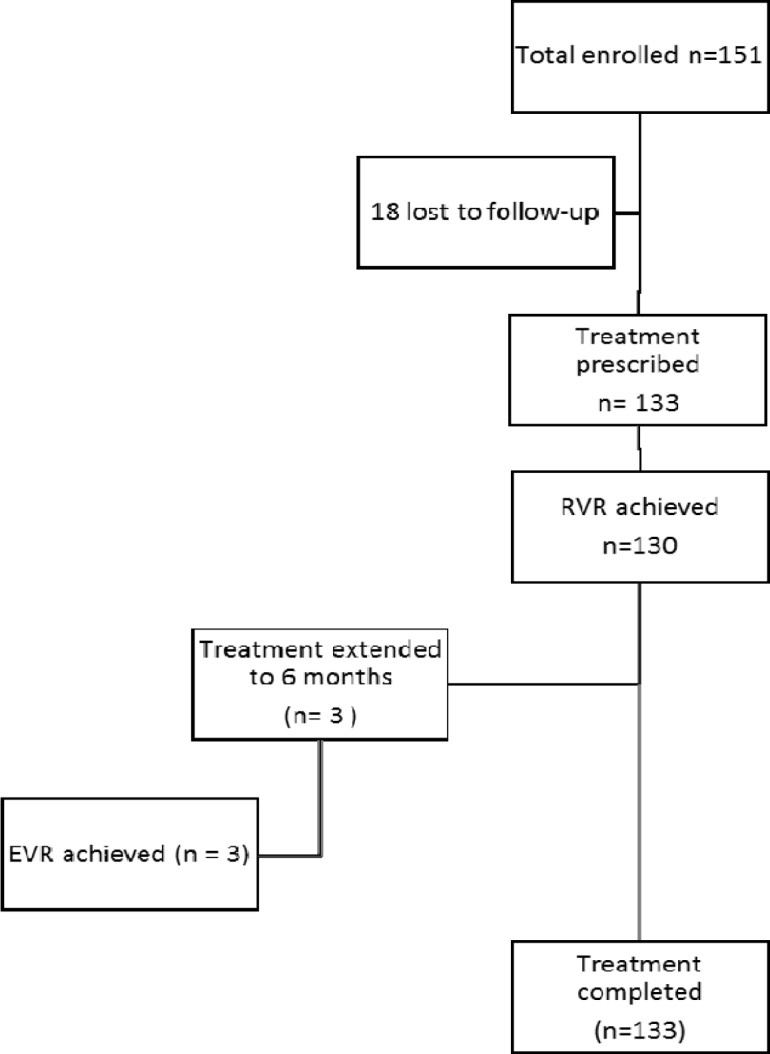
Out of 133 patients, the majority (72.9%) were males with the mean age of 31.92 ± 9.88 years. Most patients (50.3%) had HCV genotype (GN) 1, followed by GN 3 in 42.9%, 4 in 1.48% and 2 in 0.7%, while mix GN was documented in 6 (4.4%) patients. Among these, 60 (45.1 %) patients received standard SOF, IFN, and RBV (IFN group) and 73 (54.9 %) received SOF, DAC and RBV (DAC group). End of treatment and sustained virological response at 12 weeks post-treatment were achieved in 133 (100%) and 129 (97 %) patients, respectively. The adverse effects were anemia in 58 (43.6 %) patients and elevated alanine transaminases in 11 (8.1%) patients.
SOF in combination with either IFN or DAC is an equally efficacious and effective treatment regimen for patients on maintenance HD, especially in resource-poor countries.
我们旨在确定基于索磷布韦的直接作用抗病毒药物(DAA)在接受长期血液透析(HD)的慢性丙型肝炎(CHC)患者中的病毒学应答及安全性。
随着无干扰素DAA的出现,CHC的治疗发生了变革。巴基斯坦是无法获得新型不含索磷布韦(SOF)抗病毒药物的国家之一。
本项非随机、单臂、开放标签研究纳入了所有在获得知情同意后患有慢性HCV感染的HD患者。他们接受索磷布韦联合利巴韦林(RBV)治疗,联合使用干扰素(IFN组)或达卡他韦(DAC组),并根据标准指南评估病毒学应答。使用SPSS 20.00版进行数据分析。
133例患者中,大多数(72.9%)为男性,平均年龄为31.92±9.88岁。大多数患者(50.3%)为HCV基因(GN)1型,其次是GN 3型(42.9%)、GN 4型(1.48%)和GN 2型(0.7%),而6例(4.4%)患者记录为混合基因类型。其中,60例(45.1%)患者接受标准的索磷布韦、干扰素和利巴韦林治疗(IFN组),73例(54.9%)患者接受索磷布韦、达卡他韦和利巴韦林治疗(DAC组)。分别有133例(100%)和129例(97%)患者在治疗结束时及治疗后12周达到持续病毒学应答。不良反应包括58例(43.6%)患者出现贫血,11例(8.1%)患者出现丙氨酸转氨酶升高。
索磷布韦联合干扰素或达卡他韦对于维持性血液透析患者是同样有效且高效的治疗方案,尤其是在资源匮乏的国家。