Fu Hanhui, Zhang Dingding, Zhu Rui, Cui Liying, Qiu Ling, Lin Songbai, Peng Bin
Department of Neurology, Peking Union Medical College Hospital, Chinese Academy of Medical Sciences, Beijing 100730, China.
Central Research Laboratory, Peking Union Medical College Hospital, Chinese Academy of Medical Sciences and Peking Union Medical College, Beijing 100730, China.
Ann Transl Med. 2020 Mar;8(5):212. doi: 10.21037/atm.2020.01.38.
Lipoprotein(a) [Lp(a)] is a risk factor of coronary heart disease, however, its effects on stroke are less well-defined.
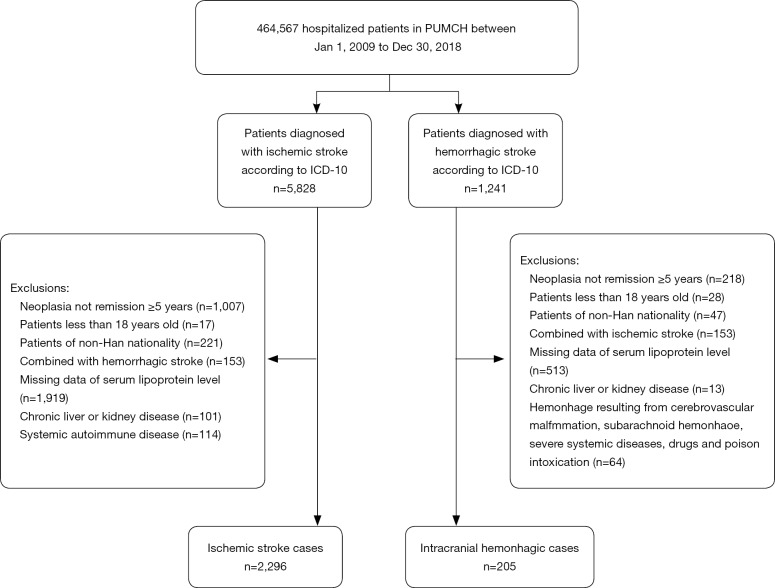
We performed a single-center, retrospective case-control study in 1,953 and 196 ischemic stroke and hemorrhagic stroke in-hospital patients, respectively. Controls were healthy individuals that were matched for sex and age (±5 years) for the ischemic (1:1 ratio) and hemorrhagic (1:2 ratio) stroke. Lp(a) concentration was measured using the latex agglutination turbidimetric method. Logarithmic transformation and quartile categorization were applied to adjust for the skewed distribution of Lp(a). Conditional logistic regression models were used to assess the association between Lp(a) and stroke risk.
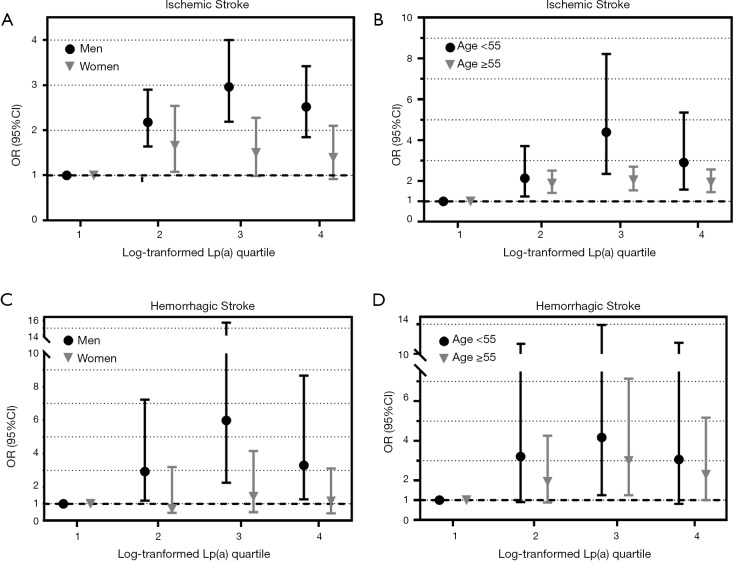
Median Lp(a) concentration was higher in stroke patients when compared with controls (12.2 . 8.60 mg/dL) and hemorrhagic strokes (14.40 13.40 mg/dL). The conditional multivariate analysis revealed a positive association between Lp(a) and ischemic stroke (OR =2.03, 2.36, and 2.03 for quartiles 2, 3 and 4, respectively, . quartile 1; P<0.001). In addition, elevated Lp(a) was also significantly associated with increased hemorrhagic stroke risk, after adjusted for potential covariates (OR =1.93, 3.24, and 2.19 for quartile 2, 3 and 4 respectively quartile 1, P<0.05). The stratified analyses for ischemic and hemorrhagic stroke revealed significant association between elevated log-transformed Lp(a) and ischemic stroke in men. Furthermore, there was a trend towards a higher stroke risk for younger patients compared with older patients.
Elevated serum Lp(a) is significantly positively correlated with ischemic and hemorrhagic stroke risk in the Chinese Han population, especially among men and younger patients.
脂蛋白(a)[Lp(a)]是冠心病的一个危险因素,然而,其对中风的影响尚不太明确。
我们分别对1953例缺血性中风患者和196例出血性中风住院患者进行了单中心回顾性病例对照研究。对照组为按性别和年龄(±5岁)匹配的健康个体,缺血性中风组(1:1比例)和出血性中风组(1:2比例)。采用乳胶凝集比浊法测定Lp(a)浓度。应用对数转换和四分位数分类法来调整Lp(a)的偏态分布。使用条件逻辑回归模型评估Lp(a)与中风风险之间的关联。
与对照组(12.2对8.60mg/dL)和出血性中风患者(14.40对13.40mg/dL)相比,中风患者的Lp(a)浓度中位数更高。条件多变量分析显示Lp(a)与缺血性中风呈正相关(四分位数2、3和4的比值比分别为2.03、2.36和2.03,对比四分位数1;P<0.001)。此外,在调整潜在协变量后,Lp(a)升高也与出血性中风风险增加显著相关(四分位数2、3和4的比值比分别为1.93、3.24和2.19,对比四分位数1,P<0.05)。缺血性和出血性中风的分层分析显示,男性中经对数转换的Lp(a)升高与缺血性中风之间存在显著关联。此外,与老年患者相比,年轻患者的中风风险有升高趋势。
在中国汉族人群中,血清Lp(a)升高与缺血性和出血性中风风险显著正相关,尤其是在男性和年轻患者中。