Xie Xi, Chen Chen, Xu Cang-Bao, Lin Jie, Cao Lei, Chen Gen, Li Jie
The First People's Hospital of Chenzhou, Institute of Pharmacy and Pharmacology, University of South China, Hengyang, Hunan, China.
Shaanxi Key Laboratory of Ischemic Cardiovascular Disease, Institute of Basic and Translational Medicine, Xi'an Medical University, Xi'an, China.
Adv Pharmacol Pharm Sci. 2020 Apr 1;2020:5070436. doi: 10.1155/2020/5070436. eCollection 2020.
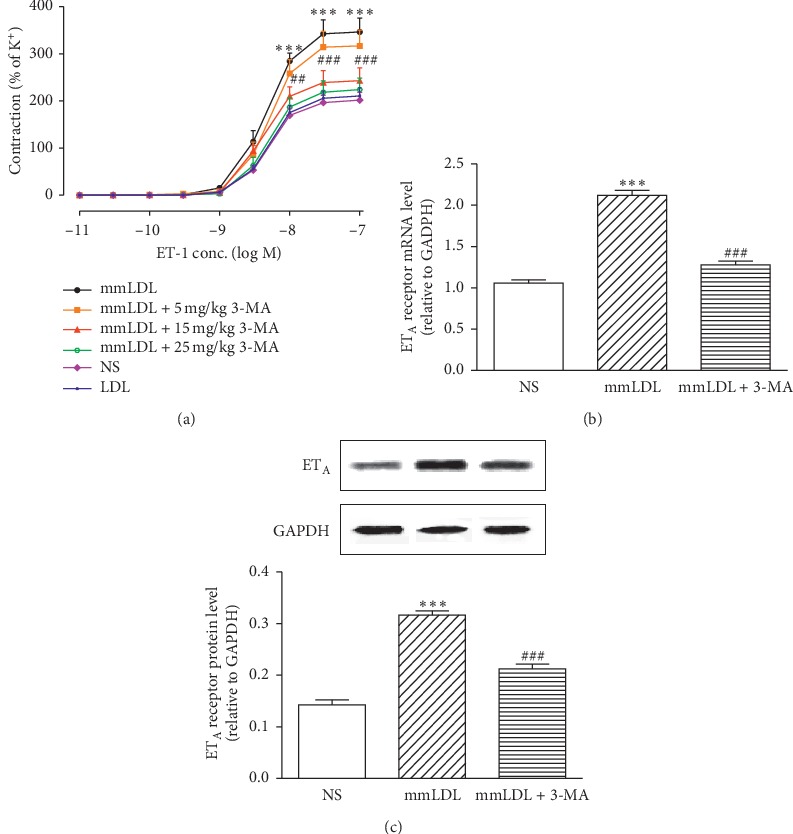
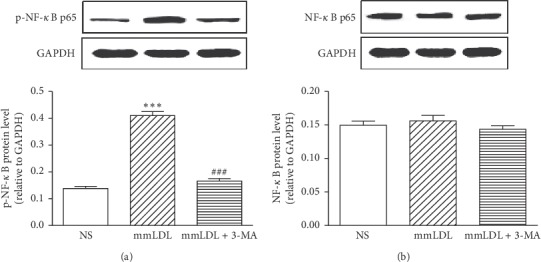
Minimally modified low-density lipoprotein (mmLDL) is a risk factor for cardiovascular diseases. The current study explored the effect of mmLDL on the endothelin type A (ETA) receptor in mouse mesenteric arteries , as well as the role of autophagy in this process. mmLDL was injected via the caudal vein, and the Class III PI3K autophagic pathway inhibitor 3-methyladenine (3-MA) was injected intraperitoneally. The animals were divided into physiological saline (NS), mmLDL, and mmLDL + 3-MA groups. The dose-effect curve of endothelin-1- (ET-1-) induced mesenteric artery contraction was measured using myography, while ET receptor mRNA expression was detected using real-time polymerase chain reactions, and the protein levels of the ET receptor, class III PI3K, Beclin-1, LC3 II/I, p62, NF-B, and p-NF-B were observed using Western blot analysis. mmLDL significantly strengthened ET-1-induced contraction (the value increased from 184.87 ± 7.46% in the NS group to 319.91 ± 20.31% in the mmLDL group ( < 0.001), and the pEC value increased from 8.05 ± 0.05 to 9.11 ± 0.09 ( < 0.01). In addition to upregulating the protein levels of Class III PI3K, Beclin-1, and LC3 II/I and downregulating that of p62, mmLDL significantly increased the mRNA expression and protein level of the ET receptor and increased the protein level of p-NF-B. However, these effects were significantly inhibited by 3-MA. mmLDL activates autophagy via the Class III PI3K/Beclin-1 pathway and upregulates the ET receptor via the downstream NF-B pathway. Understanding the effect of mmLDL on the ET receptor and the underlying mechanisms may provide a new idea for the prevention and treatment of cardiovascular diseases.
轻度修饰的低密度脂蛋白(mmLDL)是心血管疾病的一个危险因素。当前研究探讨了mmLDL对小鼠肠系膜动脉中内皮素A型(ETA)受体的影响,以及自噬在此过程中的作用。通过尾静脉注射mmLDL,并腹腔注射III类磷脂酰肌醇3-激酶(PI3K)自噬途径抑制剂3-甲基腺嘌呤(3-MA)。将动物分为生理盐水(NS)组、mmLDL组和mmLDL + 3-MA组。使用肌动描记法测量内皮素-1(ET-1)诱导的肠系膜动脉收缩的剂量效应曲线,同时使用实时聚合酶链反应检测ET受体mRNA表达,并通过蛋白质印迹分析观察ET受体、III类PI3K、Beclin-1、LC3 II/I、p62、核因子κB(NF-κB)和磷酸化核因子κB(p-NF-κB)的蛋白水平。mmLDL显著增强了ET-1诱导的收缩(NS组的增加值从184.87±7.46%增加到mmLDL组的319.91±20.31%(P < 0.001),pEC值从8.05±0.05增加到9.11±0.09(P < 0.01)。除了上调III类PI3K、Beclin-1和LC3 II/I的蛋白水平以及下调p62的蛋白水平外,mmLDL还显著增加了ET受体的mRNA表达和蛋白水平,并增加了p-NF-κB的蛋白水平。然而,这些效应被3-MA显著抑制。mmLDL通过III类PI3K/Beclin-1途径激活自噬,并通过下游NF-κB途径上调ET受体。了解mmLDL对ET受体的影响及其潜在机制可能为心血管疾病的预防和治疗提供新思路。