Department of Public Health Sciences, Penn State College of Medicine, Hershey, Pennsylvania.
Department of Obstetrics and Gynecology, Penn State College of Medicine, Hershey, Pennsylvania.
JAMA Netw Open. 2020 Apr 1;3(4):e203076. doi: 10.1001/jamanetworkopen.2020.3076.
More than 20% of births globally are by cesarean delivery, including more than 30% in the US. Prior studies have reported lower rates of childbearing after cesarean delivery, but it is not clear if this is due to maternal choice or lower conception rates.
To investigate the association between mode of first delivery and subsequent conceptions and live births.
DESIGN, SETTING, AND PARTICIPANTS: The First Baby Study was a multicenter prospective cohort study of women aged 18 to 35 years with singleton pregnancies, enrolled and interviewed before first childbirth, who delivered in Pennsylvania from 2009 to 2011 and were followed up for 36 months after delivery (until April 2014). Data analysis for this study took place between May and July 2019 and in January 2020.
Mode of first delivery (cesarean or vaginal).
Rates of subsequent conceptions and live births. Discrete-time Cox proportional hazard regression models were used to compare the rate of subsequent conception (vaginal vs cesarean) among those who completed the 36-month survey, accounting for reported months of unprotected intercourse during the follow-up period and adjusting for relevant covariates. A log binomial regression was used to compare the age-adjusted rate of subsequent live birth (vaginal vs cesarean) among those who completed the 36-month survey.
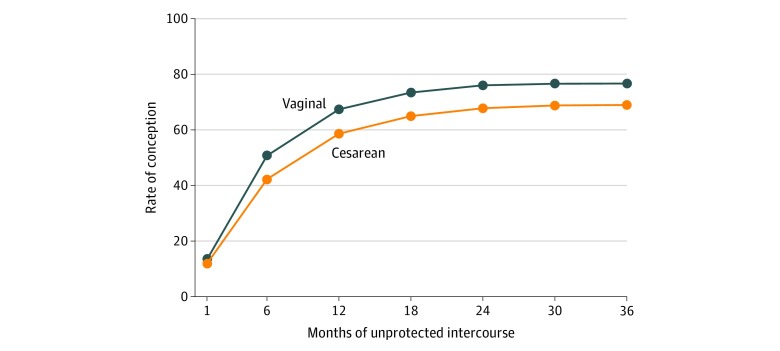
The study population consisted of 2423 women who were retained to the 36-month survey (mean [SD] age at baseline was 27.2 [4.4] years and 712 [29.4%] delivered by cesarean). There were 2046 women who had unprotected intercourse during the follow-up period, 2021 of whom provided data on months of unprotected intercourse. Cesarean delivery was associated with lower rates of conception after unprotected intercourse during the follow-up period (413 of 599 [68.9%]) compared with vaginal delivery (1090 of 1422 [76.7%]) (adjusted hazard ratio, 0.85; 95% CI, 0.74-0.96). Cesarean delivery was also associated with reduced likelihood of a subsequent live birth (305 women [42.8%]) compared with vaginal delivery (857 women [50.1%]), with an age-adjusted risk ratio of 0.83 (95% CI, 0.75-0.92).
In the 3 years following first childbirth, women who delivered their first child by cesarean had lower rates of conception after unprotected intercourse, and fewer of these women had a second child than those who delivered vaginally.
全球超过 20%的分娩是通过剖腹产进行的,其中美国超过 30%。先前的研究报告称,剖腹产分娩后的生育率较低,但尚不清楚这是由于产妇选择还是受孕率较低所致。
调查首次分娩方式与后续妊娠和活产之间的关系。
设计、地点和参与者:第一婴儿研究是一项多中心前瞻性队列研究,纳入了 2009 年至 2011 年在宾夕法尼亚州分娩的年龄在 18 至 35 岁之间、单胎妊娠的女性,并在首次分娩前进行了入组和访谈,随访时间为产后 36 个月(截至 2014 年 4 月)。这项研究的数据分析于 2019 年 5 月至 7 月和 2020 年 1 月进行。
首次分娩方式(剖腹产或阴道分娩)。
后续妊娠和活产的发生率。使用离散时间 Cox 比例风险回归模型比较了完成 36 个月调查的人群中随后妊娠(阴道分娩与剖腹产)的发生率,报告了随访期间无保护性交的月数,并调整了相关协变量。使用对数二项式回归比较了完成 36 个月调查的人群中随后活产(阴道分娩与剖腹产)的年龄调整率。
研究人群包括 2423 名完成 36 个月调查的女性(基线时的平均[SD]年龄为 27.2[4.4]岁,712 名[29.4%]经剖腹产分娩)。在随访期间有 2046 名女性发生了无保护性行为,其中 2021 名女性提供了无保护性行为月数的数据。与阴道分娩相比(无保护性交后妊娠率为 1422 例中的 1090 例[76.7%]),剖腹产与无保护性交后较低的妊娠率相关(599 例中的 413 例[68.9%])(调整后的危险比,0.85;95%CI,0.74-0.96)。与阴道分娩相比(305 名[42.8%]),剖腹产也与随后活产的可能性降低相关(857 名[50.1%]),年龄调整风险比为 0.83(95%CI,0.75-0.92)。
在首次分娩后的 3 年内,通过剖腹产分娩的女性在无保护性行为后妊娠的几率较低,而与阴道分娩的女性相比,这些女性中第二次生育的比例较低。