Park Jewel
College of Medicine, Korea University, Seoul, KOR.
Cureus. 2020 Apr 14;12(4):e7668. doi: 10.7759/cureus.7668.
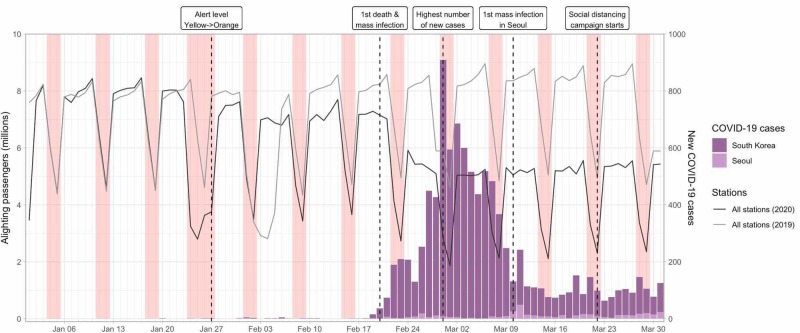
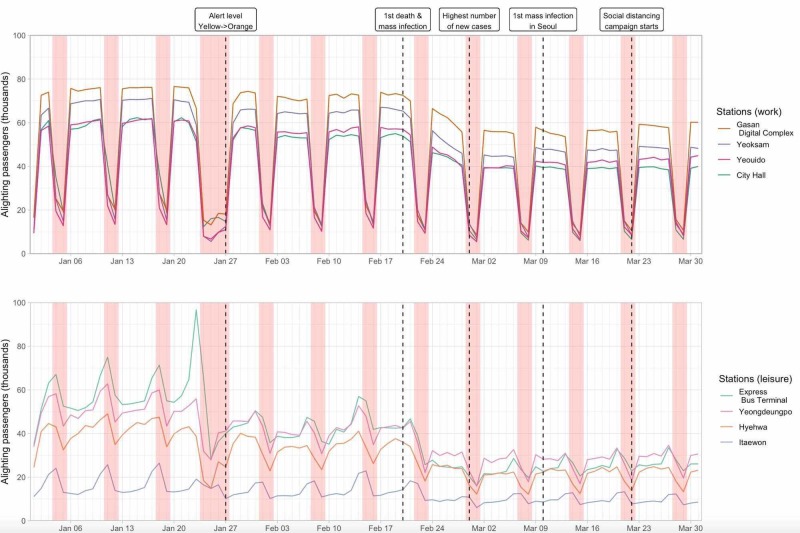
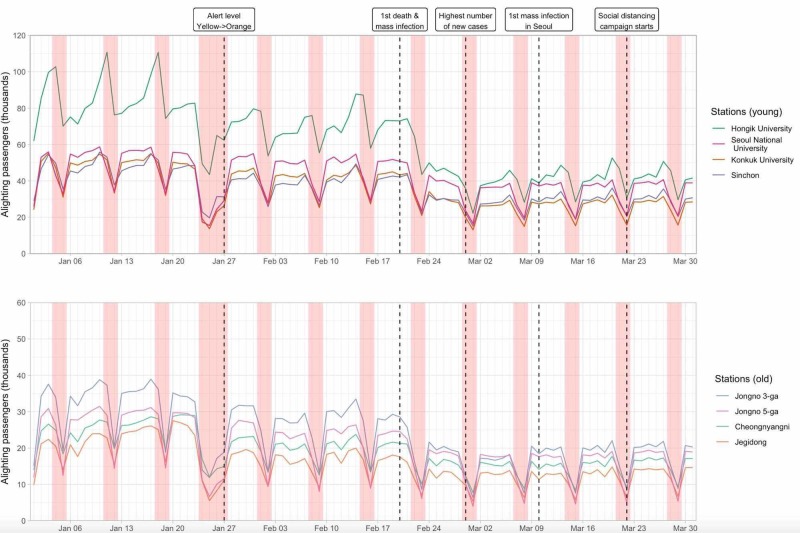
Introduction While numerous episodes of Coronavirus disease 2019 (COVID-19) infection and subsequent government announcements in South Korea were accompanied by widespread social distancing efforts by the people, it is unclear whether these episodes and government announcements were actually influential in improving social distancing, or whether the level of response among different demographic groups varied. Methods Data were downloaded from Seoul Data Open Plaza, and changes in the number of passengers on the Seoul Metropolitan Subway network between January 1, 2020, and March 31, 2020, were used to assess the extent to which people in Seoul practiced social distancing. Five events regarding COVID-19 that received wide public attention between January and March 2020 were identified and the changes in the number of passengers before and after each event were analyzed. Also, similar analyses were performed for 16 stations that were specific in either the age or purpose of the visit of the passengers. Results Compared to the third week of January 2020 (January 13-19), the mean daily number of passengers in all stations decreased by 2,984,857.4 or 40.6% by the first week of March (March 2-8). The percentage decrease in individual stations between this period was not significantly different between "young" and "old" stations (46.3% vs. 49.2%; p = 0.551) but was significantly smaller in "work" stations than in "leisure" stations (36.2% vs. 51.6%; p = 0.021). Of the five events, the first reported death due to COVID-19 in South Korea and the identification of a mass infection cluster in Daegu on February 20 were accompanied by the greatest decrease of the mean daily number of passengers (1,352,153.3 or 20.8%), while the first mass infection in Seoul on March 10 and the announcement of aggressive social distancing campaign on March 22 were accompanied by an increase in the number of passengers. Conclusions The number of subway passengers in Seoul decreased markedly during late February but slowly increased afterward, suggesting decreasing levels of risk perception and adherence to social distancing. Understanding the differing patterns of subway use by age or purpose of the visit may guide policymakers and the general public in shaping their future response to the current pandemic.
引言 虽然韩国2019冠状病毒病(COVID-19)感染的众多事件以及随后的政府公告都伴随着民众广泛的社交距离措施,但尚不清楚这些事件和政府公告是否真的对改善社交距离有影响,或者不同人口群体的反应程度是否存在差异。方法 数据从首尔数据开放广场下载,利用2020年1月1日至2020年3月31日首尔地铁网络上乘客数量的变化来评估首尔民众践行社交距离的程度。确定了2020年1月至3月期间受到广泛公众关注的五起关于COVID-19的事件,并分析了每起事件前后乘客数量的变化。此外,还对16个在乘客年龄或出行目的方面具有特殊性的站点进行了类似分析。结果 与2020年1月的第三周(1月13日至19日)相比,到3月的第一周(3月2日至8日),所有站点的日均乘客数量减少了2,984,857.4人,降幅为40.6%。在此期间,“年轻”站点和“老年”站点之间单个站点的降幅没有显著差异(46.3%对49.2%;p = 0.551),但“工作”站点的降幅明显小于“休闲”站点(36.2%对51.6%;p = 0.021)。在这五起事件中,韩国首次报告的COVID-19死亡病例以及2月20日大邱市大规模感染集群的发现伴随着日均乘客数量的最大降幅(减少1,352,153.3人,降幅为20.8%),而3月10日首尔首次出现大规模感染以及3月22日宣布积极的社交距离措施时,乘客数量却有所增加。结论 首尔地铁乘客数量在2月下旬显著下降,但随后缓慢上升,这表明风险认知和对社交距离的遵守程度在降低。了解按年龄或出行目的划分的地铁使用不同模式,可能会指导政策制定者和公众制定未来应对当前疫情的措施。