Neuroregeneration and Stem Cell Programs, Institute for Cell Engineering, Johns Hopkins University School of Medicine, Baltimore, Maryland, United States of America.
Department of Chemistry, University of Southern California, Los Angeles, California, United States of America.
PLoS One. 2020 Apr 21;15(4):e0231978. doi: 10.1371/journal.pone.0231978. eCollection 2020.
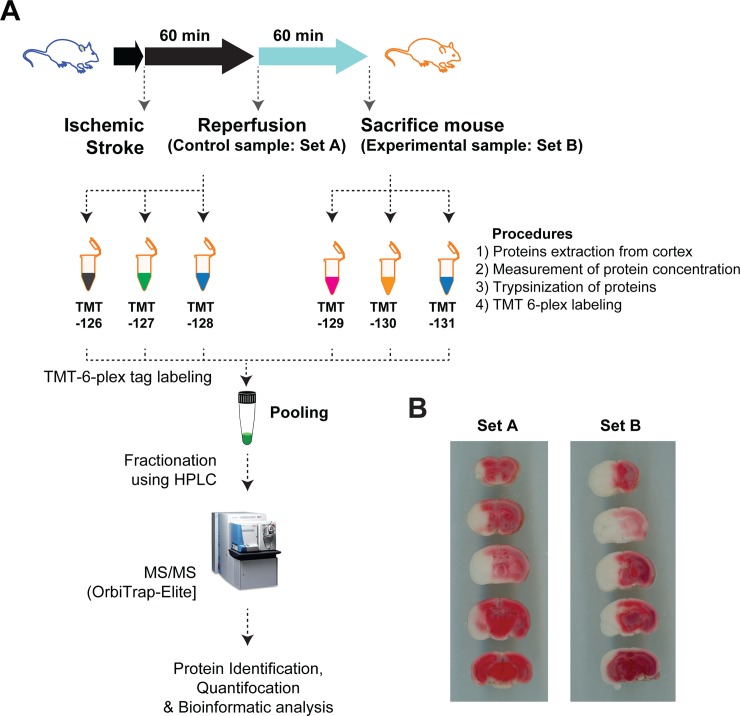
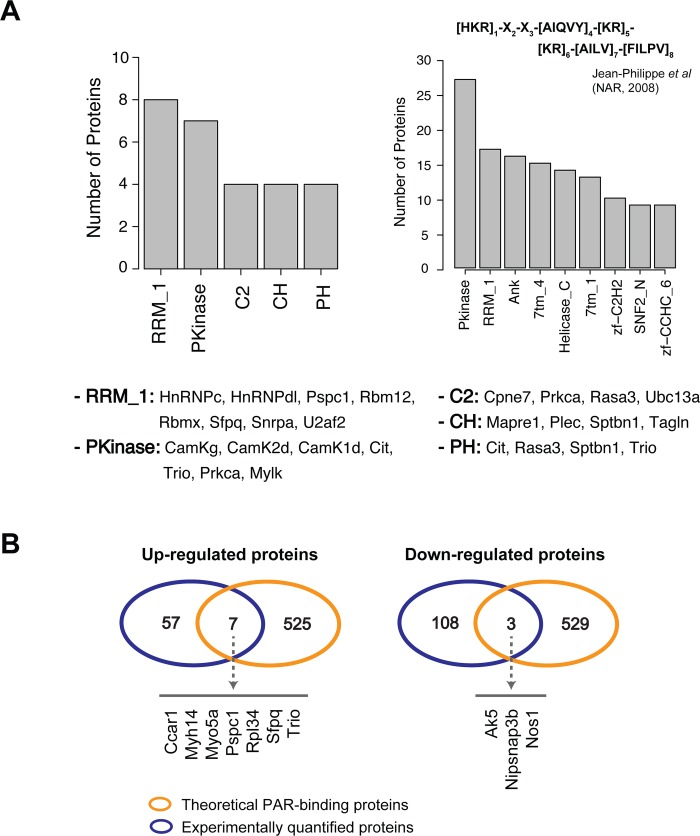
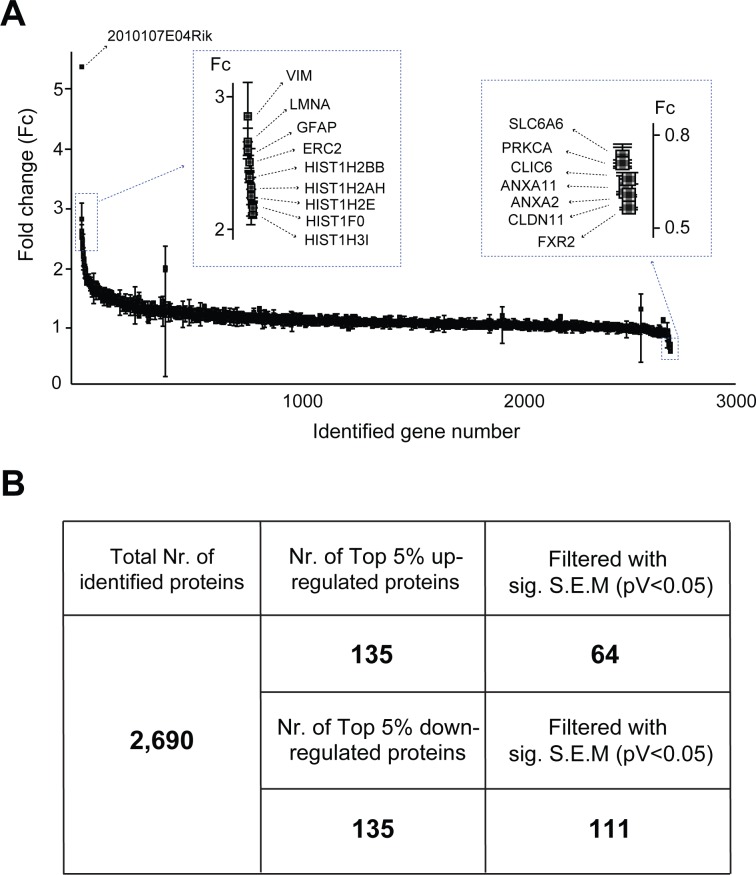
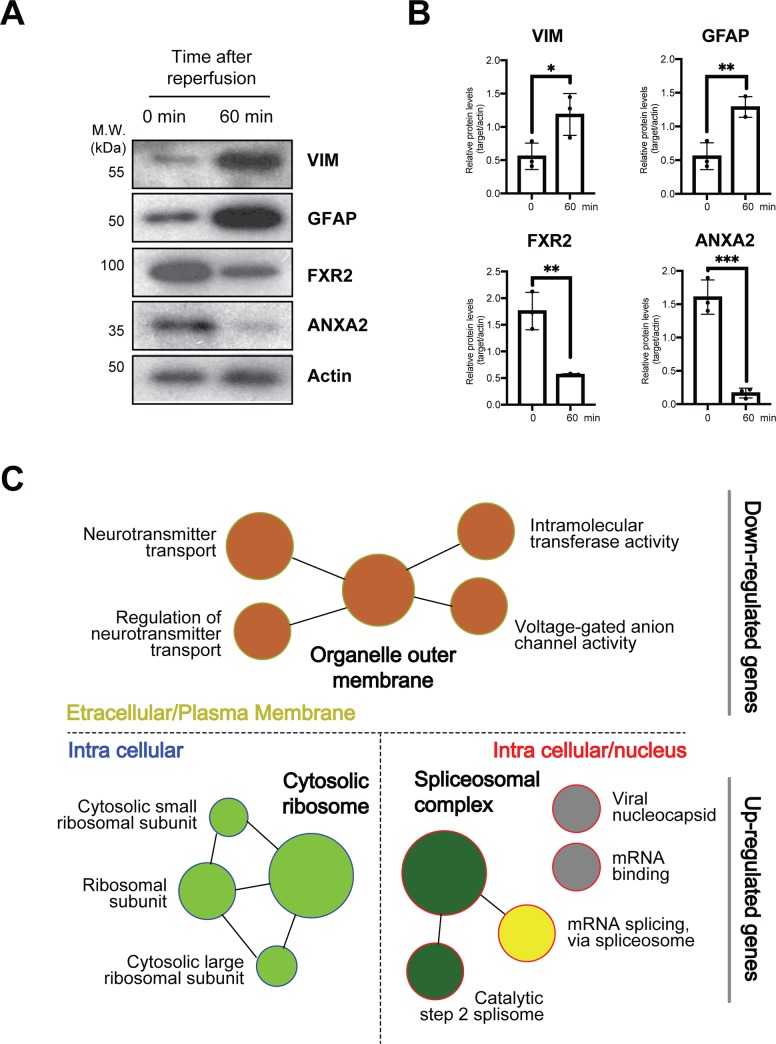
Ischemic strokes result in the death of brain tissue and a wave of downstream effects, often leading to lifelong disabilities or death. However, the underlying mechanisms of ischemic damage and repair systems remain largely unknown. In order to better understand these mechanisms, TMT-isobaric mass tagging and mass spectrometry were conducted on brain cortex extracts from mice subjected to one hour of middle cerebral artery occlusion (MCAO) and after one hour of reperfusion. In total, 2,690 proteins were identified and quantified, out of which 65% of the top 5% of up- and down-regulated proteins were found to be significant (p < 0.05). Network-based gene ontology analysis was then utilized to cluster all identified proteins by protein functional groups and cellular roles. Although three different cellular functions were identified-organelle outer membrane proteins, cytosolic ribosome proteins, and spliceosome complex proteins-several functional domains were found to be common. Of these, organelle outer membrane proteins were downregulated whereas cytosolic ribosome and spliceosome complex proteins were upregulated, indicating that major molecular events post-stroke were translation-associated and subsequent signaling pathways (e.g., poly (ADP-ribose) (PAR) dependent cell death). By approaching stroke analyses via TMT-isobaric mass tagging, the work herein presents a grand scope of protein-based molecular mechanisms involved with ischemic stroke recovery.
缺血性中风导致脑组织死亡和一波下游效应,通常导致终身残疾或死亡。然而,缺血性损伤和修复系统的潜在机制在很大程度上仍然未知。为了更好地理解这些机制,对经历 1 小时大脑中动脉闭塞(MCAO)和 1 小时再灌注后的小鼠大脑皮质提取物进行了 TMT-等压质量标记和质谱分析。总共鉴定和定量了 2690 种蛋白质,其中上调和下调蛋白的前 5%的 65%被发现具有显著差异(p<0.05)。然后利用基于网络的基因本体分析,根据蛋白质功能群和细胞作用对所有鉴定的蛋白质进行聚类。尽管鉴定出了三种不同的细胞功能——细胞器外膜蛋白、细胞质核糖体蛋白和剪接体复合物蛋白——但发现了几个共同的功能域。其中,细胞器外膜蛋白下调,而细胞质核糖体和剪接体复合物蛋白上调,表明中风后主要的分子事件与翻译相关,并随后引发信号通路(例如,多聚(ADP-核糖)(PAR)依赖性细胞死亡)。通过 TMT-等压质量标记进行中风分析,本工作提出了与缺血性中风恢复相关的基于蛋白质的分子机制的广泛范围。