Zhan Feixia, Zhang Chao, Wang Shige, Zhu Zeyu, Chen Guang, Zhao Mingliang, Cao Li
Department of Neurology, RuiJin Hospital & RuiJin Hospital North, Shanghai Jiao Tong University School of Medicine, Shanghai, China.
Department of Neurology, Suzhou Hospital Affiliated to Anhui Medical University, Suzhou, China.
J Clin Neurol. 2020 Apr;16(2):230-236. doi: 10.3988/jcn.2020.16.2.230.
Hyperekplexia (HPX), a rare neurogenetic disorder, is classically characterized by neonatal hypertonia, exaggerated startle response provoked by the sudden external stimuli and followed by a shortly general stiffness. Glycine receptor alpha 1 () is the major pathogenic gene of the disease. We described the clinical manifestations of genetically confirmed HPX patients and made a literature review of -related HPX to improve the early recognition and prompt the management of the disorder.
Extensive clinical evaluations were analyzed in 4 Chinese HPX patients from two unrelated families. Next generation sequencing was conducted in the probands. Sanger sequence and segregation analysis were applied to confirm the findings.
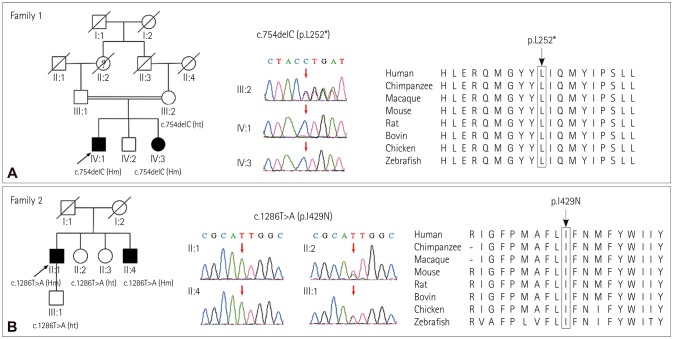
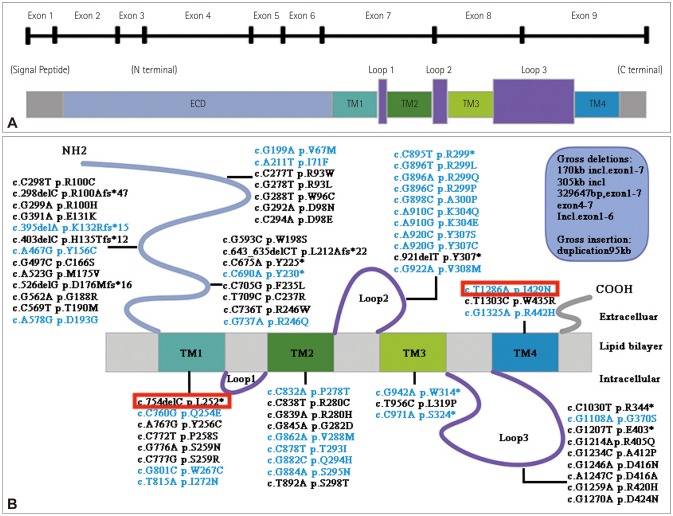
All four patients including 3 males and 1 female presented with excessive startle reflex, a cautious gait and recurrent falls. Moreover, startle episodes were dramatically improved with the treatment of clonazepam in all cases. Exome sequencing revealed 2 homozygous mutations in the patients. The mutation c.1286T>A p.I429N has been previously reported, while c.754delC p.L252* is novel.
HPX is a treatable disease, and clonazepam is the drug of choice. By studying and reviewing the disorder, we summarized the phenotype, expanded the genotype spectrum, and discussed the possible pathogenic mechanisms to enhance the understanding and recognition of the disease. Early awareness of the disease is crucial to the prompt and proper administration, as well as the genetic counseling.
僵人综合征(HPX)是一种罕见的神经遗传性疾病,其典型特征为新生儿期肌张力亢进、由突然的外部刺激诱发夸张的惊跳反应并随后出现短暂的全身僵硬。甘氨酸受体α1( )是该疾病的主要致病基因。我们描述了基因确诊的HPX患者的临床表现,并对与 相关的HPX进行了文献复习,以提高对该疾病的早期识别并促进其管理。
对来自两个无关家庭的4例中国HPX患者进行了广泛的临床评估。对先证者进行了二代测序。应用桑格测序和分离分析来确认结果。
所有4例患者,包括3例男性和1例女性,均表现出过度惊跳反射、谨慎步态和反复跌倒。此外,所有病例经氯硝西泮治疗后惊跳发作均显著改善。外显子组测序显示患者中有2个纯合 突变。突变c.1286T>A p.I429N先前已有报道,而c.754delC p.L252*是新发现的。
HPX是一种可治疗的疾病,氯硝西泮是首选药物。通过对该疾病的研究和复习,我们总结了其表型,扩展了基因型谱,并讨论了可能的致病机制,以增强对该疾病的理解和认识。对该疾病的早期认识对于及时、恰当的治疗以及遗传咨询至关重要。