Liu Ting, Zhang Jing, Li Kangdi, Deng Lingnan, Wang Hongxiang
The Central Hospital of Wuhan, Tongji Medical College, Huazhong University of Science and Technology, Wuhan, China.
College of Life Sciences, Wuhan University, Wuhan, China.
Front Pharmacol. 2020 Apr 8;11:408. doi: 10.3389/fphar.2020.00408. eCollection 2020.
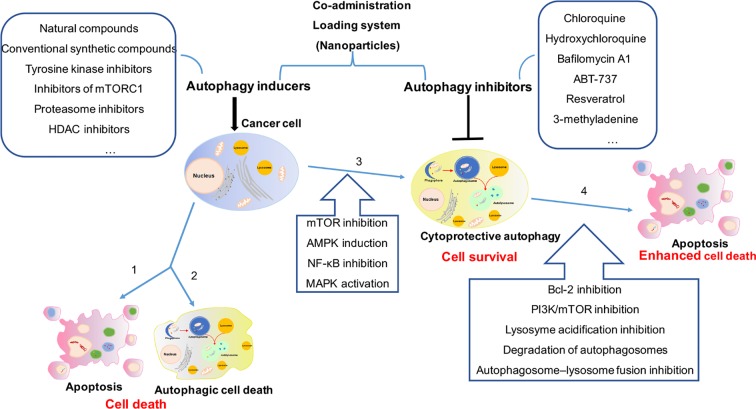
Autophagy is considered a cytoprotective function in cancer therapy under certain conditions and is a drug resistance mechanism that represents a clinical obstacle to successful cancer treatment and leads to poor prognosis in cancer patients. Because certain clinical drugs and agents in development have cytoprotective autophagy effects, targeting autophagic pathways has emerged as a potential smarter strategy for cancer therapy. Multiple preclinical and clinical studies have demonstrated that autophagy inhibition augments the efficacy of anticancer agents in various cancers. Autophagy inhibitors, such as chloroquine and hydroxychloroquine, have already been clinically approved, promoting drug combination treatment by targeting autophagic pathways as a means of discovering and developing more novel and more effective cancer therapeutic approaches. We summarize current studies that focus on the antitumor efficiency of agents that induce cytoprotective autophagy combined with autophagy inhibitors. Furthermore, we discuss the challenge and development of targeting cytoprotective autophagy as a cancer therapeutic approach in clinical application. Thus, we need to facilitate the exploitation of appropriate autophagy inhibitors and coadministration delivery system to cooperate with anticancer drugs. This review aims to note optimal combination strategies by modulating autophagy for therapeutic advantage to overcome drug resistance and enhance the effect of antitumor therapies on cancer patients.
自噬在某些情况下被认为是癌症治疗中的一种细胞保护功能,并且是一种耐药机制,它是成功进行癌症治疗的临床障碍,会导致癌症患者预后不良。由于某些临床药物和正在研发的药物具有细胞保护性自噬作用,因此靶向自噬途径已成为一种潜在的更明智的癌症治疗策略。多项临床前和临床研究表明,自噬抑制可增强抗癌药物在各种癌症中的疗效。自噬抑制剂,如氯喹和羟氯喹,已获临床批准,通过靶向自噬途径促进联合用药治疗,以此作为发现和开发更新颖、更有效的癌症治疗方法的手段。我们总结了目前关注诱导细胞保护性自噬的药物与自噬抑制剂联合使用的抗肿瘤效果的研究。此外,我们讨论了将靶向细胞保护性自噬作为一种癌症治疗方法在临床应用中的挑战与发展。因此,我们需要推动合适的自噬抑制剂和联合给药系统的开发,使其与抗癌药物协同作用。本综述旨在通过调节自噬以获得治疗优势,从而指出最佳联合策略,以克服耐药性并增强抗肿瘤治疗对癌症患者的疗效。