Syngelaki Eleni, Schinkel Christoph C F, Klatt Simone, Hörandl Elvira
Department of Systematics, Biodiversity and Evolution of Plants (with Herbarium), Albrecht-von-Haller-Institute for Plant Sciences, Georg-August-Universität Göttingen, Göttingen, Germany.
Section Safety and Environmental Protection, Georg-August-Universität Göttingen, Göttingen, Germany.
Front Plant Sci. 2020 Apr 8;11:435. doi: 10.3389/fpls.2020.00435. eCollection 2020.
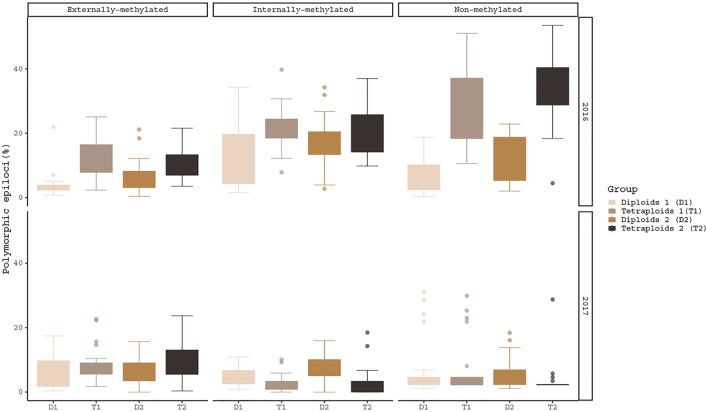
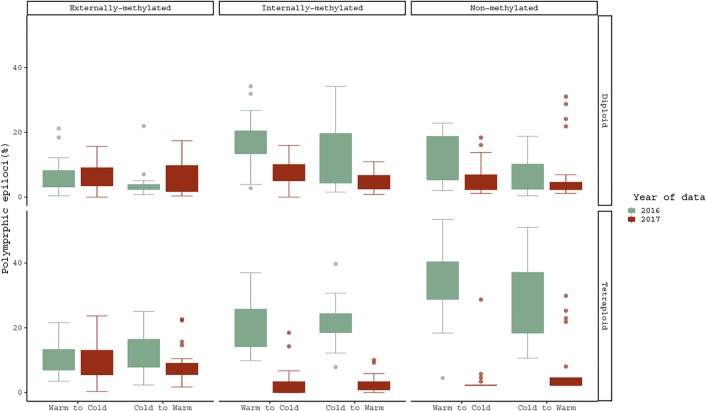
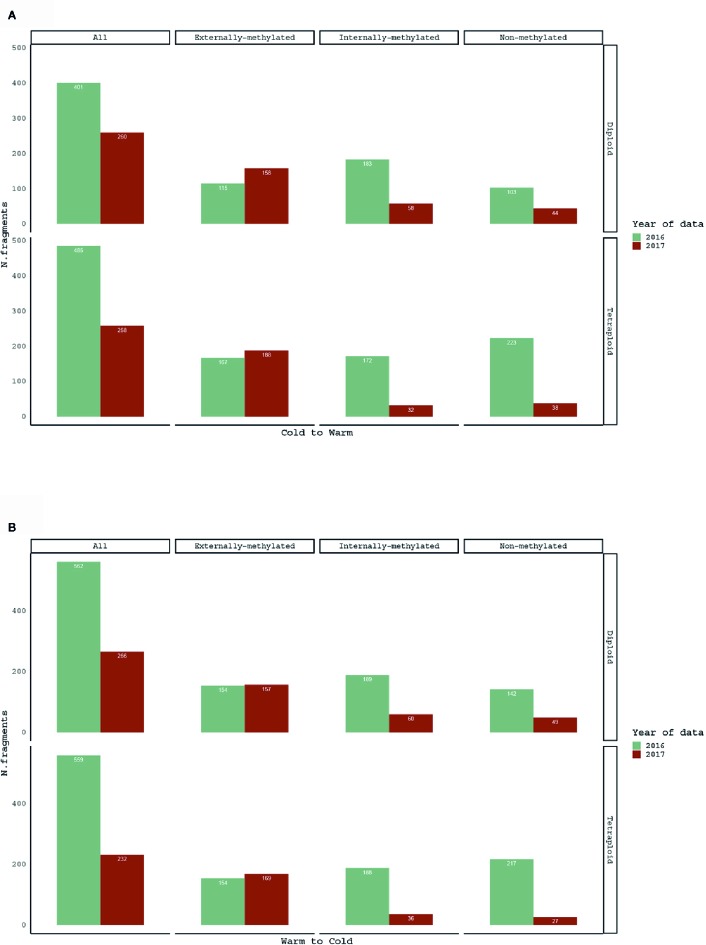
The exposure to environmental stress can trigger epigenetic variation, which may have several evolutionary consequences. Polyploidy seems to affect the DNA methylation profiles. Nevertheless, it abides unclear whether temperature stress can induce methylations changes in different cytotypes and to what extent a treatment shift is translated to an epigenetic response. A suitable model system for studying these questions is , an alpine perennial herb. Diploid and autotetraploid individuals of were exposed to cold (+7°C day/+2°C night; frost treatment -1°C cold shocks for 3 nights per week) and warm (+15° day/+10°C night) conditions in climate growth chambers for two consecutive flowering periods and shifted from one condition to the other after the first flowering period. Methylation-sensitive amplified fragment-length polymorphism markers were applied for both years, to track down possible alterations induced by the stress treatments. Patterns of methylation suggested that cytotypes differed significantly in their profiles, independent from year of treatment. Likewise, the treatment shift had an impact on both cytotypes, resulting in significantly less epiloci, regardless the shift's direction. The AMOVAs revealed higher variation within than among treatments in diploids. In tetraploids, internally-methylated loci had a higher variation among than within treatments, as a response to temperature's change in both directions, and support the hypothesis of temperature stress affecting the epigenetic variation. Results suggest that the temperature-sensitivity of DNA methylation patterns shows a highly dynamic phenotypic plasticity in , as both cytotypes responded to temperature shifts. Furthermore, ploidy level, even without effects of hybridization, has an important effect on epigenetic background variation, which may be correlated with the DNA methylation dynamics during cold acclimation.
暴露于环境压力下会引发表观遗传变异,这可能会产生多种进化后果。多倍体似乎会影响DNA甲基化谱。然而,目前尚不清楚温度胁迫是否会在不同细胞类型中诱导甲基化变化,以及处理转变在多大程度上会转化为表观遗传反应。一种适合研究这些问题的模式系统是高山多年生草本植物 。 的二倍体和同源四倍体个体在气候生长室中连续两个花期暴露于寒冷(白天+7°C/夜间+2°C;霜冻处理为每周3个晚上-1°C冷休克)和温暖(白天+15°C/夜间+10°C)条件下,并在第一个花期后从一种条件转变为另一种条件。连续两年应用甲基化敏感扩增长度多态性标记,以追踪胁迫处理诱导的可能变化。甲基化模式表明,细胞类型在其谱中存在显著差异,与处理年份无关。同样,处理转变对两种细胞类型都有影响,无论转变方向如何,导致表观位点显著减少。分子方差分析显示,二倍体中处理内的变异高于处理间。在四倍体中,内部甲基化位点在处理间的变异高于处理内,这是对温度双向变化的反应,并支持温度胁迫影响表观遗传变异的假设。结果表明,在 中,DNA甲基化模式的温度敏感性表现出高度动态的表型可塑性,因为两种细胞类型都对温度变化做出了反应。此外,即使没有杂交效应,倍性水平对表观遗传背景变异也有重要影响,这可能与冷驯化过程中的DNA甲基化动态相关。