The Third People's Hospital of Daqing, Daqing, China.
Shenzhen Traditional Chinese Medicine Hospital, Shenzhen, China.
Transl Psychiatry. 2020 Apr 23;10(1):117. doi: 10.1038/s41398-020-0785-y.
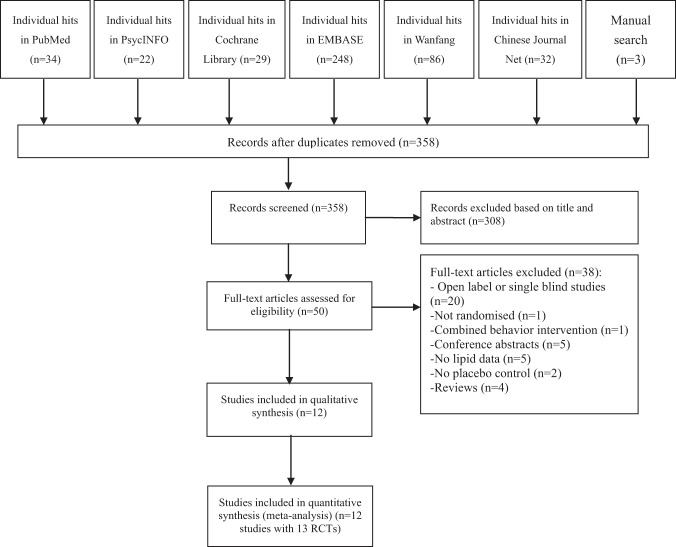
Antipsychotic-induced dyslipidemia could increase the risk of cardiovascular diseases. This is a meta-analysis of randomized double-blind placebo-controlled trials to examine the efficacy and safety of adjunctive metformin for dyslipidemia induced by antipsychotics in schizophrenia. The standardized mean differences (SMDs) and risk ratios (RRs) with their 95% confidence intervals (CIs) were calculated using the random-effects model with the RevMan 5.3 version software. The primary outcome was the change of serum lipid level. Twelve studies with 1215 schizophrenia patients (592 in metformin group and 623 in placebo group) were included and analyzed. Adjunctive metformin was significantly superior to placebo with regards to low density lipoprotein cholesterol (LDL-C) [SMD: -0.37 (95%CI:-0.69, -0.05), P = 0.02; I = 78%], total cholesterol [SMD: -0.47 (95%CI:-0.66, -0.29), P < 0.00001; I = 49%], triglyceride [SMD: -0.33 (95%CI:-0.45, -0.20), P < 0.00001; I = 0%], and high density lipoprotein cholesterol [SMD: 0.29 (95%CI:0.02, 0.57), P = 0.03; I = 69%]. The superiority of metformin in improving LDL-C level disappeared in a sensitivity analysis and 80% (8/10) of subgroup analyses. Metformin was significantly superior to placebo with regards to decrease in body weight, body mass index, glycated hemoglobin A1c, fasting insulin, and homeostasis model assessment-insulin resistance (P = 0.002-0.01), but not regarding changes in waist circumference, waist-to-hip rate, leptin, fasting glucose, and blood pressure (P = 0.07-0.33). The rates of discontinuation due to any reason [RR: 0.97 (95%CI: 0.66, 1.43), P = 0.89; I = 0%] was similar between the two groups. Adjunctive metformin could be useful to improve total cholesterol and triglyceride levels, but it was not effective in improving LDL-C level in schizophrenia.
抗精神病药引起的血脂异常会增加心血管疾病的风险。这是一项针对随机双盲安慰剂对照试验的荟萃分析,旨在研究二甲双胍辅助治疗精神分裂症患者抗精神病药引起的血脂异常的疗效和安全性。使用 RevMan 5.3 版软件的随机效应模型计算标准化均数差值(SMD)和风险比(RR)及其 95%置信区间(CI)。主要结局是血清脂质水平的变化。纳入并分析了 12 项研究共 1215 例精神分裂症患者(二甲双胍组 592 例,安慰剂组 623 例)。与安慰剂相比,二甲双胍在低密度脂蛋白胆固醇(LDL-C)[SMD:-0.37(95%CI:-0.69,-0.05),P=0.02;I=78%]、总胆固醇[SMD:-0.47(95%CI:-0.66,-0.29),P<0.00001;I=49%]、三酰甘油[SMD:-0.33(95%CI:-0.45,-0.20),P<0.00001;I=0%]和高密度脂蛋白胆固醇[SMD:0.29(95%CI:0.02,0.57),P=0.03;I=69%]方面均显著优于安慰剂。二甲双胍改善 LDL-C 水平的优势在敏感性分析和 80%(8/10)的亚组分析中消失。二甲双胍在降低体重、体重指数、糖化血红蛋白 A1c、空腹胰岛素和稳态模型评估-胰岛素抵抗方面显著优于安慰剂(P=0.002-0.01),但在腰围、腰臀比、瘦素、空腹血糖和血压方面无显著差异(P=0.07-0.33)。因任何原因停药的发生率[RR:0.97(95%CI:0.66,1.43),P=0.89;I=0%]两组相似。二甲双胍辅助治疗可有效改善精神分裂症患者的总胆固醇和三酰甘油水平,但对 LDL-C 水平无效。