Cortese Daniela, Riganello Francesco, Arcuri Francesco, Lucca Lucia, Tonin Paolo, Schnakers Caroline, Laureys Steven
Research in Advanced NeuroRehabilitation, Istituto Sant'Anna, Crotone, Italy.
Coma Science Group, GIGA-Consciousness, University & Hospital of Liege, Liege, Belgium.
Front Hum Neurosci. 2020 Apr 9;14:97. doi: 10.3389/fnhum.2020.00097. eCollection 2020.
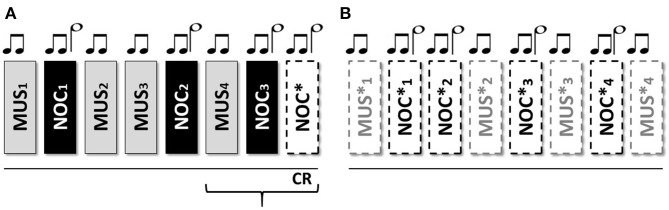
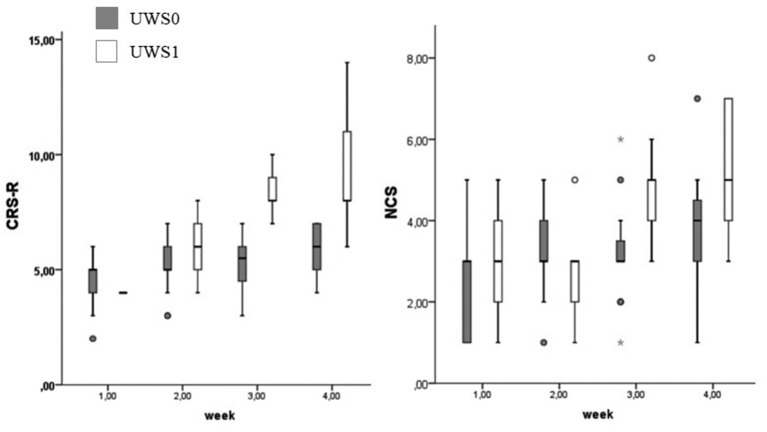
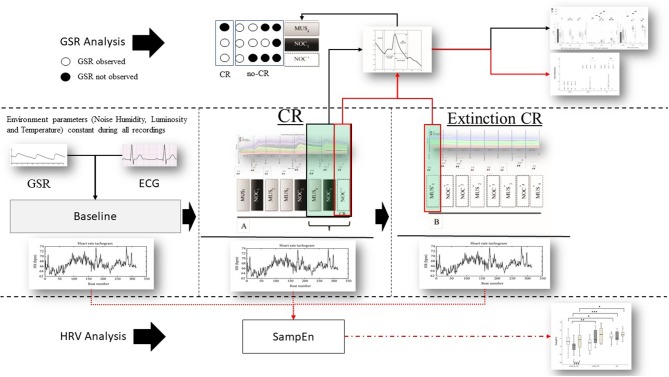
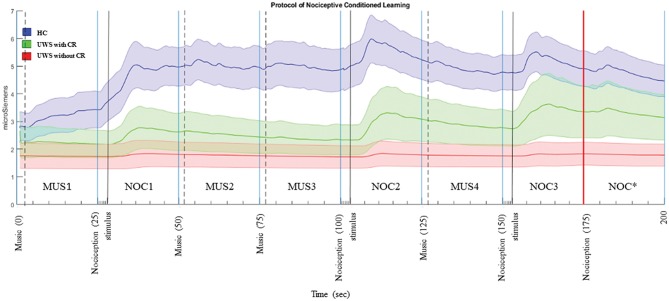
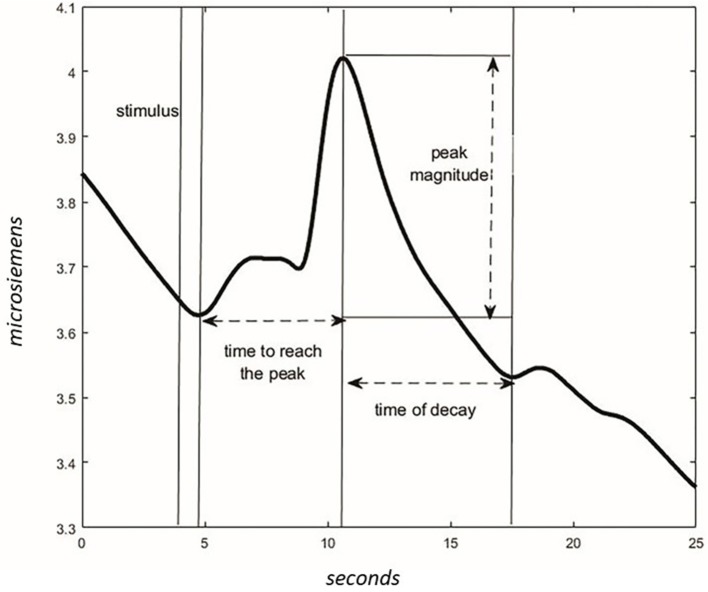
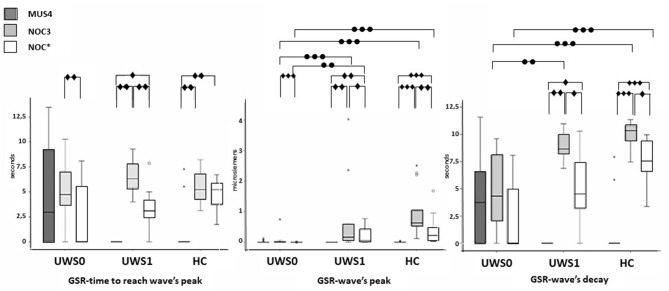
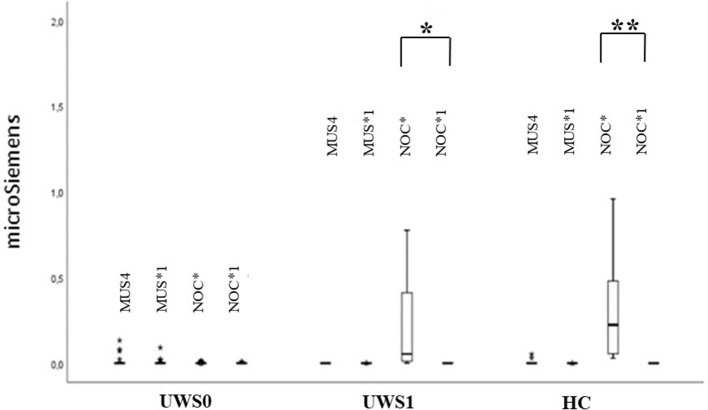
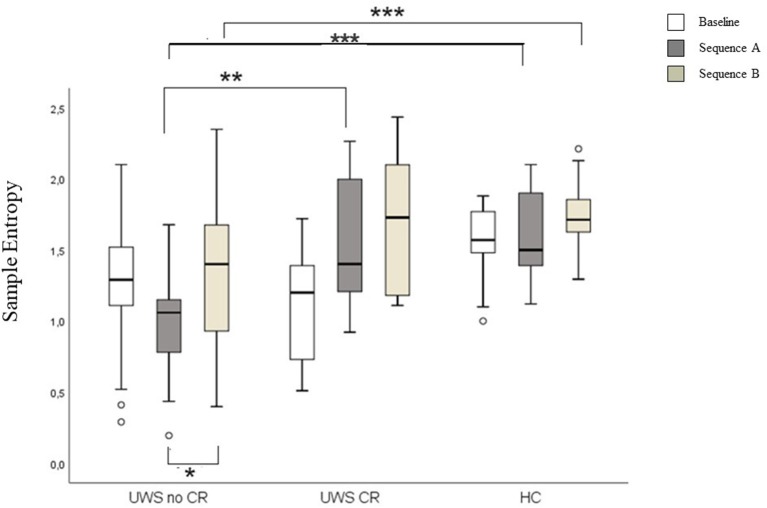
The assessment of the consciousness level of Unresponsive Wakefulness Syndrome (UWS) patients often depends on a subjective interpretation of the observed spontaneous and volitional behavior. To date, the misdiagnosis level is around 30%. The aim of this study was to observe the behavior of UWS patients, during the administration of noxious stimulation by a Trace Conditioning protocol, assessed by the Galvanic Skin Response (GSR) and Heart Rate Variability (HRV) entropy. We recruited 13 Healthy Control (HC) and 30 UWS patients at 31 ± 9 days from the acute event evaluated by Coma Recovery Scale-Revised (CRS-R) and Nociception Coma Scale (NCS). Two different stimuli [musical stimulus (MUS) and nociceptive stimulus (NOC)], preceded, respectively by two different tones, were administered following the sequences (A) MUS1 - NOC1 - MUS2 - MUS3 - NOC2 - MUS4 - NOC3 - NOC, and (B) MUS1, NOC1, NOC2, MUS2, NOC3, MUS3, NOC4, MUS4. All the () indicate the only tones administration. CRS-R and NCS assessments were repeated for three consecutive weeks. MUS4, NOC3, and NOC were compared for GSR wave peak magnitude, time to reach the peak, and time of wave's decay by Wilcoxon's test to assess the Conditioned Response (CR). The Sample Entropy (SampEn) was recorded in baseline and both sequences. Machine Learning approach was used to identify a rule to discriminate the CR. The GSR magnitude of CR was higher comparing music stimulus ( < 0.0001) and CR extinction ( < 0.002) in nine patients and in HC. Patients with CR showed a higher SampEn in sequence A compared to patients without CR. Within the third and fourth weeks from protocol administration, eight of the nine patients (88.9%) evolved into MCS. The Machine-learning showed a high performance to differentiate presence/absence of CR (≥95%). The possibility to observe the CR to the noxious stimulus, by means of the GSR and SampEn, can represent a potential method to reduce the misdiagnosis in UWS patients.
无反应觉醒综合征(UWS)患者意识水平的评估通常依赖于对观察到的自发和自主行为的主观解读。迄今为止,误诊率约为30%。本研究的目的是通过痕迹条件反射方案给予有害刺激期间,观察UWS患者的行为,通过皮肤电反应(GSR)和心率变异性(HRV)熵进行评估。我们招募了13名健康对照者(HC)和30名UWS患者,这些患者在急性事件发生后31±9天,通过昏迷恢复量表修订版(CRS-R)和伤害感受昏迷量表(NCS)进行评估。按照以下顺序给予两种不同的刺激[音乐刺激(MUS)和伤害性刺激(NOC)],每种刺激之前分别有两种不同的音调:(A)MUS1 - NOC1 - MUS2 - MUS3 - NOC2 - MUS4 - NOC3 - NOC,以及(B)MUS1、NOC1、NOC2、MUS2、NOC3、MUS3、NOC4、MUS4。所有的()表示仅给予音调。CRS-R和NCS评估连续重复三周。通过Wilcoxon检验比较MUS4、NOC3和NOC的GSR波峰值幅度、达到峰值的时间以及波的衰减时间,以评估条件反应(CR)。在基线和两个序列中记录样本熵(SampEn)。使用机器学习方法来确定区分CR的规则。在9名患者和健康对照者中,与音乐刺激相比,CR的GSR幅度更高(<0.0001),与CR消退相比也更高(<0.002)。与没有CR的患者相比,有CR的患者在序列A中的SampEn更高。在方案实施后的第三和第四周内,9名患者中有8名(88.9%)转变为最小意识状态(MCS)。机器学习在区分CR的存在与否方面表现出高性能(≥95%)。通过GSR和SampEn观察对有害刺激的CR的可能性,可以代表一种减少UWS患者误诊的潜在方法。