Gross Jeffrey A, Lefebvre François, Lutz Pierre-Eric, Bacot François, Vincent Daniel, Bourque Guillaume, Turecki Gustavo
McGill Group for Suicide Studies, Douglas Mental Health University Institute, Department of Psychiatry, McGill University, Montreal, Quebec, Canada.
Canadian Centre for Computational Genomics, McGill University, Montreal, Quebec, Canada.
Biol Methods Protoc. 2016 Dec 27;1(1):1-8. doi: 10.1093/biomethods/bpw002. eCollection 2016 Mar.
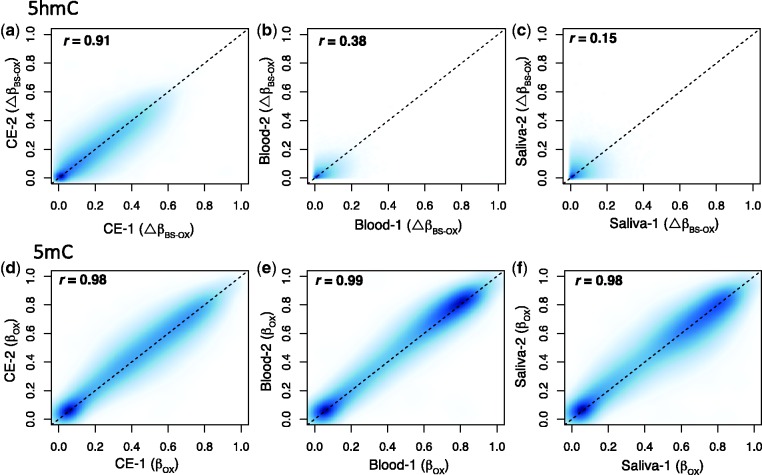
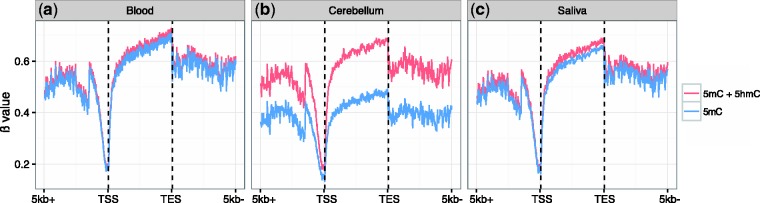
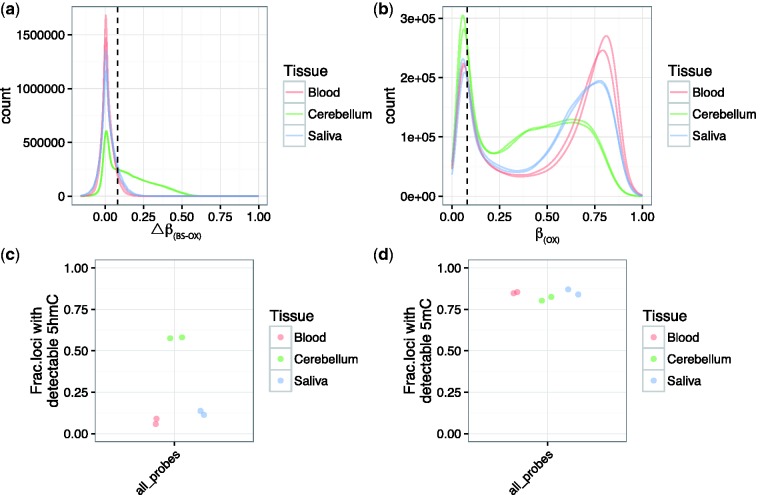
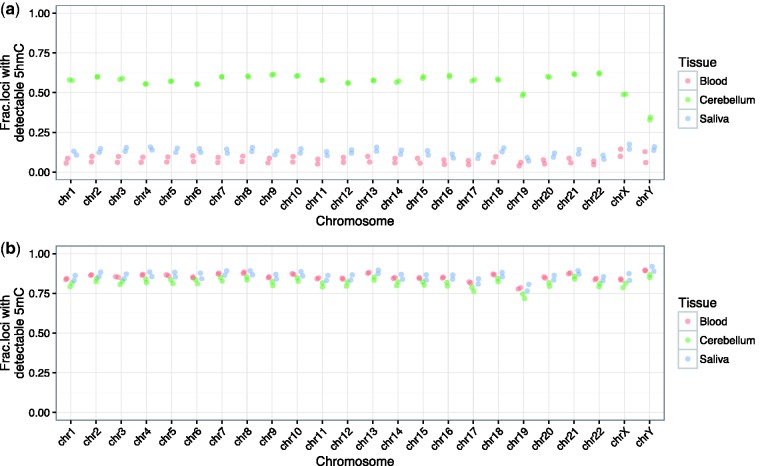
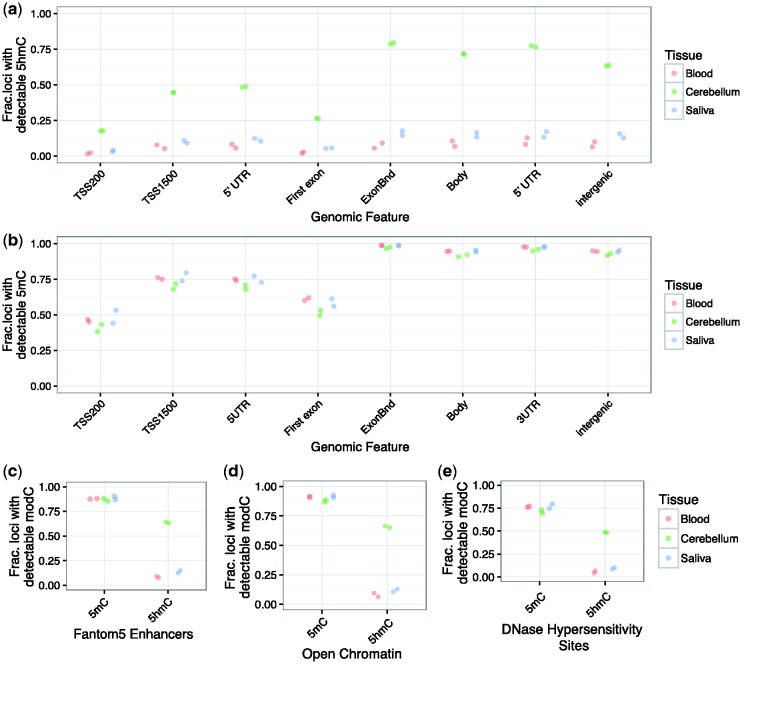
Investigating 5-methylcytosine (5mC) has led to many hypotheses regarding molecular mechanism underlying human diseases and disorders. Many of these studies, however, utilize bisulfite conversion alone, which cannot distinguish 5mC from its recently discovered oxidative product, 5-hydroxymethylcytosine (5hmC). Furthermore, previous array-based technologies do not have the necessary probes to adequately investigate both modifications simultaneously. In this manuscript, we used technical replicates of DNA from human brain, human blood, and human saliva, in combination with oxidative bisulfite conversion and Illumina's Infinium MethylationEPIC array, to analyze 5mC and 5hmC at more than 650 000 and 450 000 relevant loci, respectively, in the human genome. We show the presence of loci with detectable 5mC and 5hmC to be equally distributed across chromosomes and genomic features, while also being present in genomic regions with transcriptional regulatory properties. We also describe 2528 5hmC sites common across tissue types that show a strong association with immune-related functions. Lastly, in human brain, we show that 5hmC accounts for one-third of the total signal from bisulfite-converted data. As such, not only do our results confirm the efficacy and sensitivity of pairing oxidative bisulfite conversion and the EPIC array to detect 5mC and 5hmC in all three tissue types, but they also highlight the importance of dissociating 5hmC from 5mC in future studies related to cytosine modifications.
对5-甲基胞嘧啶(5mC)的研究催生了许多关于人类疾病和功能紊乱潜在分子机制的假说。然而,这些研究大多仅采用亚硫酸氢盐转化法,该方法无法区分5mC与其最近发现的氧化产物5-羟甲基胞嘧啶(5hmC)。此外,以往基于芯片的技术没有足够的探针来同时充分研究这两种修饰。在本论文中,我们使用来自人类大脑、血液和唾液的DNA技术重复样本,结合氧化亚硫酸氢盐转化法和Illumina公司的Infinium MethylationEPIC芯片,分别在人类基因组中超过650000个和450000个相关位点分析5mC和5hmC。我们发现,可检测到5mC和5hmC的位点在染色体和基因组特征上均匀分布,同时也存在于具有转录调控特性的基因组区域。我们还描述了2528个在不同组织类型中都存在的5hmC位点,这些位点与免疫相关功能密切相关。最后,在人类大脑中,我们发现5hmC占亚硫酸氢盐转化数据总信号的三分之一。因此,我们的结果不仅证实了氧化亚硫酸氢盐转化法与EPIC芯片相结合在检测所有三种组织类型中的5mC和5hmC时的有效性和敏感性,还强调了在未来与胞嘧啶修饰相关的研究中区分5hmC和5mC的重要性。